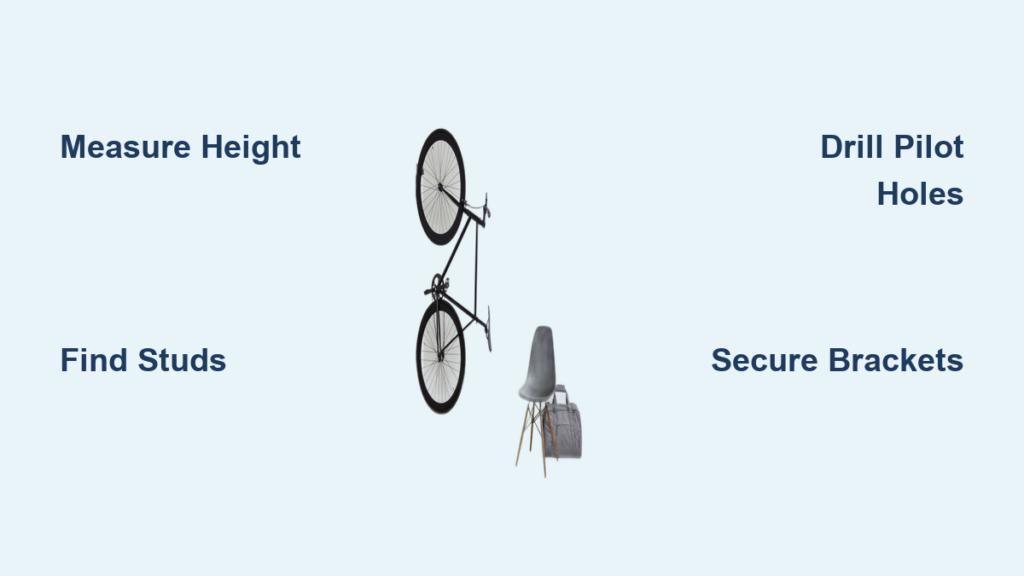
That empty garage wall could solve your bike storage chaos—if you install the rack correctly. One misaligned bracket or undersized anchor can send your $3,000 carbon frame crashing to the concrete. Whether you’re hanging a single commuter bike or building a five-bike family garage system, this guide delivers precise measurements, drill bit specifications, and safety checks professional installers use. You’ll learn exactly how to mount any wall bike rack securely—saving you emergency repair bills and protecting your investment.
Choose Your Mounting Pattern & Height

Single-Row Front-Wheel Setup
Mount hanger brackets at 68 inches above the floor with 24-inch horizontal spacing between brackets. This configuration works best for 1-3 bikes in a straight line along one wall. Front-wheel hanging keeps bikes stable while minimizing wall projection—critical if you need to walk behind parked bikes. Measure from the floor to the bracket’s mounting hole center, not the bottom edge, to avoid inconsistent heights.
Alternating Wheel Configuration
Keep the 68-inch mounting height but reduce horizontal spacing to 16 inches between brackets. Alternate hanging bikes by front and rear wheels in the same row. This pattern fits 25% more bikes in the same wall space but requires lifting bikes higher to engage rear wheels. Ensure your ceiling height allows 80 inches of vertical clearance when lifting bikes into position.
Maximum Density “W” Pattern
Stagger bracket heights: alternate 68-inch and 80-inch placements vertically while spacing brackets 12 inches apart horizontally. Hang bikes in front-rear-front-rear sequence to create a dense, interlocking formation. This fits the most bikes per square foot but demands precise lifting technique—test your reach before committing to this pattern. If you can’t comfortably lift a bike overhead, choose a simpler configuration.
Corridor Clearance Rules
Bikes extend 40 inches from the wall when hung. Ignoring clearance requirements causes daily collisions and damaged components. Enforce these non-negotiable zones:
– Absolute minimum: 3-foot-wide corridor for emergency access
– Daily usability: Maintain 5-foot clearance for comfortable movement
– Corner zones: Leave 6-8 feet clear where walls meet—this prevents door collisions and tripping hazards
Pro Tip: Before drilling, use painter’s tape to mark bike positions on your floor. Walk the route you’ll take to access tools or vehicles. If you bump the taped outline even once, increase your clearance.
Gather Required Tools & Hardware

Universal Hardware Kit Per Hanger
- 2 × 3/8″ × 2″ hex-head lag screws (never use drywall anchors alone—they fail under bike weight)
- 2 × 3/8″ flat washers (distribute pressure to prevent wood splitting)
Masonry Additions for Concrete/Brick
- 2 × 3/8″ lag expansion shields (sized precisely for your screw diameter)
Essential Tools Checklist
- Stud finder (calibrate on known stud before use)
- 1/4″ wood drill bit (for pilot holes in wood)
- 1/2″ masonry bit + hammer drill (concrete only—regular drills crack anchors)
- 12″ level (laser levels drift; verify with bubble level)
- Socket wrench (impact drivers often over-torque lag screws)
Critical Warning: Skip the tape measure that came with your rack kit. Use a metal tape measure with clear markings—fabric tapes stretch and cause misalignment.
Locate Wall Support Structure
Find Wall Studs Accurately
Run your stud finder vertically at your target height (68″ or 80″). Mark both edges of each stud with pencil lines—never rely on center indicators alone. Modern walls have studs spaced 16″ apart, but older homes may vary. Verify by drilling a 1/8″ test hole between marks; solid resistance confirms stud location.
Create Mounting Board When Studs Misalign
If studs don’t match your bracket spacing:
1. Cut a 2×10 board (actual size: 1.5″×9.25″) to span two full studs
2. Pre-drill holes and secure with 3″ wood screws every 8 inches
3. Paint/stain board to blend with wall
4. Mount rack brackets to this board—not drywall
This distributes weight safely across multiple studs. Never mount directly to drywall—even with toggle bolts.
Check Masonry Wall Integrity
Tap concrete/brick walls with a hammer. A solid “clink” indicates sound structure; a hollow “thud” means crumbling mortar. Drill a test hole in an inconspicuous spot—if debris crumbles like chalk, consult a masonry specialist before proceeding.
Mark & Drill Mounting Points
Precision Positioning Technique
- Hold bracket against wall at target height
- Place level on top edge—adjust until bubble centers
- Mark both hole centers with awl (pencil marks smear)
- Step back 6 feet to verify alignment—your eyes deceive up close
Common Mistake: Installing brackets level individually but not relative to each other. Measure from floor to each hole center—don’t assume wall is flat.
Drill Correct Pilot Holes
Wood Walls:
– Use 1/4″ bit for 3/8″ lag screws
– Drill 1.75-2 inches deep (matches screw thread length)
– Check for wiring with stud finder’s AC detection mode
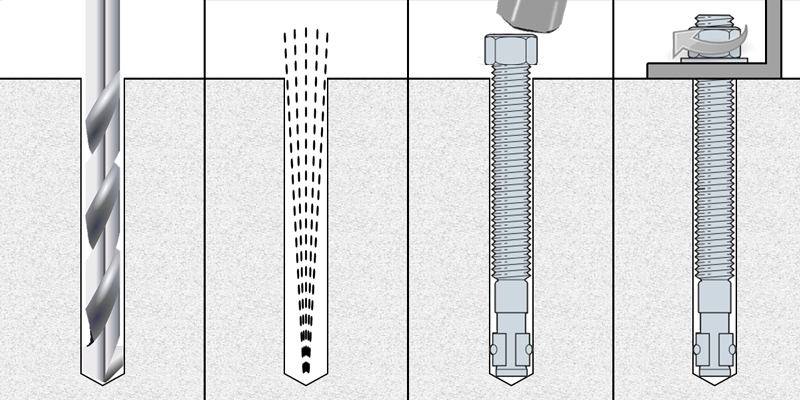
Masonry Walls:
– Use hammer drill on “hammer + rotation” mode
– Drill 1/2″ holes 1/4″ deeper than expansion shields
– Vacuum debris—dust prevents anchor expansion
Pro Tip: Dip your drill bit in soapy water when drilling masonry. Lubrication reduces heat buildup and extends bit life.
Secure Bracket to Wall
Lag Screw Installation Sequence
- Insert washer on top screw first, hand-thread until 1/8″ gap remains
- This gap allows micro-adjustment for perfect alignment
- Insert bottom screw with washer and hand-tighten
- Alternate tightening both screws in quarter-turn increments
Stop tightening when bracket sits flush against wall. Over-tightening strips wood threads or cracks concrete.
Security Verification Test
Apply 25 lbs of downward force on the bracket (like hanging a heavy backpack). If you see:
– Bracket rotation → Loosen and reposition
– Wall cracking → Relocate immediately
– Screw sinking deeper → Replace with longer screws
Never skip this test—it takes 10 seconds but prevents $1,200+ frame repairs.
Hang & Secure Bicycles
Wheel Placement Technique
Lift bike until the wheel drops into the bracket’s curved cradle with a distinct “thunk.” The recurved geometry locks the wheel in place—no straps needed for standard storage. For carbon frames, place a microfiber towel in the cradle first to prevent finish damage.
Stabilize Against Movement
All quality racks include:
– Angle brace on one side (prevents wheel twist during storage)
– Cable loop opposite the brace (for security cables)
Engage both features to eliminate frame sway that stresses headset bearings.
Optional Security Cable Setup
Thread cable through:
1. Top section of front wheel spokes
2. Around down tube or seat tube
3. Through rear wheel
4. Lock back to frame or itself
This prevents theft and stops bikes from swinging into each other during earthquakes or accidental bumps.
Maintenance & Safety Checks
Monthly Inspection Routine
Grab each bike and shake firmly while checking:
– Lag screws for looseness (re-torque to 15-20 ft-lbs)
– Wall cracks radiating from mounts (indicates structural failure)
– Bracket alignment (bikes should hang perfectly level)
Critical Red Flag: Sawdust around wood mounts means screws are stripping—replace with longer screws immediately.
Prevent Common Installation Failures
- Over-tightening: Causes wood splitting or concrete spalling—stop when bracket stops moving
- Under-tightening: Creates dangerous wobble; test every 3 months
- Wrong height: Bikes hung below 65″ risk pedal strikes on passing legs
Corridor Maintenance Protocol
When adding bikes, re-measure clearance with bikes hung. If corridor width drops below 36″, remove bikes from the end of the row—not the middle. This maintains safe access paths while maximizing storage.
Final Note: A properly installed wall bike rack should hold your bike securely through a minor earthquake. If you wouldn’t trust it during seismic activity, reinstall it. For concrete walls, upgrade to 1/2″ lag screws with sleeve anchors—they support 250+ lbs per bracket versus 150 lbs for standard kits. Always prioritize structural integrity over installation speed; your bike’s frame is counting on it.