
The roar of the crowd at X Games Philadelphia in 2002 suddenly went silent as Mike Metzger launched his dirt bike off the ramp, rotated backward through the air, and landed cleanly on the other side. In that single moment, Metzger didn’t just land the first competition backflip on a full-size dirt bike—he shattered the perceived limits of freestyle motocross forever. Before this historic achievement, industry insiders considered the dirt bike backflip physically impossible due to the motorcycle’s weight and power dynamics. This article reveals exactly how Metzger transformed what was deemed impossible into the foundational trick that defines modern FMX, complete with the physics, psychology, and competitive strategy behind the maneuver that continues to evolve today.
For years, BMX riders had been executing backflips with relative ease, but the idea of performing the same trick on a 250-pound dirt bike seemed like pure fantasy. The sheer weight difference, combined with the motorcycle’s powerful engine and complex physics, created what many believed was an insurmountable barrier. Metzger’s breakthrough didn’t happen by accident—it resulted from meticulous preparation, strategic timing, and an almost supernatural level of commitment. Understanding how the dirt bike backflip evolved from “impossible” to “standard competition requirement” provides crucial insight for anyone studying extreme sports progression or aspiring to push boundaries in their own field.
Why Mike Metzger’s X Games Backflip Shocked the FMX World in 2002
When Metzger dropped in for his final run at X Games Philadelphia, the entire FMX community held its breath. Just two weeks earlier at the Gravity Games, both Metzger and Travis Pastrana had landed the first documented competition backflips, with Pastrana taking first place. However, Pastrana suffered an injury before X Games and watched from the announcer’s booth as Metzger prepared to attempt back-to-back backflips on two different jumps—a maneuver nobody had ever tried in competition.
Metzger’s strategic brilliance shone through his course selection. He identified the 45-foot metal jump as ideal for the first flip, but it was his decision to attempt the second flip on an 80-foot dirt jump—the “most perfect freestyle jump” he’d ever seen—that demonstrated his competitive genius. “I knew I was going to flip the first jump, and in the back of my mind I was thinking, ‘When that second one comes around, I just might go for it,'” Metzger later recalled. This calculated risk paid off spectacularly when he became the first rider to land consecutive backflips in X Games history, securing gold in Moto X Freestyle that day.
How Caleb Wyatt’s Secret Backflip Practice Made Metzger’s Success Possible
Few realize that Metzger didn’t land the first dirt bike backflip—Caleb Wyatt accomplished this feat months before X Games 2002. Wyatt’s breakthrough provided Metzger with the crucial proof that flipping a full-size 250cc motorcycle was physically possible. The technical challenges of performing a backflip on a heavy motorcycle versus a smaller bike are dramatically different, requiring significantly more power, precise body positioning, and rotational momentum.
Wyatt’s success gave Metzger the confidence to pursue the trick seriously, but Metzger improved upon the technique through systematic practice. Unlike Wyatt, who performed his backflips in relative secrecy, Metzger documented his progress with ESPN cameras leading up to X Games, understanding the historical significance of what he was attempting. This documentation proved vital when he needed to prove his accomplishment to skeptics who initially refused to believe a full-size dirt bike could be flipped in competition.
The Exact Physics Behind a Perfect Dirt Bike Backflip Rotation
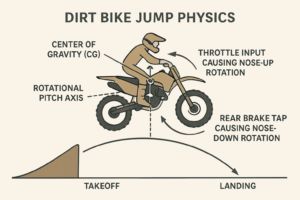
Executing a successful dirt bike backflip requires mastering three critical physics principles simultaneously:
- Approach speed: Too fast causes over-rotation (landing on your head), too slow results in incomplete rotation (crashing on your back)
- Throttle control: Precise power application at takeoff generates necessary rotational force
- Body positioning: Tucking reduces rotational inertia, extending slows rotation for controlled landing
Metzger discovered through trial and error that the sweet spot for a standard backflip required hitting the ramp at precisely 35-40 mph with a sharp throttle blip at takeoff. His body position—leaning back slightly while pulling up on the handlebars—created the perfect torque to initiate rotation without losing control. Modern FMX bikes now feature reinforced frames and specialized suspension settings optimized specifically for backflip attempts, but Metzger accomplished his historic feat on a stock motorcycle with standard equipment.
21 Consecutive Backflips: How Metzger Mastered the Trick in 48 Hours
Two days after his first successful backflip off a freestyle ramp on July 2nd, 2002, Metzger achieved what many considered impossible—he landed 21 consecutive backflips without crashing. This remarkable feat demonstrated that the trick wasn’t just a fluke but a repeatable skill that could be mastered with proper technique. Crucially, Metzger accomplished this without the safety nets modern riders take for granted—no foam pits, no airbags, just pure commitment with no margin for error.
This rapid progression from first successful attempt to consistent mastery followed a deliberate pattern:
1. Initial success after multiple crashes (July 2nd)
2. Camera verification of successful attempts
3. Gradual refinement of approach speed and body position
4. Building confidence through repeated success
5. Achieving muscle memory for consistent execution
The July 4th streak proved to Metzger that he could perform the trick reliably under pressure—essential preparation for the high-stakes X Games environment where one mistake could mean career-ending injury.
Double Backflip No-Footer: Metzger’s Riskiest X Games Winning Move
After winning Moto X Freestyle gold with his back-to-back backflips, Metzger didn’t rest on his laurels. He raised the stakes dramatically by landing a backflip no-footer to claim Moto X Best Trick gold—the same trick where he removed his foot from the footpeg mid-rotation. This additional element of difficulty showcased not just Metzger’s technical mastery but his willingness to push beyond what was expected.
Why the no-footer was so dangerous:
– Reduced control points during critical rotation phase
– Increased risk of foot getting caught in machinery
– Required perfect timing to reposition foot for landing
– Doubled the mental focus required during execution
This triple-medal performance (adding silver in Moto X Step Up) represented the biggest payday of Metzger’s career and cemented his place in FMX history. More importantly, it established a new standard for what audiences and judges expected from FMX competitors—overnight, the backflip transformed from a novelty trick to a competitive necessity.
The Psychological Terror of Inventing a Game-Changing FMX Trick
For Metzger, the greatest fear wasn’t crashing—it was the implications of success. “I knew once I did it, I was going to have to do it again and again for the rest of my life for as long as I was riding freestyle motocross. I knew it was going to be a game-changer for me and for everybody in the sport, and that terrified me,” he later admitted. This psychological burden of innovation often gets overlooked in extreme sports coverage but represents a critical challenge for pioneers.
The mental preparation required went beyond physical training:
– Daily prayer before competition (“Before we put on those helmets, we all pray, every one of us”)
– Visualization of perfect execution
– Acceptance of potential career-ending consequences
– Strategic management of expectations and timing
Metzger’s awareness that successfully landing the backflip would fundamentally alter his career trajectory demonstrates the complex psychological landscape that extreme athletes navigate when pushing boundaries. The fear of success can be as paralyzing as the fear of failure, particularly when that success comes with lifetime expectations.
Why Modern FMX Riders Must Master Backflips Just to Compete Today

The dirt bike backflip’s legacy extends far beyond Metzger’s historic X Games performance—it completely transformed the baseline requirements for professional FMX riders. What was once considered impossible has become so standard that modern competitors are expected to perform backflips with relative ease just to qualify for major events. The progression has been staggering:
- 2002: Backflip wins gold medals
- 2005: Double backflips enter competition
- 2010: Triple backflips attempted (though rarely landed)
- Today: Backflip variations like no-handers and body varials are standard
This evolution has dramatically increased both the technical difficulty and physical risk of FMX competition. Modern riders must master multiple backflip variations just to remain competitive, pushing the boundaries of human capability further than ever before. The sport’s constant evolution ensures that today’s impossible tricks will become tomorrow’s standard requirements—a direct legacy of Metzger’s pioneering work.
From Broken Vertebrae to Tattoo Guns: Metzger’s Post-Racing Career Shift
The physical toll of pioneering FMX tricks eventually caught up with Metzger. A training crash forced him to withdraw from X Games Los Angeles 2011 with catastrophic injuries: broken vertebrae in his back and neck, two broken collarbones, and a lacerated kidney. These career-ending injuries led to a dramatic career shift—he now works as a tattoo artist at Renaissance Studios in San Clemente, California.
Despite his retirement from competition, Metzger remains connected to the sport he revolutionized. Military personnel and current FMX stars seek him out specifically as the “Godfather of FMX,” though he remains humble about the nickname. His candid reflection on his career—”It hurts too damn much. I don’t miss being hurt all the time”—offers a sobering reminder of the physical price extreme athletes pay for their achievements.
Metzger’s journey from dirt bike pioneer to tattoo artist demonstrates that even the most revolutionary innovators must eventually confront the physical limitations of their sport. His legacy lives on not just in competition results, but in the thousands of riders worldwide who now consider the dirt bike backflip a fundamental part of their riding repertoire—a testament to how one person’s vision can transform an entire sport.