Struggling to clear jumps with limited run-up space? Your dirt bike’s suspension holds untapped potential that could transform your jumping performance. Seat bouncing—properly loading your bike’s rear suspension into the jump face—is one of the most valuable yet frequently misunderstood techniques in off-road riding. This specialized method allows you to maximize jump height and distance by actively compressing your rear shock, creating additional potential energy that translates into explosive lift when you leave the ground. Whether navigating tight woods trails with restricted space or struggling to clear jumps that seem just beyond your reach, mastering how to seat bounce a dirt bike opens up new possibilities on the track or trail.
The seat bounce technique isn’t something you can simply read about and instantly execute—it requires dedicated practice and a willingness to fail safely while refining your coordination. However, understanding the mechanics before you attempt them significantly accelerates your learning curve and prevents the development of bad habits. Unlike standard jumping where you stand through the face, seat bouncing lets you generate significant air time while remaining seated, making it indispensable when you can’t transition to standing before hitting the lip. By the end of this guide, you’ll have a complete framework for developing your seat bounce skills systematically.
Why Your Jump Height Increases With Proper Seat Bouncing
Seat bouncing works by creating additional potential energy beyond what your speed and jump geometry would naturally produce. When you actively compress your rear suspension into the jump face, you store more energy than would occur through normal riding. This stored energy releases as kinetic energy precisely as your rear wheel leaves the lip, propelling your bike higher and farther into the air. The technique essentially allows you to extract more performance from a given jump than physics would normally provide—critical when approaching jumps with limited run-up space.
This technique proves particularly valuable in woods racing environments where tight sections and natural obstacles make jumping preferable to riding over hazards. When encountering exposed roots, logs, or rocks in confined areas, a well-executed seat bounce lets you maintain momentum while clearing obstacles entirely. The seated position eliminates the need for the extensive runway that transitioning from standing to jumping would normally require, making it your go-to solution when space is limited but airtime is essential.
Recognize Jump Scenarios Perfect for Seat Bouncing

Seat bouncing shines in specific situations where standard jumping techniques fall short. Short run-up jumps represent the prime application—when you approach a jump with insufficient distance to transition from seated to standing position before reaching the lip. In these scenarios, remaining seated and actively compressing the suspension becomes your only viable option for achieving adequate jump height. Trying to force a standing position on a short approach typically results in awkward, unbalanced launches that fail to clear the jump properly.
Natural trail obstacles also demand this technique. When tight woods sections present exposed roots, rocks, or logs that are better cleared by jumping than ridden over, seat bouncing allows you to maintain speed through technical terrain. Advanced riders also use this method selectively on larger jumps when they want to modify their launch trajectory without completely changing their approach style. However, avoid attempting seat bounces on high-speed jumps that already provide ample compression, as the technique could create excessive height that disrupts your rhythm. The jump face must be smooth with no kickers or irregular sections that could disrupt the suspension’s predictable compression cycle.
Execute the Perfect Seat Bounce: Body Position to Air Time
Approach and Seat Positioning for Maximum Compression
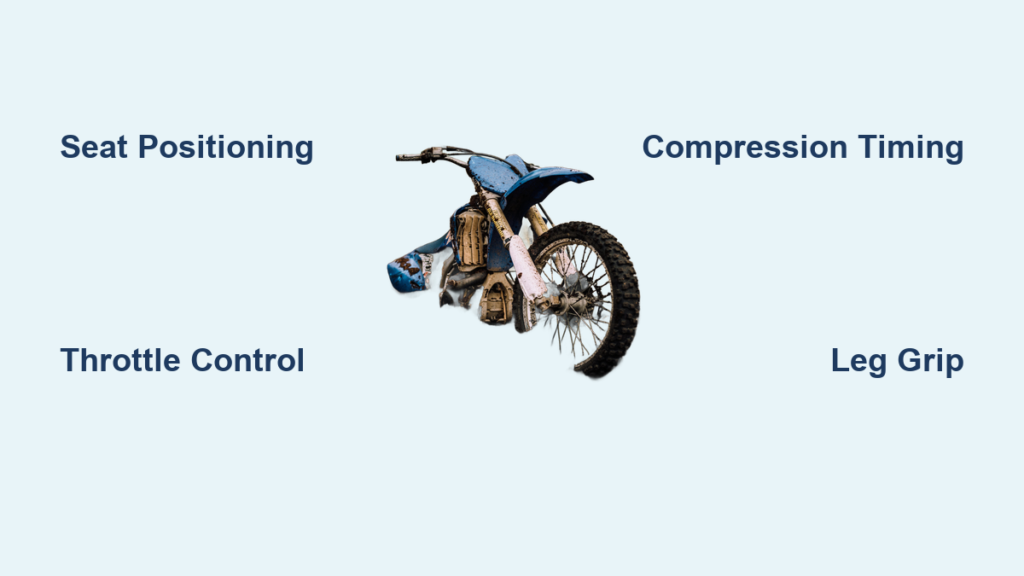
As you approach the jump, transition smoothly from standing to seated position well before your rear wheel contacts the jump face. Your seating position proves critical—sit slightly rearward of center but not at the extreme back edge. This rear-weighted position ensures the rear suspension receives more compression than the front, maximizing the rebound effect. However, sitting too far back risks getting bucked over the bars when the suspension releases its stored energy.
Maintain constant pressure with your lower legs squeezing the bike frame. This leg grip provides essential stability and helps you feel connected to the chassis as the suspension works through its travel. Many developing riders focus entirely on upper body position while neglecting this crucial connection point, resulting in lost control during the violent compression and rebound cycle.
Compression and Throttle Control Through the Jump Face
As your rear wheel contacts the jump face, emphasize weight on the rear of the bike while simultaneously delivering smooth, progressive throttle. This combination fully compresses the rear suspension while maintaining rear wheel traction. Crucially, accelerate all the way through the compression phase—backing off at the last moment is virtually guaranteed to cause an endo.
Throttle management requires precision: too much power breaks traction, causing the rear wheel to spin; too little fails to capitalize on the technique’s potential. The ideal scenario involves the rear wheel maintaining grip while the suspension compresses deeply. Clutch control also matters—use subtle adjustments to fine-tune power delivery as the suspension rebounds toward the lip.
Release Timing and Transition to Standing Position
The most critical moment occurs as your rear wheel begins to leave the ground. At this precise instant, start unweighting the rear of the bike to help transfer the suspension’s stored energy into lift. This unweighting motion, combined with the shock’s rebound, creates the “pop” that elevates the bike. Simultaneously begin transitioning from seated to standing position in a controlled flow rather than a sudden leap.
Your leg grip remains strong throughout this transition, providing the connection necessary to control the bike’s attitude. Once airborne, you should be fully standing with your body centered over the bike, ready to make any necessary adjustments to your landing position. The timing of this transition varies based on jump geometry—you’ll develop intuitive timing through practice rather than rigid counting.
Fix These 3 Seat Bouncing Errors That Cause Endos

Sitting Too Far Back or Forward on the Seat
The most frequent error involves improper seat positioning. Sitting too far back creates a dangerous situation where the sudden release of compressed suspension can buck you forward or over the bars entirely. Conversely, sitting too far forward prevents adequate rear suspension compression, resulting in minimal rebound benefit and flat jumps that barely clear the lip.
Solution: Find your personal balance point slightly rearward of center. Experiment on small jumps to discover where your weight optimally loads the rear suspension without compromising front wheel contact. This sweet spot varies based on your height, bike geometry, and suspension setup.
Throttle Hesitation at the Critical Moment
Reducing throttle pressure as you approach the lip represents one of the most dangerous mistakes. This natural reaction, born from self-preservation, completely undermines the technique and creates high-risk endo situations. When you back off while the suspension is compressed, the front end drops dramatically as stored energy releases without forward momentum.
Solution: Commit fully to smooth, progressive throttle through the entire compression phase. Practice on small jumps to build trust in the technique. Remember—maintaining power is essential for both safety and performance.
Poor Leg Connection During Compression
Many riders neglect the essential role of their lower body, focusing entirely on upper body position while their legs remain passive. This disconnection often results in lost control during the violent motion of the suspension working through its travel.
Solution: Maintain constant pressure with your lower legs squeezing the bike frame. This “leg grip” provides stability and keeps you connected to the chassis throughout the compression and rebound cycle.
Progress From Small to Big Jumps Safely
Begin developing your seat bounce skills on small tabletop jumps with gentle transitions—the ideal learning environment that encourages proper technique without severely punishing errors. These low-consequence jumps allow you to focus on body position, throttle control, and transition timing without fear of serious injury. Your goal at this stage is building muscle memory and developing feel for the technique, not pushing limits.
As your comfort grows, progress to medium-sized jumps that require more active compression. During this phase, focus on feeling how your body position and throttle input affect the suspension’s behavior. Video analysis proves extremely valuable—watching yourself execute successful and unsuccessful attempts side by side accelerates refinement of your technique.
Large jumps and doubles should only be attempted after mastering the technique on smaller features. These require not just proper technique but also the physical stamina to maintain position through extended compression phases and mental focus to execute precisely under increased pressure. Patience in progression pays dividends in both safety and skill development.
Advanced Seat Bounce Variations for Technical Terrain
Once you’ve mastered the basic technique, develop variations to address specific situations. Some experienced riders incorporate a subtle pulling motion on the handlebars at the moment of transition, using their upper body to augment the lift generated by the suspension. When executed correctly with perfect timing, this adds meaningful hang time for style points or additional adjustment time in the air.
Learn to calibrate your compression intensity based on jump requirements—a moderate seat bounce provides just enough height for technical clearance, while full compression generates maximum airtime. Skilled riders avoid the common mistake of always using maximum effort regardless of need, instead modulating their approach to match each jump’s specific demands.
The seat bounce technique also integrates seamlessly with other advanced jumping skills. Use it to generate extra height for particularly aggressive whip sections or to maintain momentum through rhythm sections where multiple jumps follow in quick succession. The technique’s primary benefit of maintaining seated position through the jump face makes it valuable in situations where standing would disrupt your rhythm.
Suspension Setup Tips for Better Seat Bouncing
While seat bouncing is primarily a rider skill, your suspension setup significantly affects effectiveness. Shock spring rate should match your weight—improperly rated springs either bottom out excessively or fail to compress adequately under the added force of seat bouncing. Riders who frequently use this technique may benefit from slightly softer spring rates that enhance compression effect.
Rebound damping settings influence how quickly the shock releases stored energy. Faster rebound releases energy more quickly (suiting riders who prefer lift to occur precisely at the lip), while slower settings allow energy to release more gradually. Finding your optimal setting requires experimentation on different jump types.
Compression damping affects how the shock responds to your active compression. Riders seeking maximum snap may prefer slightly firmer compression settings that resist initial compression but release more energetically. However, excessively firm settings can reduce your sensitivity to the suspension’s behavior, potentially compromising control during the critical transition phase.