Choosing the right dirt bike starts with understanding engine displacement. If you’ve been researching dirt bikes, you’ve likely encountered the term “CC” repeatedly—but what does it actually mean for your riding experience? A dirt bike CC chart helps riders match engine size to skill level, terrain type, and riding goals. This comprehensive guide breaks down every engine category so you can make an informed decision before your next purchase.
Cubic centimeters (CC) measure engine displacement, essentially indicating how much air and fuel mixture the engine can process in one complete cycle. Larger CC engines produce more power, but they also require more skill to manage. The relationship between CC and capability isn’t always straightforward, as factors like two-stroke versus four-stroke design, rider weight, and terrain conditions all influence how a bike feels on the track or trail. Understanding these nuances separates experienced riders from those who struggle with bikes that don’t match their abilities.
Decoding Dirt Bike Engine Displacement Numbers

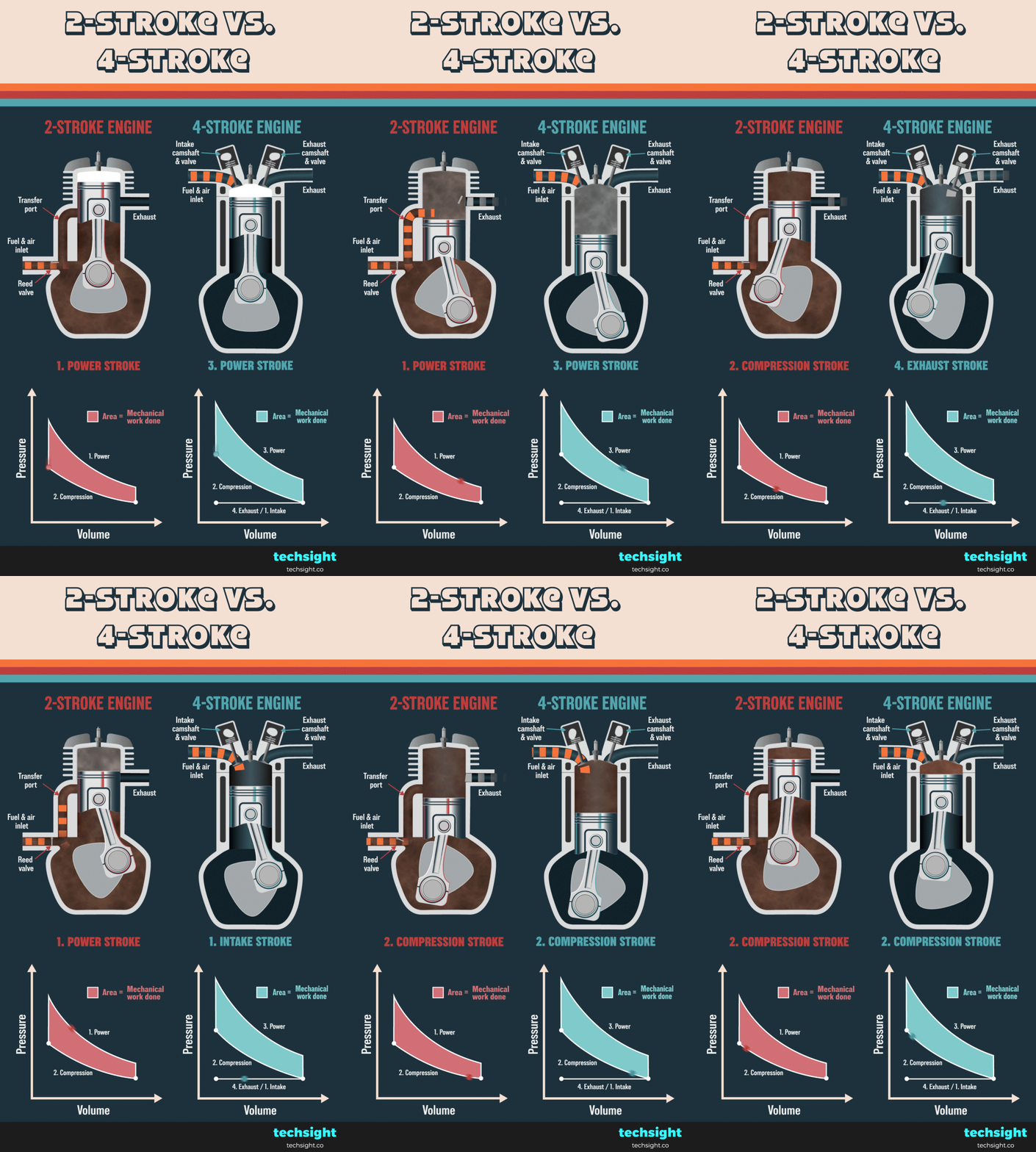
Engine displacement determines fundamental performance characteristics. A 250cc four-stroke dirt bike produces substantially different power delivery compared to a 250cc two-stroke, despite identical displacement numbers. Two-stroke engines generate power on every crankshaft revolution, creating explosive acceleration that demands precise throttle control. Four-stroke engines fire once every two revolutions, producing smoother, more linear power that’s often more manageable for newer riders learning proper technique.
The CC measurement directly correlates with torque output and top-end power, but it doesn’t tell the whole story. A lightweight 125cc two-stroke can feel more powerful than a heavier 250cc four-stroke in certain situations because power-to-weight ratio matters as much as absolute displacement. Experienced riders often choose smaller displacement bikes with better power-to-weight characteristics over larger bikes with excess weight that saps performance in technical terrain.
Youth Dirt Bike CC Categories Explained
50cc Bikes: The Starting Point for Young Riders
The 50cc class represents the entry point for young riders typically aged 4 to 7 years old. These miniature machines feature automatic centrifugal clutches and single-speed transmissions, eliminating the need for clutch and gear coordination while young riders develop fundamental balance and throttle control. Top speed hovers around 30-40 mph depending on rider weight and terrain, which proves more than sufficient for building confidence on beginner tracks and trails.
Most 50cc dirt bikes come in two configurations: electric start models for convenience and kick-start versions that teach mechanical understanding of engine operation. These bikes often weigh under 100 pounds, allowing children to maneuver confidently and recover from minor spills without serious injury risk.
85cc Bikes: The Teenage Transition Machine
The 85cc category bridges youth and adult-sized machinery, serving riders aged 10 to 15 depending on physical development. These bikes come in “small wheel” and “big wheel” configurations, with the big wheel versions (19-inch front, 16-inch rear) offering stability closer to full-sized machines while maintaining accessible power delivery. Engine options include both two-stroke and four-stroke variants, each providing distinct riding experiences.
Two-stroke 85cc engines deliver explosive power that rewards aggressive riding styles and precise throttle timing. Four-stroke alternatives provide broader power bands that many riders find more forgiving during learning phases. Competition in this class remains intense, with many professional riders tracing their careers through successful 85cc campaigns before advancing to larger machines.
Optimal CC Choices for Adult Beginners
125cc Two-Stroke: The Skill Development Platform
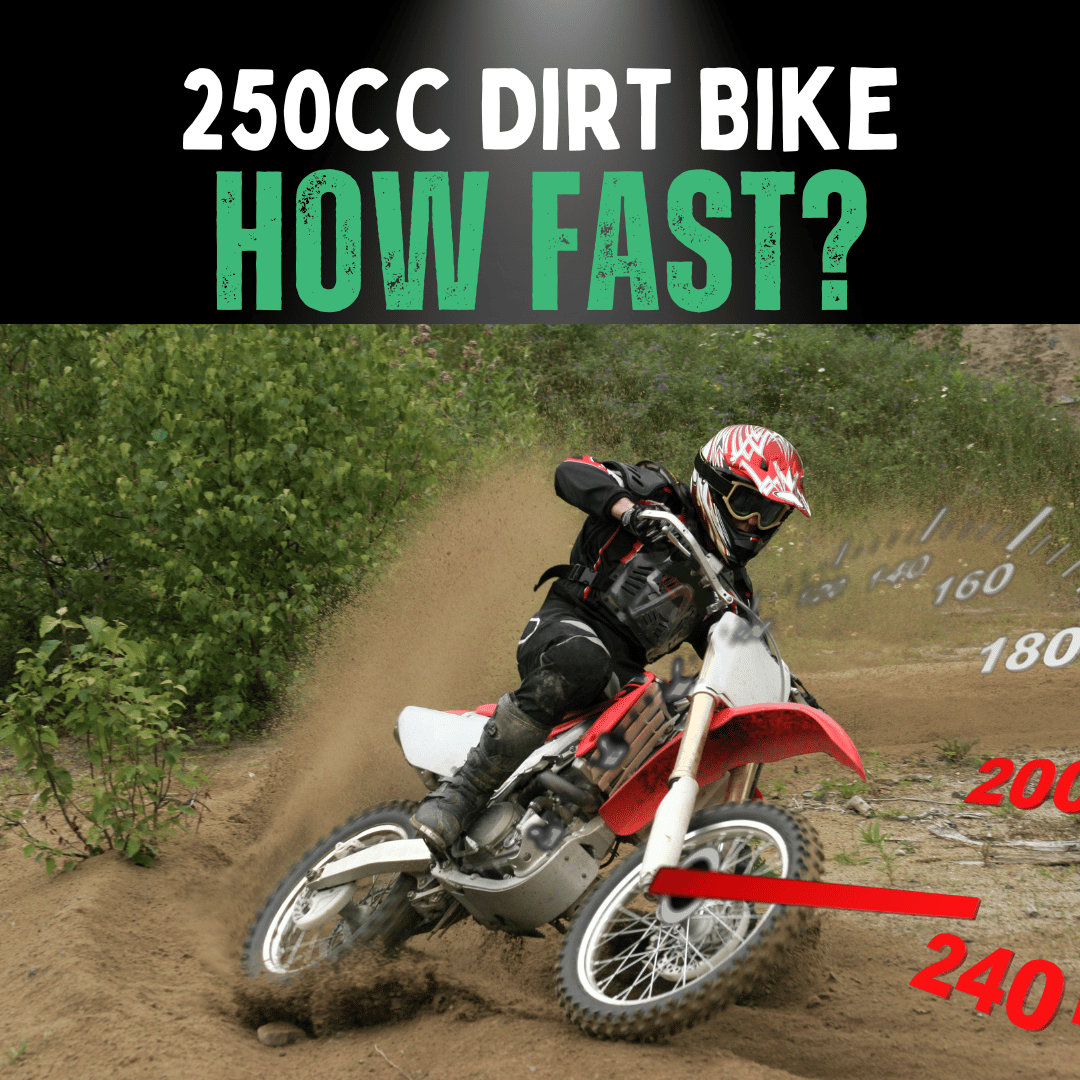
Despite modest displacement, the 125cc two-stroke class attracts serious adult riders seeking to refine technical skills. These bikes emphasize momentum and carrying speed through obstacles rather than brute force. The high-revving character demands active riding—braking late, accelerating early, and maintaining forward momentum through challenging sections becomes essential.
Many experienced riders recommend the 125cc class as an adult starting point because it forces proper technique from day one. There’s no hiding poor body positioning or momentum skills behind abundant low-end torque. Riders who master 125cc two-strokes typically develop superior bike control that translates directly to larger machines when they’re ready to advance.
250cc Four-Stroke: The Most Popular Beginner Choice
The 250cc four-stroke represents the most popular displacement for adult dirt bike newcomers. Power delivery is broad and manageable, with enough torque for hill climbs and trail obstacles while maintaining reasonable top speed for open sections. These bikes typically produce 20-30 horsepower depending on specific engine design, enough capability for aggressive trail riding without overwhelming control demands.
Modern 250cc four-strokes weigh in the 220-250 pound range, making them light enough for technical maneuverability while providing stable high-speed handling. Fuel injection, electric start, and power modes have become standard features, allowing you to choose power delivery characteristics that match your current skill level and terrain demands.
Intermediate and Advanced Dirt Bike CC Options
300cc Two-Stroke: The Trail Rider’s Secret Weapon
The 300cc two-stroke class has emerged as a favorite among trail riders and enduro competitors who appreciate the lightweight, high-revving character of two-stroke power. These engines deliver massive torque relative to their weight, pulling strongly from low RPM while maintaining top-end performance that keeps larger four-strokes in sight on technical terrain.
Riders transitioning from 250cc four-strokes often find 300cc two-strokes requiring adjusted technique. The power delivery is more aggressive, demanding precise throttle control to prevent wheelies and loss of traction. However, the significantly lower weight (often 30-40 pounds less than comparable four-strokes) transforms handling in rocky, technical sections where maneuverability matters more than outright power.
450cc: The Performance Standard for Serious Riders
The 450cc class delivers the benchmark for serious trail riding and competitive racing. These bikes produce 50+ horsepower, providing acceleration that demands respect while remaining manageable for skilled intermediate riders. For most riders who have mastered fundamentals on smaller bikes, the 450cc four-stroke represents the sweet spot between raw power and controllable performance.
Suspension components in this displacement class typically feature premium adjustable components front and rear, allowing fine-tuning for your weight, riding style, and terrain type. Braking systems scale accordingly, with large-diameter rotors providing stopping power that matches the available acceleration.
Two-Stroke vs Four-Stroke: Making the Right Choice
Two-Stroke Advantages and Challenges
Two-stroke engines deliver power in explosive bursts that demand active rider engagement and precise throttle timing. Their simpler construction reduces weight and maintenance complexity, though frequent top-end rebuilds (ring and bearing replacement every 30-50 hours) add ongoing maintenance requirements. For riders who enjoy mechanical work and want maximum power-to-weight ratio, two-strokes remain compelling despite requiring more frequent maintenance.
Four-Stroke Benefits for Most Riders
Four-stroke engines provide broader, more linear power delivery that many riders find accessible, particularly in technical terrain where smooth throttle application prevents wheel spin and loss of control. The valve train complexity adds weight and maintenance intervals, but modern four-strokes often surpass 100 hours between major services while delivering more user-friendly power characteristics.
For beginners, four-stroke options in the 125cc to 250cc range typically provide the most forgiving learning curve. As skills develop, many riders experiment with two-stroke alternatives to explore different power characteristics and develop broader riding capabilities.
Matching CC to Your Specific Riding Needs
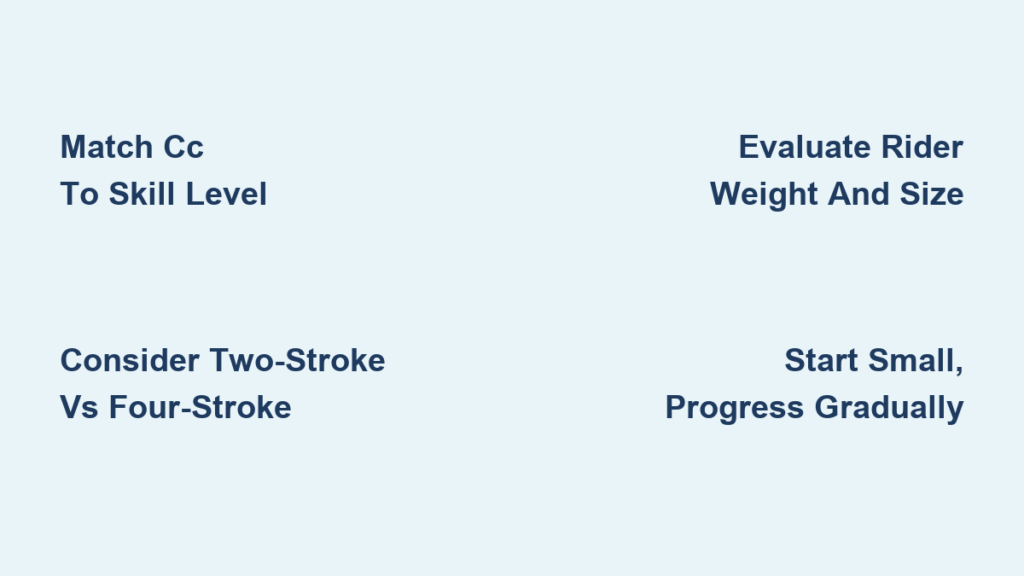
Selecting appropriate displacement requires honest self-assessment of current skills and realistic progression plans. New riders consistently fare better on smaller, more manageable machines that allow skill development without overwhelming power. The temptation to purchase larger bikes “to grow into” typically results in frustration, limited skill development, and potential safety issues.
Body size and weight influence displacement selection beyond pure skill level. Heavier riders often benefit from stepping up one displacement class to maintain comparable power-to-weight ratios, while smaller riders might find larger machines unwieldy regardless of their experience level. Renting or demoing different displacement options before purchasing provides invaluable insight that specifications alone cannot deliver.
Smart CC Selection Tips for Long-Term Satisfaction
The ideal dirt bike CC depends entirely on rider factors, intended use, and progression plans. Youth riders should progress through 50cc, 65cc, and 85cc classes systematically, allowing skill development to dictate advancement timing rather than age or size alone. Adult beginners typically find the 250cc four-stroke class provides optimal starting capability, with 125cc two-stroke options serving riders prioritizing technical skill development over immediate power.
Intermediate riders ready to advance should evaluate specific riding goals when selecting displacement. Trail riders seeking technical capability often prefer 300cc two-strokes for their excellent power-to-weight ratios, while desert and open-terrain riders may benefit from 350-450cc four-stroke options providing broader power bands and greater top-speed potential.
Regardless of displacement selection, proper gear, training, and progressive skill development remain the foundation of safe, enjoyable dirt bike riding. Engine size amplifies capability but cannot replace fundamental techniques that distinguish skilled riders from dangerous ones. Start appropriately, progress deliberately, and the riding community welcomes enthusiasts at every displacement level. Your perfect dirt bike CC chart match awaits when you prioritize your actual riding needs over perceived status.