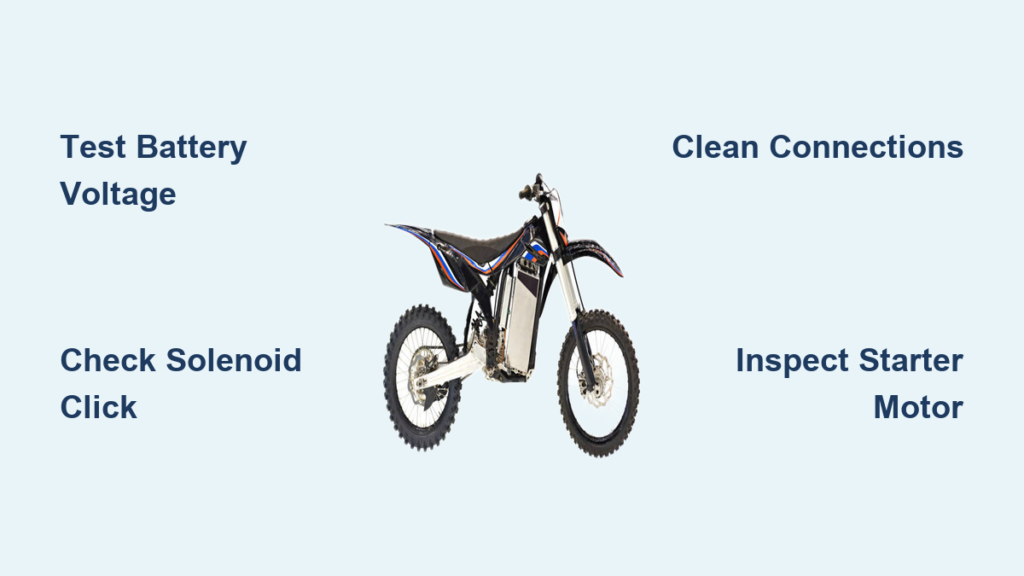
Your dirt bike sits silent when you press the start button, yet the kick start spins the engine over without hesitation. This frustrating scenario happens to riders everywhere, but it actually provides crucial diagnostic information. When the kick start works reliably while the electric start fails, you’ve immediately narrowed the problem to electrical systems rather than engine compression, fuel delivery, or ignition timing. The engine itself is mechanically sound—the issue lies somewhere in the pathway from battery to starter motor.
Electric start failure ranks among the most common mechanical problems dirt bike owners face, and the symptom pattern tells a specific story. The starting system involves multiple interconnected components: the battery supplies power, the start button initiates the circuit, the relay transmits the signal, the solenoid engages to connect battery power to the starter, and the starter motor converts electrical energy into mechanical rotation. A failure at any single point in this chain prevents the electric start from functioning, which is why systematic testing proves essential.
This guide walks you through the complete diagnostic process, from the most frequent causes to less common issues, helping you identify and fix the specific problem affecting your bike. You’ll learn how to test each component, recognize failure symptoms, and take appropriate action to restore reliable electric starting.
Test Your Dirt Bike Battery Voltage Under Load

The battery accounts for the majority of electric start failures, making it your first and most important diagnostic point. A weak or failing battery cannot deliver the substantial amperage required to turn a four-stroke engine over at sufficient speed for ignition. Even when your headlight shines brightly and your digital display appears normal, the battery may still lack the cranking amps necessary for starter operation. This situation occurs frequently after winter storage, during temperature extremes, or as batteries naturally degrade over time.
Measure Battery Voltage at Rest and Under Cranking
Begin diagnosis by measuring battery voltage at rest. Turn off the engine and set your multimeter to DC volts. Place the red probe on the positive battery terminal and the black probe on the negative terminal. A healthy, fully charged battery should read approximately 12.6 volts. Readings below 12.4 volts suggest the battery lacks full charge, while readings below 12.0 volts indicate significant discharge. Charge the battery fully before proceeding with further testing.
Next, perform a critical load test to evaluate battery performance under cranking conditions. Have an assistant press the start button while you observe the multimeter. Voltage should remain above 10 volts during cranking. If voltage drops dramatically—below 9 volts—the battery cannot deliver adequate current regardless of its rest voltage. In one documented case involving a KTM 450 EXC, voltage dropped to 9.6 volts under load, which, while technically within acceptable range for some applications, indicated the battery could not deliver sufficient current for reliable starting.
Pro Tip: Cold temperatures significantly reduce battery capacity. Riders who store bikes outside or in unheated spaces face elevated risk of battery failure. Consider investing in lithium-ion batteries like Shorai units that demonstrate better cold-weather performance.
Verify Your Charging System Functionality
After confirming rest voltage, start the engine and measure voltage at idle. The reading should increase to approximately 13.7 volts or higher, indicating the charging system functions correctly. If voltage remains at or below rest voltage while the engine runs, the alternator or rectifier/regulator has failed. A failing charging system will repeatedly kill batteries even after replacement, creating a frustrating cycle of repeated failures.
Consider battery age and history when evaluating test results. Batteries typically last three to five years, though harsh conditions can shorten this lifespan significantly. If your battery has demonstrated past performance issues, has been deeply discharged multiple times, or has exceeded its expected service life, replacement makes more sense than continued testing.
Diagnose Starter Motor Failure Symptoms
When the starter motor fails, the electric start system cannot generate the necessary cranking force regardless of battery condition. Starter motor failures typically manifest through several distinct symptoms: no response when the start button is pressed, a grinding noise during attempted operation, or a single click without motor rotation. Each symptom points toward specific internal problems within the motor.
Test Starter Motor Independently
Testing a suspected starter motor involves disconnecting it from the bike and applying direct power. According to service manual procedures for KTM models, connect the negative battery terminal directly to the motor housing and the positive terminal to the solenoid connector. A functioning motor should immediately turn or at least produce a whirring sound. If sparks fly but no rotation occurs, the motor has internal failure.
Listen carefully to the sounds your starter produces. A single sharp click, followed by silence, often indicates a stuck starter motor or severe internal damage. A grinding noise suggests worn gears or damaged internal components. A whirring sound that doesn’t translate to engine rotation may indicate a failed one-way clutch or stripped starter gear.
Expert Note: In one documented case, a KTM 450 EXC starter motor produced sparks but absolutely no movement, confirming internal failure despite the motor appearing physically intact. This demonstrates why visual inspection alone isn’t sufficient for accurate diagnosis.
Identify Solenoid and Relay Failure Patterns

The starter solenoid serves as an electrically controlled switch that connects battery power to the starter motor when you press the start button. This component takes the battery’s high-amperage current and routes it to the motor while protecting the relatively delicate start button circuit from carrying that load. When the solenoid fails, you may hear clicking or buzzing sounds as the solenoid attempts to engage but cannot complete the electrical connection.
Test Solenoid Input and Output Voltage
Testing the solenoid requires checking for voltage at both input and output terminals when the start button is pressed. The input terminal should show battery voltage when the button is pressed. The output terminal should show similar voltage if the solenoid functions correctly and the starter motor is connected. If voltage reaches the input but not the output, the solenoid has failed internally.
A buzzing sound specifically indicates that the solenoid receives power and tries to activate but cannot maintain the connection due to insufficient voltage or internal solenoid wear. This symptom often accompanies weak batteries but can also occur with fully charged batteries if the solenoid itself has failed. Corrosion on solenoid terminals, loose connections, or internal contact wear can prevent proper operation even when adequate power reaches the solenoid.
Clean Critical Electrical Connections That Kill Your Start

Electrical connections throughout the starting system can degrade over time, creating resistance that prevents adequate power delivery. Battery terminals, ground straps, solenoid connections, and starter motor connections all require periodic inspection and cleaning. Corrosion appears as white, green, or bluish deposits on metal surfaces and significantly increases electrical resistance.
Perform Professional-Grade Connection Cleaning
Begin cleaning by disconnecting the battery, starting with the negative terminal to prevent accidental shorts. Inspect each connection point for corrosion, discoloration, or damage. Wire brush terminals and posts until all corrosion disappears and the metal shines. For internal connections like solenoids and relays, use electrical contact cleaner spray followed by compressed air to remove loosened debris.
When reinstalling connections, ensure they are tight enough that the terminals cannot move by hand. Loose connections create resistance that generates heat, which accelerates corrosion and can eventually cause complete connection failure. After tightening, apply a thin layer of dielectric grease to each connection point to protect against future corrosion.
Critical Insight: Pay special attention to the starter motor ground connection, which often escapes routine maintenance. This connection typically bolts to the engine case near the starter and can accumulate corrosion that prevents proper grounding. Remove the bolt, clean both surfaces completely, apply dielectric grease, and reinstall with proper torque.
Verify Kill Switch and Safety Circuit Functionality
Modern dirt bikes incorporate multiple safety switches that can prevent electric start operation if activated or malfunctioning. The kill switch, typically located on the handlebar, must be in the “run” position for the electric start to function. Similarly, the ignition switch must be activated. These switches provide emergency shutdown capability but can inadvertently prevent starting if bumped or damaged.
Test Safety Switches for Intermittent Failure
Before proceeding with extensive troubleshooting, verify that both switches are in their correct positions. Inspect both switches for debris, damage, or improper positioning. Cleaning switch contacts with electrical cleaner can resolve intermittent failures caused by dirt accumulation. Some riders temporarily bypass kill switches for testing purposes, though this should never be done on a bike intended for regular riding.
The clutch switch on manually shifted bikes provides another safety interlock that can prevent starting if the clutch lever isn’t fully pulled in. Verify that the clutch lever fully disengages the switch when pulled and that the switch returns to its closed position when released. A worn or damaged switch may fail to make contact even when the lever appears properly positioned.
Prevent Dirt Bike Electric Start Failures Through Maintenance
Preventing electric start failures requires regular attention to the starting system during routine maintenance. Battery terminal cleaning and tightening should occur at regular intervals, particularly for bikes used in dusty or wet conditions. Battery voltage should be checked periodically, especially before storage or after extended periods of inactivity.
Implement Winter Storage Best Practices
Proper winter storage significantly impacts battery longevity and starting system reliability. Fully charge the battery before storage and maintain charge through periodic recharging or connection to a maintenance charger. Store the bike in a temperature-controlled environment when possible to prevent battery damage from freezing temperatures. For extended storage, consider removing the battery from the bike and storing it separately with periodic charging to maintain optimal condition.
Consider investing in quality lithium-ion batteries that offer longer lifespan, lighter weight, and better cold-weather performance compared to traditional lead-acid batteries. One rider reported running the same Shorai lithium battery for five years without issues, demonstrating the potential durability of premium battery technology when properly maintained.
Cost-Effective Repair Options for Failed Components
Electric start repair costs vary significantly based on the failed component and replacement strategy selected. New starter motors typically cost around $400 for many dirt bike models, representing the most expensive common repair. Batteries range from approximately $50 for basic lead-acid units to $150 or more for premium lithium-ion variants. Solenoid replacement costs remain relatively modest compared to starter motor replacement, typically under $50 for the component itself.
Choose Between Replacement and Rebuilding
Starter motor rebuilding offers cost savings compared to new replacement while providing reliable results when performed by experienced rebuilders. Some specialty shops and auto electricians specialize in starter and alternator rebuilding, bringing expertise that ensures proper reassembly and testing. The decision between rebuilding and replacement depends on component availability, cost differential, and desired reliability level.
For bikes used in competition or critical applications where failure creates significant consequences, new replacement may provide peace of mind. For recreational riders or budget-conscious maintenance, rebuilding offers acceptable reliability at reduced cost. Regardless of your choice, ensure that the underlying cause of failure is identified and addressed to prevent repeated failures of replacement components.
Your Dirt Bike Electric Start Troubleshooting Action Plan
When your dirt bike’s electric start fails while kick start continues working, follow this systematic sequence. First, test battery voltage with a multimeter, both at rest and under cranking load, replacing the battery if readings fall outside healthy ranges. Second, inspect and clean all electrical connections in the starting circuit, with particular attention to battery terminals, ground straps, and solenoid connections. Third, test for power delivery to the solenoid when the start button is pressed, verifying that the button and relay function correctly. Fourth, test the solenoid itself for proper operation, listening for consistent clicking rather than buzzing. Fifth, if power reaches the starter motor but no rotation occurs, remove and test the starter motor directly.
Throughout this process, remember that successful kick starting confirms engine integrity. The problem exists specifically in the electrical starting circuit, allowing you to focus your diagnostic efforts efficiently. By methodically eliminating the most common causes first—battery issues, connection problems, and solenoid failures—you’ll restore electric start function without unnecessary component replacement or expense.
Final Checklist for Quick Diagnosis:
– Battery voltage at rest: 12.6V (minimum 12.4V)
– Battery voltage under load: Above 10V (minimum 9.5V)
– All electrical connections clean, tight, and free of corrosion
– Solenoid clicks firmly (not buzzing) when start button pressed
– Starter motor spins freely when tested directly
– Kill switch and clutch safety circuits functioning properly
By following this precise diagnostic approach, you’ll solve your dirt bike electric start not working issue efficiently and get back to riding without unnecessary expense or frustration. Regular maintenance of these critical components will prevent most electric start failures before they occur, keeping your bike reliable season after season.