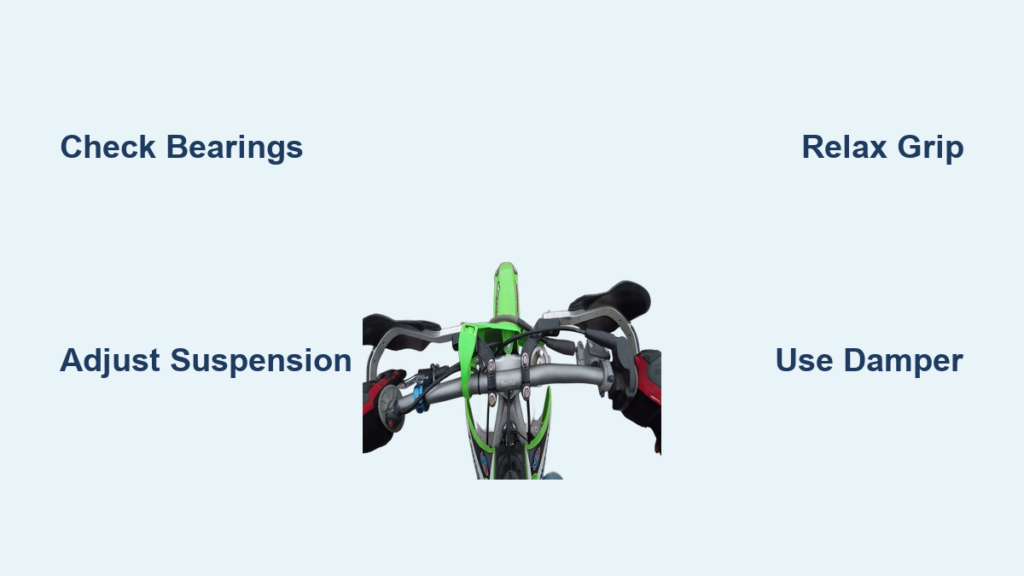
That sudden, violent shaking of your handlebars at speed—dirt bike speed wobble strikes fear into even experienced riders. This terrifying phenomenon involves rapid side-to-side oscillations of the steering, typically occurring between 30-70 mph but possible across your bike’s entire speed range. The front wheel loses its ability to track straight, creating five to ten cycles of violent shaking per second that can literally throw you from your machine. Understanding why dirt bike speed wobble happens, how to respond when it strikes, and what preventive measures work can mean the difference between a scary moment and a serious crash.
Speed wobble isn’t just vibration from rough terrain—it’s a distinct mechanical instability where oscillations build rather than settle. Unlike weave instability (which affects both wheels in a slower snake-like motion), dirt bike speed wobble centers on the front wheel alone. This critical distinction matters because it directs your focus to front-end components and rider technique rather than overall bike balance. Whether you’ve survived a wobble event or want to prevent one entirely, this guide delivers actionable solutions based on proven physics and rider-tested techniques.
Identify Speed Wobble Before It Escalates
Dirt bike speed wobble announces itself with unmistakable violence—your handlebars shake rapidly from side to side with increasing intensity. This isn’t the minor vibration you feel on rough trails; it’s a self-amplifying oscillation where each swing grows larger than the last. The front wheel essentially loses its tracking ability, and the five to ten hertz frequency creates forces strong enough to eject riders from their seats.
Critical distinction: Speed wobble differs from weave instability in both speed and origin. Weave involves slower oscillations (about one cycle per second) where both front and rear wheels snake across your path. Speed wobble, however, stems from front wheel dynamics alone—the rear wheel merely modifies the oscillation characteristics. Recognizing this difference prevents misdiagnosis and wasted effort on ineffective solutions.
Most dirt bikes experience wobble within specific speed ranges determined by your bike’s geometry, tire properties, and mass distribution. For many riders, the danger zone falls between 30-50 mph, though modified bikes or different conditions can shift this range. Understanding that wobble occurs in specific speed bands explains why slightly increasing or decreasing speed often breaks the oscillation cycle.
Diagnose Mechanical Triggers of Speed Wobble

Your dirt bike’s mechanical condition plays a decisive role in speed wobble occurrence. Pinpointing which component affects your bike directs you to the most effective solution—no guesswork required.
Test Your Front Wheel Bearings for Dangerous Play
Worn front wheel bearings allow excessive movement that initiates and amplifies wobble oscillations. Here’s how to check them properly:
- Lift your bike so the front wheel clears the ground
- Align handlebars straight as if riding
- Tap bars left/right with one finger
- Observe resistance and movement
Properly adjusted bearings should require two light taps to swing fully from side to side. If bars flop easily with minimal pressure, bearings need tightening or replacement. If multiple firm taps are required, the adjustment is too tight—this creates its own stability issues by making steering unnaturally stiff.
Verify Critical Suspension Setup Issues

Incorrect suspension setup causes more speed wobble incidents than any other mechanical factor, especially for riders outside the bike’s intended weight range. Focus on these suspension elements:
- Race sag measurement: Incorrect sag fundamentally alters bike geometry. When rear suspension sits too high in its stroke, steering becomes sharper and less stable.
- Fork position in triple clamps: Lowering forks changes geometry to reduce front-end sensitivity to small inputs.
- Spring rate mismatch: Riders significantly lighter than design weight often need softer springs to achieve proper sag.
Common mistake: Assuming factory settings work for your weight. Always measure race sag with you on the bike—never rely on generic settings.
Correct Rider Techniques That Prevent Wobble
Your riding position and technique contribute more to speed wobble than most riders realize. Master these techniques to eliminate rider-induced instability.
Maintain the Proper Attack Position
The correct standing position shifts weight to your rear wheel, reducing front-end sensitivity that amplifies oscillations. Key elements:
- Position body weight back over the rear tire
- Keep elbows raised and bent (never locked)
- Maintain flexed knees to absorb terrain
- Avoid leaning forward during acceleration
Riders who lean forward while standing—especially during hard acceleration—load the front end in ways that promote wobble initiation. This single position error triggers more wobble events than mechanical issues for intermediate riders.
Apply Correct Grip Technique During Wobble
When speed wobble begins, your grip technique determines whether the oscillation builds or dissipates. Follow this sequence:
- Loosen rather than tighten your grip (counterintuitive but critical)
- Keep elbows bent to absorb movement
- Allow handlebars to move within your relaxed grip
- Gradually reduce speed while maintaining this position
Gripping too tightly converts your body into an ineffective steering damper that actually amplifies oscillations. Your arms should work as shock absorbers, not rigid stabilizers.
Immediate Response to Active Speed Wobble
When wobble strikes, your reaction in the first two seconds determines the outcome. Follow this proven response sequence to regain control safely.
Execute the Correct Emergency Procedure
Do these actions immediately:
– Roll off the throttle gradually (abrupt changes worsen oscillations)
– Maintain a firm but relaxed grip with bent elbows
– Shift body weight slightly forward to improve front tire traction
– Apply rear brake gently if needed—never grab the front brake
Critical warning: Never apply the front brake during wobble. This concentrates weight and grip on the front wheel, dramatically amplifying oscillations and often causing immediate crashes.
Avoid These Dangerous Mistakes
Certain reactions consistently lead to crashes during wobble events. Never do these:
– Grip handlebars tightly in panic
– Apply front brake abruptly
– Make sudden steering corrections
– Attempt to put foot down during oscillation
– Pull in the clutch (removes engine braking stability)
Allow the bike to decelerate naturally while maintaining relaxed control. Most wobble events resolve within 2-3 seconds if you follow the correct procedure.
Prevent Speed Wobble Through Maintenance
Prevention beats reaction when it comes to dirt bike speed wobble. Implement these maintenance practices to eliminate most wobble triggers before they develop.
Perform These Critical Weekly Checks
Tire pressure: Underinflated tires reduce lateral stiffness, allowing sidewall deformation that disrupts stability. Check pressure before every ride and maintain manufacturer specifications adjusted for your weight.
Wheel trueness: Bent rims create imbalance that amplifies at speed. Spin wheels and check for wobble—replace or true wheels showing more than 2mm deviation.
Steering head adjustment: Use the two-tap test described earlier—proper adjustment requires exactly two light taps for full bar swing. Adjust immediately if outside this range.
Install a Steering Damper for Immediate Protection

A quality steering damper like the Scotts unit provides instant wobble protection by converting oscillation energy into heat through hydraulic resistance. Installation benefits:
- Suppresses wobble across the critical speed range
- Works regardless of the underlying cause
- Provides immediate stability improvement
- Requires minimal maintenance
Start with manufacturer baseline settings, then make small adjustments based on your specific riding experience. An improperly tuned damper can create its own handling issues, so test carefully after each adjustment.
Optimize Tire Setup to Eliminate Wobble Triggers
Tire properties significantly affect wobble susceptibility—understanding these factors helps you select and maintain optimal tires.
Balance Relaxation Length and Cornering Stiffness
The two most critical tire properties are:
– Relaxation length: Measures how quickly tires respond to steering inputs
– Cornering stiffness: Describes how well tires maintain shape under lateral force
Optimal pressure balances these factors—too low reduces cornering stiffness while too high decreases the tire’s ability to conform to surface irregularities. Even 2-3 PSI changes can eliminate wobble for many riders.
Pro tip: Monitor tire wear patterns—they reveal suspension issues that contribute to wobble. Uneven wear indicates alignment problems that create imbalance at speed.
Special Solutions for Lighter Riders
Smaller riders frequently experience speed wobble on bikes designed for heavier users. Implement these targeted solutions if you weigh significantly less than your bike’s design target.
Modify Geometry for Improved Stability
When suspension is too stiff for your weight, the bike rides too high in its stroke, creating sharper steering geometry that promotes wobble. Solutions include:
- Lowering forks in triple clamps to reduce steering aggressiveness
- Installing softer springs to achieve proper sag
- Adding weight to the rear of the bike to improve front tire loading
Test procedure: After modifications, verify steering requires exactly two light taps to swing fully side-to-side. This confirms proper adjustment without binding.
Mastering dirt bike speed wobble prevention starts with understanding its mechanical triggers and proper response techniques. By implementing these maintenance practices, suspension adjustments, and riding techniques, you can virtually eliminate this dangerous phenomenon from your riding experience. Key takeaways: Check steering head adjustment weekly using the two-tap test, maintain proper tire pressure, and practice the correct wobble response technique before you need it. For persistent issues, consider a steering damper installation—it provides the most immediate and reliable protection against speed wobble regardless of the underlying cause. Stay safe out there, and remember that confidence comes from preparation, not luck.