Converting a dirt bike into a street-legal machine opens up entirely new riding possibilities. Whether you want to commute on your KTM 500 EXC-F, transform a Honda CRF450L into a canyon carver, or build a dual-sport monster from a stripped-down Yamaha WR250R, the conversion process requires careful attention to legal requirements, safety modifications, and technical specifications. This comprehensive guide walks you through every step of a dirt bike to street bike conversion, from gathering the proper documentation to installing the final safety components that will keep you legal on public roads.
The appeal of converting a dirt bike to street bike status makes perfect sense when you consider the versatility these machines offer. A properly converted dirt bike retains its off-road capability while gaining the ability to handle highway speeds, navigate urban traffic, and eliminate the need for trailer transport to trailheads. However, the transformation isn’t simply a matter of adding lights and hoping for the best—each state and jurisdiction has specific requirements that must be met before your machine can legally operate on public streets. Understanding these requirements upfront prevents costly mistakes, rejected registration attempts, and the frustrating process of starting over.
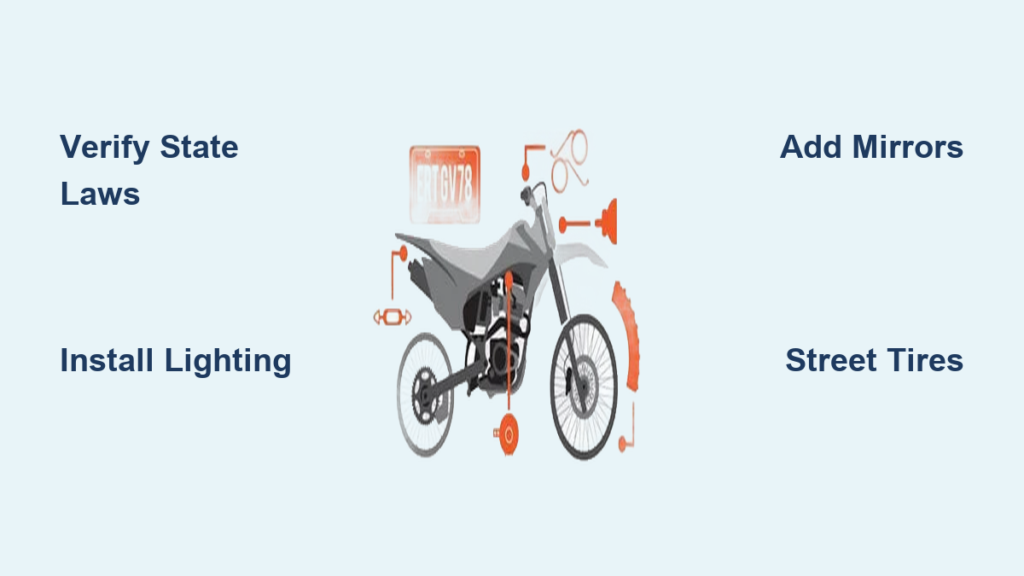
Before diving into the technical modifications, you need to understand the fundamental reality of dirt bike to street bike conversions: success depends on following a specific sequence that begins with legal verification and ends with final inspection. Skipping steps or installing components in the wrong order often results in failed inspections and wasted money. The guide below provides everything you need to know about transforming your dirt bike into a street-legal machine, including which modifications are mandatory, which are optional, and how to navigate the registration process in most jurisdictions.
Verify Your State’s Street Legal Requirements Before Spending a Dime
The single most critical mistake dirt bike converters make is starting modifications without confirming exact legal requirements in their specific jurisdiction. Requirements vary dramatically between states, and assuming California standards apply in Texas or New York leads to expensive rework. Most states require specific components that must be present and functional before registration approval, but the exact specifications differ significantly.
Check with your local Department of Motor Vehicles website or visit in person to obtain the official street-legal motorcycle requirements. The most commonly required components include:
– Headlamps with both high and low beam capability
– Tail lamps with integrated brake light function
– Front and rear turn signals
– Rear reflectors and license plate illumination
– Mirrors on both left and right sides
– Functional horn audible for 100 feet
– DOT-approved exhaust system with spark arrestor
– Proper tires meeting street-use specifications
Beyond equipment requirements, verify whether your specific dirt bike model can even be registered for street use in your state. Some jurisdictions prohibit registering off-road-only motorcycles regardless of modifications, while others have specific “dual-sport” categories with different requirements. Having clear title to the dirt bike is essential—vehicles with salvage titles or unclear ownership often cannot be registered for street use regardless of their condition. If purchasing a dirt bike specifically for conversion, verify title status and VIN condition before committing to the project.
Install Mandatory Lighting Systems That Pass Inspection
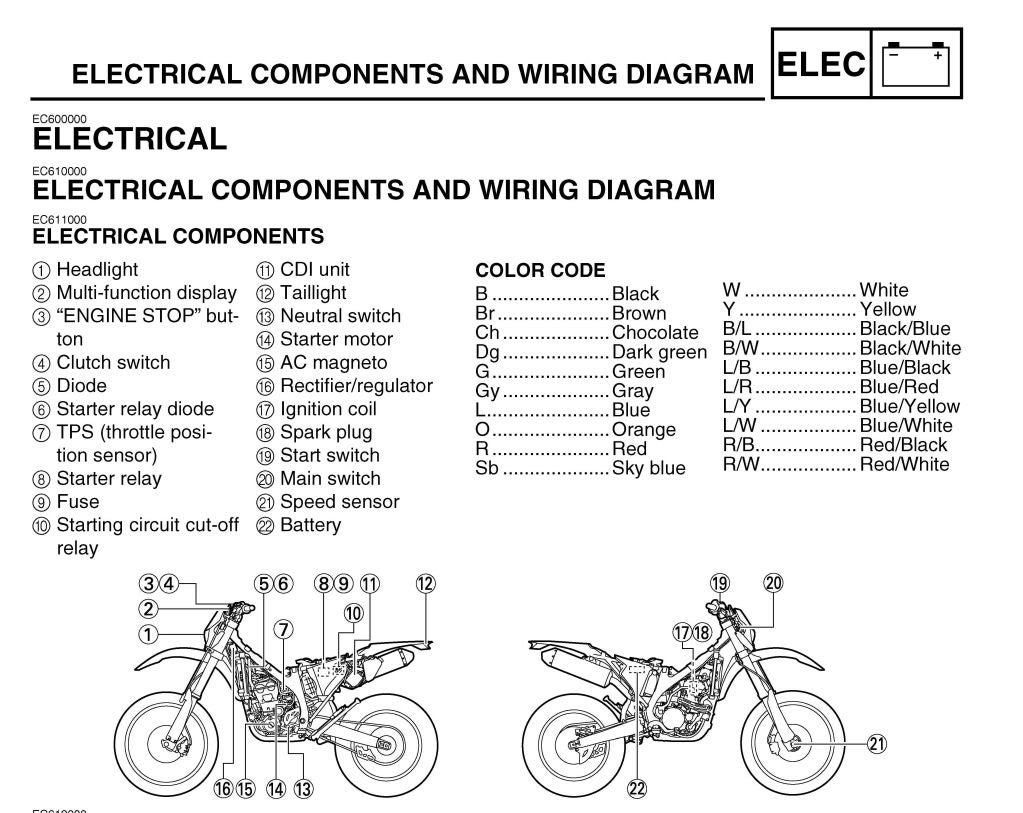
Lighting represents the most visible and critical modification category for dirt bike to street bike conversion. A complete lighting system must include a DOT-approved headlight assembly with high and low beam capability, tail light with brake function, front and rear turn signals, and license plate illumination. Most modern enduro bikes like KTM EXC-F series come with sufficient electrical infrastructure, making these additions relatively straightforward.
Headlight installation requires mounting a DOT-approved assembly to your handlebars or triple clamp with proper wiring to the motorcycle’s electrical system. Never splice directly into factory wiring without proper fusing—this creates fire hazards and electrical failures. Use complete conversion kits designed specifically for your bike model, which include proper mounting hardware, wiring harnesses, and integrated high-low beam switching. When installed correctly, your headlight should provide adequate illumination without blinding oncoming traffic.
Tail light and brake light installation requires running wires from the rear of the bike to both brake levers. Aftermarket kits typically include a license plate bracket with integrated tail light, mounting hardware, and necessary wiring. Critical testing point: When either brake lever is applied, the brake light must illuminate brightly within 0.2 seconds. Turn signals require separate mounting points on rear fender and handlebar ends, a compatible flasher relay, and proper wiring to the ignition system. Most jurisdictions require turn signals to operate at 60-120 flashes per minute.
Secure Proper Mirrors and Safety Equipment That Meet Specifications

Mirrors are mandatory on street-legal motorcycles in virtually every jurisdiction, yet competition-focused dirt bikes typically ship without them. Street bike conversions require mirrors on both sides with minimum reflective surface areas—most states require at least 2.5 inches in diameter. Bar-end mirrors offer cleaner aesthetics but stalk-mounted mirrors often provide better visibility adjustment for taller riders.
The horn is frequently overlooked during conversions but is mandatory in all 50 states. Adding one requires mounting a compact horn (minimum 85dB sound level), running proper gauge wiring, and installing a horn button on your handlebar. Warning: Using automotive horns creates electrical overload risks—select motorcycle-specific units designed for your bike’s electrical system.
Exhaust systems on dirt bikes often lack the required spark arresters and noise compliance for street legality. Street-legal exhausts must include integrated spark arresters, proper labeling indicating DOT approval, and maintain noise levels below local limits (typically 80-96 dB depending on jurisdiction). Keeping your stock exhaust for off-road use while purchasing a separate street-legal system maintains versatility while meeting legal requirements.
Choose Street-Optimized Tires That Balance Performance

Tire selection dramatically affects street performance of converted dirt bikes. Stock knobby tires create poor handling on pavement, excessive road noise, and instability during high-speed cornering. Street-legal tires for conversions feature more moderate tread patterns that provide adequate dirt capability while maintaining predictable pavement handling.
Your tire size must match manufacturer specifications for your dirt bike model. Most dirt bikes use 21-inch front wheels and 18-inch rear wheels, but profiles and widths vary significantly. Look for dual-sport or adventure-touring compounds that balance on-road performance with limited off-road capability. Pro tip: For mixed use, consider tires like the Michelin Anakee Adventure or Bridgestone A41 that offer 70% street/30% dirt performance balance.
Tire pressure requirements differ significantly between street and off-road use. Street tires typically require higher pressures—32-36 PSI rear and 30-32 PSI front for most dual-sport applications. Checking pressure before every ride and adjusting for conditions (lower for soft dirt, higher for highway) ensures optimal performance from your converted machine.
Adjust Gearing for Highway Cruising Comfort
Gearing modifications are often necessary when converting a dirt bike for extended street use. Dirt bikes are geared low for trail acceleration, resulting in high RPM at highway speeds that creates excessive noise, vibration, and engine wear. Changing sprockets allows you to achieve comfortable cruising RPM while retaining acceptable acceleration.
A common starting point is increasing the rear sprocket tooth count by 2-4 teeth relative to stock, which reduces engine RPM at any given speed. Alternatively, decreasing the front sprocket tooth count achieves similar results. Finding ideal gearing requires balancing priorities—whether you prioritize highway cruising comfort, around-town acceleration, or trail performance.
Chain and sprocket wear accelerates at highway speeds, so upgrading to high-quality components designed for sustained high-RPM operation is essential. Look for chains with rivetable master links for easy maintenance, and consider O-ring chains for dusty conditions. Critical maintenance point: Proper chain tension becomes more critical at highway speeds—check and adjust tension before every street ride to prevent dangerous chain issues.
Complete Registration and Insurance for Your Converted Machine
Once modifications are complete, navigate registration and insurance requirements in your jurisdiction. Most states require vehicle inspection before issuing street registration for converted vehicles. Organize all documentation—including title, bill of sale, receipts for all modification parts, and any inspection certifications—to smooth this process.
Insurance for converted dirt bikes typically falls under standard motorcycle policies, though some insurers require additional documentation. Provide your insurance company with a complete list of modifications and their costs to ensure adequate coverage. Comprehensive coverage is particularly valuable for converted machines due to their custom nature and higher replacement costs.
The cost to convert a dirt bike to street legal typically ranges from $800 to $2,500 in parts alone when done properly, with professional installation potentially doubling that figure. However, this investment is often significantly less than purchasing a purpose-built dual-sport motorcycle, making conversions attractive for riders who already own suitable dirt bikes.
Maintain Your Converted Bike with Street-Specific Care
A dirt bike converted to street use requires maintenance bridging pure dirt bike care and standard motorcycle maintenance. The increased highway speeds and extended ride times place different demands on engine oil, chain tension, tire condition, and brake wear.
Chain maintenance becomes critical on street-converted bikes due to higher speeds and longer distances. Inspect chain tension before every ride, clean and lubricate every 200-300 miles, and replace chains and sprockets before excessive wear. Highway speeds generate more heat, making proper lubrication essential for longevity.
Regular oil changes at shorter intervals protect engine internals from sustained highway operation stress. Many conversion specialists recommend changing oil every 1,000-1,500 miles using high-quality motorcycle-specific oil. Air filter maintenance remains equally important whether your converted bike sees dirt or street use.
Converting a dirt bike to street legal status maximizes utility of off-road machines while adding street registration flexibility. The process requires patience, attention to detail, and methodical approach prioritizing legal compliance and safety. Investing in quality parts and proper installation pays dividends in reliability, safety, and long-term enjoyment of your versatile street-converted dirt bike.