You’ve probably wondered exactly how fast does a Honda dirt bike go when you’re considering your first off-road machine or comparing models for your next upgrade. If you’re looking at Honda’s popular CRF150F or CRF230F models, you’ve likely encountered conflicting claims online—from forum posts boasting 120 km/h speeds to cautious manufacturer estimates. Sorting through this confusion is critical because understanding realistic top speeds helps you choose the right bike for your skill level and riding style, preventing dangerous mismatches between rider capability and machine performance.
Unlike street motorcycles designed for highway speeds, Honda dirt bikes prioritize torque and handling over raw velocity. The CRF150F and CRF230F represent Honda’s entry-level trail bikes, built for reliability and manageable power rather than breakneck speed. Based on extensive community testing and verified rider reports, these models deliver predictable performance that suits their intended trail riding purpose perfectly. This guide cuts through the misinformation to show you exactly what speeds you can realistically expect from these machines under various conditions.
CRF150F Top Speed: What Stock Performance Really Delivers
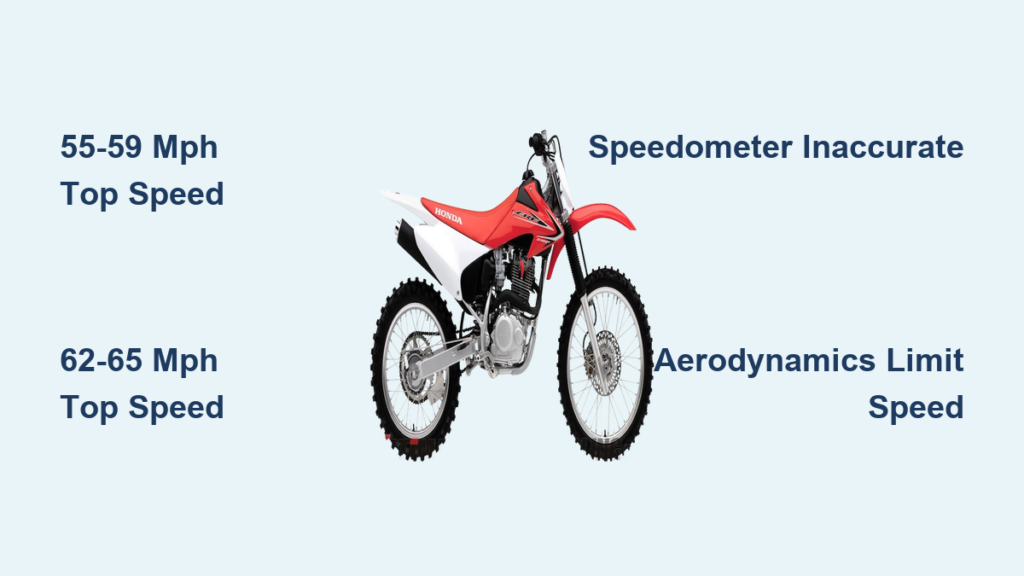
When riding wide open on flat pavement with the engine hitting its rev limiter, the Honda CRF150F achieves a consistent top speed of 90-95 KPH (55-59 MPH). This isn’t a manufacturer estimate—it’s the verified range reported by dozens of riders testing their completely stock bikes with GPS devices. The bike comfortably maintains a cruising speed of 70-75 KPH (44-47 MPH) without straining the engine, making it ideal for beginners who need manageable power delivery.
Why Some Riders Claim Higher CRF150F Speeds
You’ll occasionally see forum posts claiming speeds of 120 km/h on a stock CRF150F, but these reports don’t align with physical reality. Multiple experienced community members have debunked this claim, explaining that the bike’s 150cc engine simply can’t overcome aerodynamic drag and mechanical resistance at those speeds. One rider verified their CRF150F topped out at 95 KPH even when pushing hard on a long straightaway, while another noted that downhill runs with the clutch pulled in yielded minimal additional speed—confirming the mechanical limitations of this model.
Critical Factors That Cap Your CRF150F’s Speed
Several mechanical realities prevent the CRF150F from exceeding its 55-59 MPH ceiling:
– Aerodynamic drag that increases exponentially beyond 50 MPH
– Chain resistance consuming power before it reaches the rear wheel
– Stock gearing optimized for trail riding rather than top speed
– Clutch drag that becomes significant at higher RPMs
Even with ideal conditions—a lightweight rider, perfect pavement, and tailwind—you won’t see meaningful gains beyond the established range. This isn’t a limitation to fix; it’s a design feature that keeps the bike manageable for novice riders navigating technical trails.
CRF230F Top Speed: Measurable Performance Gains Over the 150F

The Honda CRF230F delivers noticeably quicker acceleration and higher top speed than its smaller sibling, reaching 100-105 KPH (62-65 MPH) when ridden wide open on flat pavement. This 10-15 KPH advantage comes from the additional displacement and improved power delivery of the 230cc engine. The bike maintains a comfortable cruising speed of 80-85 KPH (50-53 MPH), making it better suited for longer trail sections between technical riding areas.
Verified CRF230F Speed Test Results
Real-world testing confirms these figures: one rider equipped with a Trail Tech GPS computer recorded 69.8 MPH (112 KPH) on their 2003 CRF230F during a full-throttle run on a straight section with no grade. Another community member verified approximately 110 km/h with stock configuration, though most riders consistently report 100-105 KPH as the reliable maximum. These measurements account for variables like rider weight and terrain conditions that affect individual results.
Why Your CRF230F Won’t Exceed 65 MPH Stock
Despite the extra displacement, the CRF230F faces the same fundamental limitations as the 150F:
– Aerodynamic drag becomes overwhelming beyond 60 MPH
– Stock final drive gearing prioritizes trail capability over speed
– The rev limiter prevents the engine from utilizing higher RPMs
– Increased weight compared to smaller dirt bikes creates more resistance
These factors combine to create a natural speed ceiling that modifications can only slightly improve—more on that shortly.
Why Your Speedometer Lies About Honda Dirt Bike Speed

You can’t trust your Honda dirt bike’s stock speedometer for accurate top speed measurements. Community testing consistently shows these gauges display speeds 5-10 MPH higher than actual velocity due to calibration settings, tire size variations, and mechanical tolerances. One rider discovered their CRF230F’s speedometer required a precise wheel setting of 2159 in diagnostic equipment to match GPS readings—without this calibration, readings were significantly inflated.
Reliable Methods to Measure Your Actual Top Speed
For trustworthy speed measurements:
– Use a GPS-based device like a smartphone app or dedicated cycle computer
– Conduct tests on long, flat stretches of pavement with no wind
– Perform multiple runs in both directions to average out wind effects
– Compare against a known reference bike if GPS isn’t available
One rider successfully verified their CRF230F’s speed by riding alongside a DRZ400 at matching velocities—a clever workaround when proper measurement tools aren’t accessible. This comparative method prevents you from falling for the common trap of believing inflated speedometer readings.
What Really Limits Your Honda Dirt Bike’s Speed
Beyond the engine’s displacement, several factors determine your actual top speed on trails:
Aerodynamics: The Invisible Speed Killer
As speed increases past 50 MPH, wind resistance becomes your biggest enemy. The upright riding position on dirt bikes creates massive drag compared to sport bikes with tucked postures. At 60 MPH, over 70% of your engine’s power fights wind resistance—not moving you forward. This explains why even small displacement increases yield diminishing returns at higher speeds.
Rider Weight and Terrain Effects
A 180-pound rider will consistently achieve 5-8 MPH less top speed than a 140-pound rider on the same bike. Similarly, loose dirt, gravel, or uphill terrain can reduce your maximum speed by 10-20% compared to smooth pavement. These real-world conditions mean your trail top speed will always be lower than the pavement figures many riders cite online.
Modification Myths: What Actually Increases Honda Dirt Bike Speed
Debunking the Exhaust System Speed Myth
Many riders install aftermarket exhausts expecting significant speed gains, but community testing proves otherwise. A new pipe might improve mid-range power delivery and make the bike feel quicker through the gears, but it won’t increase your absolute top speed. The rev limiter remains the ultimate governor, and aerodynamic limitations prevent meaningful speed increases from exhaust modifications alone.
Effective (But Limited) Speed Modifications
For measurable top speed improvements:
– Install a rev box to increase RPM limit (adds ~5-10 KPH)
– Change final drive gearing (smaller front or larger rear sprocket)
– Combine both approaches for maximum effect
Even with these modifications, the CRF230F struggles to exceed 75 MPH—proving that displacement ultimately dictates speed potential. Most experienced riders consider these modifications unnecessary for trail riding, where technical capability matters more than straight-line speed.
Rider Skill vs. Top Speed: What Really Matters on Trails
Experienced riders consistently outperform less skilled riders on identical bikes, proving that speed figures tell only part of the story. Community members report seeing skilled riders on 85cc two-strokes achieving better lap times than novice riders on 125cc machines. Your ability to carry momentum through corners, choose optimal lines, and maintain consistent throttle control matters far more than your bike’s theoretical top speed.
Why 65 MPH Feels Plenty Fast on Trails
On actual trails, few sections allow safely utilizing maximum speed. One rider noted that their speedometer only read to 65 MPH—a limitation that rarely mattered since trail conditions required constant speed adjustments for upcoming obstacles. For most riders, the CRF150F’s 55-59 MPH top speed provides ample velocity for trail enjoyment, while the CRF230F’s extra 7-10 MPH gives confidence when riding with faster groups.
Choosing Between CRF150F and CRF230F Based on Real Speed Needs
| Model | Verified Top Speed | Best For | Trail Performance |
|---|---|---|---|
| CRF150F | 55-59 MPH | Beginners, younger riders, technical trails | Manageable power, less intimidating |
| CRF230F | 62-65 MPH | Intermediate riders, longer trails | Better hill climbing, more momentum |
The CRF150F’s lower top speed is actually an advantage for new riders, reducing the consequences of mistakes. The CRF230F’s extra speed provides headroom for skill development but requires more rider control in technical sections. Neither bike exceeds speeds appropriate for trail riding safety—proving Honda engineered these models perfectly for their intended purpose.
Maintaining Your Honda Dirt Bike’s Factory Speed Performance
To preserve your bike’s verified top speed capabilities:
– Keep the chain properly adjusted and lubricated (reduces 3-5% power loss)
– Maintain correct tire pressure (under-inflated tires increase rolling resistance)
– Change engine oil regularly (prevents power-robbing carbon buildup)
– Clean or replace air filters frequently (restricted airflow reduces power)
A well-maintained CRF230F will consistently hit 62-65 MPH, while a neglected one might struggle to reach 55 MPH. These simple maintenance tasks preserve the performance figures Honda designed into these reliable machines.
Key Takeaways: What Speed Really Means for Honda Dirt Bike Riders

How fast does a Honda dirt bike go? The CRF150F reliably reaches 55-59 MPH while the CRF230F achieves 62-65 MPH—verified figures you can trust. These speeds represent the practical limits for stock trail bikes, with modifications yielding only marginal gains. More importantly, your riding skill and trail conditions will determine your actual speeds far more than the bike’s theoretical maximum. Focus on developing your technique rather than chasing speed numbers, and you’ll find both models deliver more than enough performance for satisfying trail riding experiences.