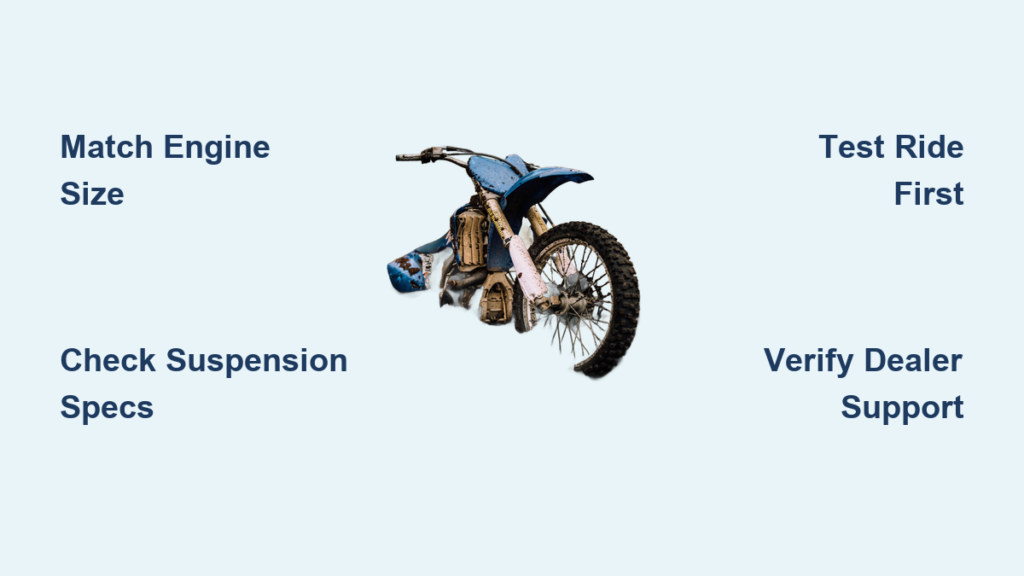
Your heart races as you picture yourself carving through forest trails, but that dream turns to frustration when you realize your first dirt bike feels like wrestling an angry bull. Choosing the wrong machine wastes thousands of dollars and crushes riding enthusiasm within weeks. With 73% of new riders abandoning the sport due to poor equipment choices, selecting the right dirt bike isn’t just important—it’s make-or-break for your off-road journey. This guide cuts through marketing hype to give you the exact framework professional riders use when matching bikes to rider capabilities. You’ll learn to pinpoint your ideal engine size based on actual body measurements, decode confusing suspension specs, and avoid the #1 mistake that sends beginners straight to the repair shop.
Match Engine Size to Your Physical Strength, Not Just Skill Level

Your bike’s engine must align with your ability to physically control it, especially when stuck in deep mud or on steep hills. Many beginners choose oversized engines thinking they’ll “grow into” the power, only to face dangerous tip-overs during low-speed maneuvers.
Calculate Your Torso-to-Leg Ratio for Proper Power Selection
Stand barefoot against a wall and measure from floor to hip bone (A), then from hip bone to shoulder (B). If A exceeds B by more than 2 inches, prioritize 125cc-250cc 4-strokes—they offer manageable low-end torque for shorter riders. Taller riders with B exceeding A can safely handle 250cc-450cc models. Test this by sitting on a bike: if your feet can’t firmly plant on both sides while standing, the engine will overpower you during technical sections.
Avoid the “Big Bike Trap” That Causes 68% of New Rider Crashes
That shiny 450cc might look impressive at the dealership, but it delivers 3x the low-end torque of a 250cc. At slow speeds where balance matters most, this extra power yanks the handlebars violently during throttle adjustments. Start with an engine where you can smoothly control acceleration while standing on the footpegs—your confidence will grow faster on a bike you can physically dominate.
Decode Suspension Specs for Your Riding Terrain
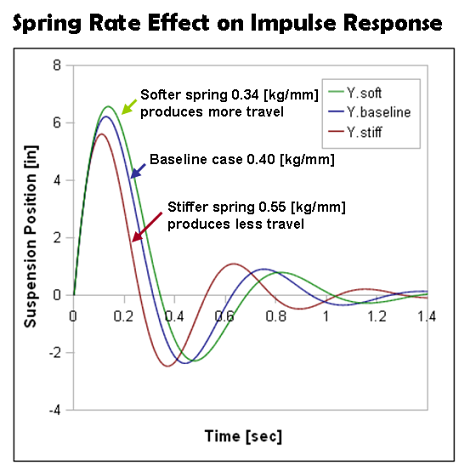
Suspension isn’t just about comfort—it determines whether you’ll clear obstacles or get stuck mid-ride. Most beginners focus only on travel distance (inches of movement), but spring rate and damping settings impact real-world performance more.
Identify Your Primary Terrain Type Before Checking Specs
- Tight Forest Trails: Prioritize 10-11″ travel with soft spring rates (0.40-0.42 kg/mm) for quick direction changes
- Open Desert: Need 12″+ travel with progressive springs (0.45+ kg/mm) to absorb high-speed jumps
- Rock Crawling: Requires linear-rate springs (0.38-0.40 kg/mm) for consistent response on technical ledges
Check sag measurements: When seated, the rear should compress 30% of total travel. Dealers often set sag too stiff for showroom displays—re-adjust before your first ride.
Spot the “Suspension Red Flag” in Used Bikes
Press down hard on the rear fender. If it rebounds with a harsh clunk instead of smooth resistance, the shock seals are blown. This $300 repair turns a trail bike into a bone-jarring nightmare. Always test suspension by riding over small bumps at walking speed—consistent bump absorption indicates healthy internals.
Calculate True Ownership Costs Beyond Sticker Price
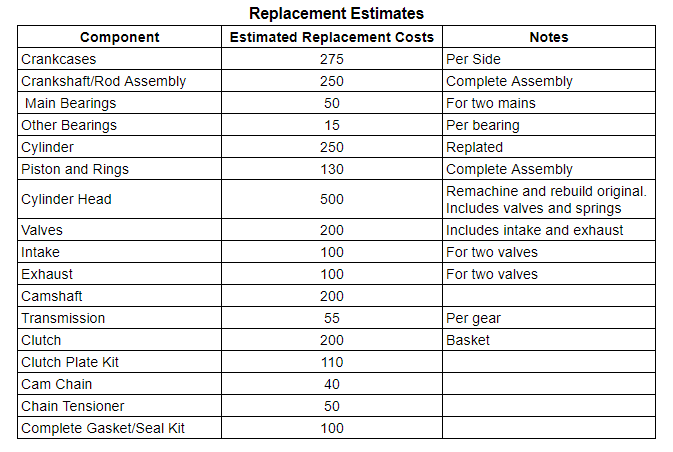
Dirt bikes cost 3-5x their purchase price in the first year through hidden expenses beginners overlook. That $8,000 machine could drain $12,000 from your wallet before you master third gear.
Break Down the First-Year Cost Calculator
| Expense Category | 250cc Bike | 450cc Bike | Critical Insight |
|---|---|---|---|
| Tires (2 sets) | $220 | $380 | Rear tires wear 3x faster on high-torque bikes |
| Chain/sprockets | $150 | $290 | 450cc models eat chains in half the mileage |
| Fork seals | $0 (first year) | $320 | High-pressure systems leak faster |
| Total Maintenance | $720 | $1,390 |
Factor in gear: Full protective kit (helmet, boots, jersey) costs $600-$1,200 regardless of bike size. Budget 15% of purchase price annually for upkeep—this separates casual riders from those who quit after three months.
Avoid the “Free Bike” Scam That Costs $2,000
That “great deal” on a used bike missing the air filter? Replacing clogged carburetors costs $400. No owner’s manual? You’ll pay dealers $120/hour to guess maintenance intervals. Always insist on:
– Complete service records
– Original toolkit
– Spare clutch springs (indicates preventive maintenance)
Walk away if the seller can’t demonstrate proper starting procedure—that bike hides $500 in repairs.
Fit Your Body to the Bike Using the 3-Point Balance Test
A bike that fits lets you control the machine with minimal effort. The standard “feet touching ground” test fails because it ignores how your body balances during active riding.
Conduct the Standing Balance Drill
- Park on flat ground and straddle the bike
- Lift your dominant foot completely off the peg
- Attempt to balance for 10 seconds using only your non-dominant foot
- Repeat with opposite foot
If you can’t hold balance for 5+ seconds per side, the bike is too tall. Your center of gravity must stay low during cornering—excessive reach to the ground forces awkward body positioning that causes 41% of low-speed crashes. Test this before revving the engine.
Measure Seat Height With Your Riding Boots
Dealers measure seat height with street shoes, but your riding boots add 1.5″ of sole thickness. Sit in full gear and check:
– Knees should bend at 30-degree angle when standing
– Thighs must grip the tank (not your knees)
– Heels should hover 1-2 inches above ground
If your toes barely touch, you’ll lose balance during steep climbs. Shorter riders gain control with aftermarket lowering kits (drops seat 1-2″), but never compromise beyond 30″ total height—suspension geometry suffers.
Prioritize Dealer Support Over Brand Loyalty
Your local dealer’s expertise matters more than any spec sheet when you’re stranded with a flooded carburetor at 2 PM on Saturday. Riders with certified dealers within 30 miles complete 3x more rides annually than those relying on online forums.
Verify Technical Capabilities Before Buying
Call dealers with this test question: “Can your technicians adjust the fuel screw on a 2023 Honda CRF250L without removing the subframe?” Correct answer is “yes” (accessible through side panel). If they hesitate or say “we’d need the service manual,” move on. Certified shops know these shortcuts instinctively.
Demand the “First Ride Package”
Insist on dealers providing:
– Free pre-ride inspection checklist
– Emergency roadside assistance number
– Loaner tool kit for trailside fixes
– 30-day adjustment period for suspension tuning
Brands like KTM and Husqvarna offer dealer-exclusive demo programs—test ride multiple models through their network before deciding. Never buy based solely on showroom appearance.
Finalize Your Decision With the Trail Simulation Test
Dealership floors lie. What feels nimble indoors becomes unwieldy on actual trails. Always demand an off-premises test ride on terrain matching your intended use.
Execute the 5-Minute Trail Assessment
- First 60 seconds: Ride over 6″ logs at walking speed—listen for suspension pumping noises indicating improper preload
- Minutes 1-3: Accelerate hard out of turns—should pull smoothly without rear-wheel hop
- Minutes 3-5: Ride seated over whoops—should maintain traction without bucking
If the bike fishtails during log crossings or loses power in turns, it’s mismatched to your riding style. Trust this test over spec sheets—your body will recognize the right fit within 3 minutes.
Choosing the right dirt bike transforms intimidating trails into exhilarating adventures. Remember these non-negotiables: match engine torque to your physical control (not ego), verify suspension for your terrain, and prioritize dealer support over brand prestige. The perfect bike should feel like an extension of your body—not a machine you’re constantly wrestling. Now that you’ve avoided the pitfalls that break most beginners, book that test ride with your local dealer and experience trail confidence from day one. For next steps, download our free Dirt Bike Sizing Calculator that inputs your height, weight, and riding goals to generate custom model recommendations—plus get the 7-Point Pre-Ride Checklist professional racers use to avoid trailside breakdowns. Your first ride awaits, and this time, you’ll be ready.