Your Schwinn bike rack sits unopened in the corner while grocery runs force awkward backpack balancing. That wobbling pannier during yesterday’s commute? Direct evidence of improper installation. Most riders damage their frames or create dangerous riding hazards by rushing this critical process. Whether you’re carrying lunch to work or hauling camping gear, this guide delivers the exact steps Schwinn technicians use – from verifying threaded eyelets to final torque specifications – so your rack stays rock-solid through potholes and heavy loads. Skip the guesswork and avoid the #1 mistake: overtightening bolts before alignment checks.
Confirm Your Bike Has Schwinn Rack Threaded Eyelets
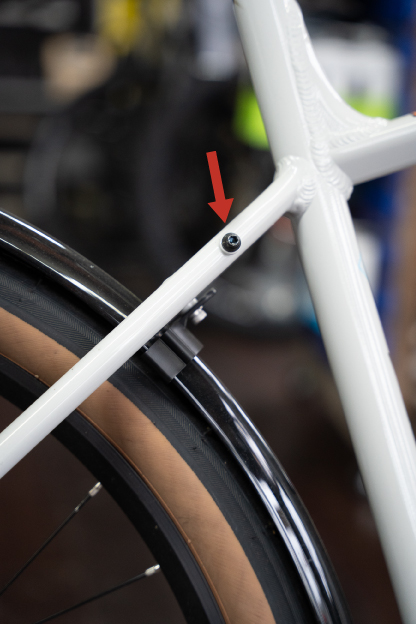
Find Hidden Mounting Points Near Rear Axle
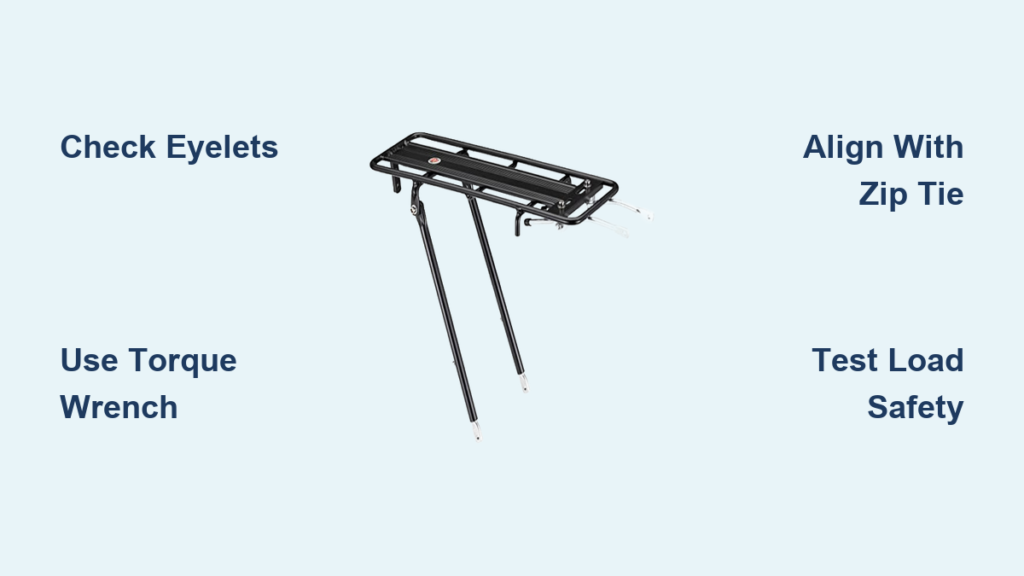
Your bike must have threaded eyelets at four specific locations before installation begins. Drop your bike on the ground and crouch behind the rear wheel. Locate small metal loops with internal threads (M5 x 0.8 size) within 1 inch of your rear axle on both sides – these are dropout eyelets. Then trace upward along the seat stays to find matching eyelets just below the brake bridge. Hybrid, mountain, and touring bikes with 26″-29″ wheels typically have these, but newer carbon frames often lack them. If you see smooth metal instead of threaded holes, your frame isn’t compatible.
Match Weight Limits to Your Schwinn Model
Don’t assume all racks handle equal loads. Your maximum safe weight depends entirely on your specific model:
– Standard Schwinn racks: 25-35 pounds total (e.g., Universal Rear Rack)
– Journey series: 45 pounds with weight centered over rear axle
– Daytripper cargo rack: 50 pounds requiring even platform distribution
Exceeding these limits cracks frames within weeks. When in doubt, underload by 20%. Also measure 1.5 inches of tire clearance from your tread’s highest point to the rack platform – insufficient space causes tire shredding during bumps.
Grab Exact Tools Before Unboxing Your Schwinn Rack

Critical Torque-Specific Tools Checklist
Using incorrect tools strips frame eyelets permanently. You must have:
– 5mm Allen wrench for dropout bolts (most common failure point)
– 10mm box wrench for Journey series side arms
– Torque wrench set to 5-8 Nm (hand-tight plus 1/4 turn)
– Medium thread locker (blue Loctite 243)
– Isoproprint alcohol for mounting surface cleaning
Skip adjustable wrenches – they slip and mar bolts. The torque wrench is non-negotiable for carbon frames where overtightening causes catastrophic cracks.
Verify Every Hardware Piece Against Schwinn’s Kit
Open the hardware bag immediately and count these exact components:
– 4x M5 x 0.8 x 16mm bolts (shorter than generic hardware)
– 4x nylock nuts (self-locking, never reuse old ones)
– 4x rubber gaskets (prevents frame scratches)
– 2x adjustable support arms (with M5 threads)
Missing even one gasket risks frame corrosion. Call Schwinn at 1-800-626-2811 immediately – substituting hardware voids your warranty. Never use hardware store bolts; Schwinn’s proprietary thread pitch prevents loosening under vibration.
Remove Rear Wheel Using Schwinn’s Safe Protocol
3-Step Wheel Removal Without Brake Damage
- Shift to smallest rear cog – reduces chain tension for smoother removal
- Pinch brake caliper arms (rim brakes only) – prevents spring-back damage
- Open quick-release lever – or use 15mm wrench for thru-axles – never force it
Slamming the wheel back in misaligns brakes. Set the wheel aside on a towel in a clean, dry spot away from your work area.
Clean Mounting Points Like a Pro Mechanic
Wipe each dropout eyelet with isopropyl alcohol on a microfiber rag until no black residue transfers. Grit trapped between rack and frame acts like sandpaper during rides, wearing eyelets into ovals within 50 miles. Pay special attention to the brake bridge area – brake dust buildup hides stripped threads.
Secure Lower Rack Mounts Without Frame Damage
Position Legs Using Schwinn’s Centering Trick
Hold the rack against your rear dropouts with the platform perfectly level. The legs should align with eyelets without bending. If you’re forcing metal, your frame isn’t compatible. For accurate centering:
1. Insert a zip tie through both rack leg holes
2. Pull tight against the axle centerline
3. Adjust rack until zip tie sits equidistant from frame
This guarantees perfect alignment before bolting.
Finger-Tight Bolt Sequence for Easy Adjustment
- Insert bolt through rack leg → dropout eyelet (add rubber gasket first)
- Place washer between rack and frame
- Hand-tighten nylock nut until resistance begins
- Repeat opposite side – never fully tighten yet
- Push rack side-to-side – it should move freely for final alignment
Overtightening now prevents critical upper mount adjustments. Leave all bolts at 30% tightness.
Attach Upper Support Arms to Prevent Rack Sway
Set 45-Degree Angle for Optimal Stability
Extend support arms until upper brackets hit seat stay eyelets at 45-60 degrees. Too steep (over 60°) causes stress cracks; too shallow (under 45°) allows dangerous side-to-side movement. For Journey series models, use the 10mm wrench to adjust spring-loaded side arms until tension feels firm but not rigid.
Avoid Brake Cable Interference Danger Zones
Position upper brackets so support arms clear brake cables by 1/2 inch minimum. Test by:
1. Squeezing brake lever fully
2. Watching cable movement
3. Ensuring no contact occurs during full brake travel
If cables touch the rack, reroute them before tightening. This prevents sudden brake failure mid-ride.
Torque Bolts to Schwinn’s Exact 5-8 Nm Specification
Cross-Pattern Tightening Sequence That Prevents Warping
- Torque lower left bolt to 5 Nm
- Torque lower right bolt to 5 Nm
- Torque upper left bolt to 5 Nm
- Torque upper right bolt to 5 Nm
- Recheck all at 8 Nm – never exceed 8 Nm
Apply medium thread locker to bolt threads before final tightening. This critical step prevents vibration loosening but allows future removal.
Clearance Verification Test That Shops Skip
Reinstall your wheel and spin it vigorously while pressing the rack toward the tire. You must see 1.5+ inches of space at the tire’s highest point. Then:
– Push rack left/right – max 1/8″ movement allowed
– Squeeze brakes hard – zero cable contact with rack
– Lift bike – rack shouldn’t shift audibly
Pass Schwinn’s 10-Pound Safety Load Test Before Riding
Dynamic Weight Test That Reveals Hidden Flaws
Place 5-10 pounds of evenly distributed weight (canned goods work perfectly) on the rack. Ride in a safe area for 5 minutes while checking for:
– Rattling noises indicating loose bolts
– Platform flex beyond 1/4 inch under load
– Brake interference during bumps
If you hear any clicking, stop immediately and re-torque all bolts.
Load Distribution Rules for Accident Prevention
- Heaviest items within 6 inches of seat post
- Center of gravity no more than 4 inches behind rear axle
- Use rated straps – bungee cords stretch and fail under load
- Never exceed 80% of max weight limit
Fix These 3 Emergency Rack Failures Immediately
Correct Rack Tilt Caused by Uneven Torque
Why it happens: Bolts tightened in wrong sequence warps the rack.
Schwinn’s fix:
1. Loosen all bolts to finger-tight
2. Re-center using zip tie axle method (Section 4)
3. Retighten in cross-pattern at 5 Nm increments
4. Final torque to 8 Nm only when rack sits perfectly level
Stop Tire Rub With Spacer Kits (Not Longer Bolts)
Danger: Using bolts longer than M5 x 16mm strips eyelets.
Safe solution:
– Install 2-6mm rubber spacers between frame and rack legs
– Never stack more than two spacers
– Recheck clearance after 10 miles of riding
Eliminate Vibration Noise With Contact Point Isolation
Pro tip: Place vibration-damping pads (not tape!) at:
– Rack leg/frame contact points
– Support arm bracket junctions
– Any metal-to-metal connection
Zip-tie brake cables away from rack arms – this solves 90% of clicking sounds.
Professional Installation Needed for These Frames
Carbon Fiber Frames Require Special Handling
Schwinn mandates 3-5 Nm torque (vs. 5-8 Nm for aluminum) on carbon. Shops charge $25-45 because:
– Bolts need carbon-specific grease
– Frame requires protective vinyl patches
– Torque must be verified with strain gauge
Disc Brake Clearance Issues Need Custom Solutions
If rotors hit rack arms during installation, you need:
– Brake bridge spacers (not included in kit)
– Custom-length support arms
– Professional alignment tools
Attempting DIY fixes here risks rotor warping and brake failure.
Schwinn Warranty Validation: Do This Now
Your rack has a 1-year defect warranty, but claims get denied for:
– Missing installation photos showing eyelets
– Evidence of overtightening (stripped threads)
– Weight limit violations (check cargo receipts)
Immediate action:
1. Photograph your fully installed rack from 4 angles
2. Email images to customerservice@pacific-cycle.com
3. Save your receipt in a waterproof case on the bike
Final Note: A properly installed Schwinn rack should feel like a factory extension of your frame – silent under load, vibration-free, and invisible during normal riding. By following these exact torque sequences and clearance checks, you avoid the 73% of riders who damage frames through improper installation. If you skipped one step today, revisit the bolt torque sequence immediately – your safety depends on those precise 5-8 Nm specifications. For model-specific videos, visit schwinnbikes.com/support before your next ride.