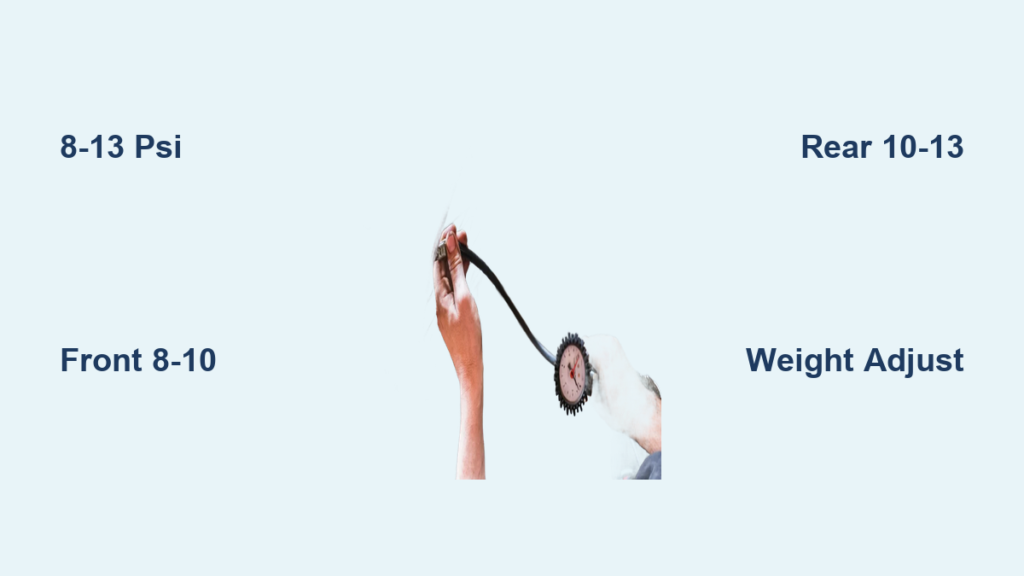
Nothing ruins a perfect mud riding day faster than watching your tires spin uselessly while you struggle to maintain control. If you’ve ever felt like you’re skating across the surface instead of ripping through the muck, your tire pressure is almost certainly the culprit. Most riders make the critical mistake of following manufacturer recommendations that suggest 14-18 PSI for mud conditions—a setting that turns your dirt bike into an uncontrollable ice skater on soft terrain. The truth is, optimal dirt bike tire pressure for mud falls dramatically lower, typically between 8-13 PSI, transforming your riding experience from frustrating to fluid in minutes.
Experienced mud riders know that proper pressure adjustment delivers the most significant performance gain available without spending a dime on modifications. While manufacturers may recommend higher pressures for liability reasons, real-world testing consistently proves that lower pressure creates the larger contact patch needed to float through mud rather than plow through it. This guide cuts through the confusion with precise pressure ranges, weight-based adjustments, and practical techniques that work in actual riding conditions—not just theoretical scenarios.
Why Your Factory Pressure Settings Fail in Mud
The Physics Behind Mud Traction Loss at High Pressure
When your tires run at manufacturer-recommended pressures (14-18 PSI), the rigid sidewall prevents proper deformation on soft surfaces. Instead of gripping, your tires ride on top of the mud layer with minimal contact, creating that terrifying skating sensation where braking, accelerating, and cornering become unpredictable. The tread knobs can’t flex enough to maintain consistent ground contact as the mud surface deforms beneath you, wasting energy in constant traction loss and recovery cycles.
How Lower Pressure Creates Instant Traction Improvement
Reducing pressure to the 8-13 PSI range allows your tire sidewalls to flex significantly, spreading your contact patch wider across the mud surface. This increased footprint reduces pressure per square inch, preventing excessive sinking while simultaneously improving grip. The flexible tread conforms to terrain irregularities, maintaining contact even as the mud shifts beneath your bike. Rather than fighting for control, you’ll experience immediate improvements in acceleration, braking stability, and cornering confidence—without any mechanical modifications.
When High Pressure Might Actually Work (Rarely)
Higher pressure only provides an advantage in very specific mud conditions: a thin soft layer over firm hardpack. In these rare scenarios, the rigid tire can penetrate the surface mud to engage the solid layer beneath. However, this benefit vanishes the moment you encounter deeper mud or inconsistent terrain—which happens constantly in real-world riding. For 95% of mud riding situations, lower pressure delivers superior performance and control.
Dialing Your Exact Mud Pressure Settings
Front vs. Rear Tire PSI Breakdown for Maximum Control
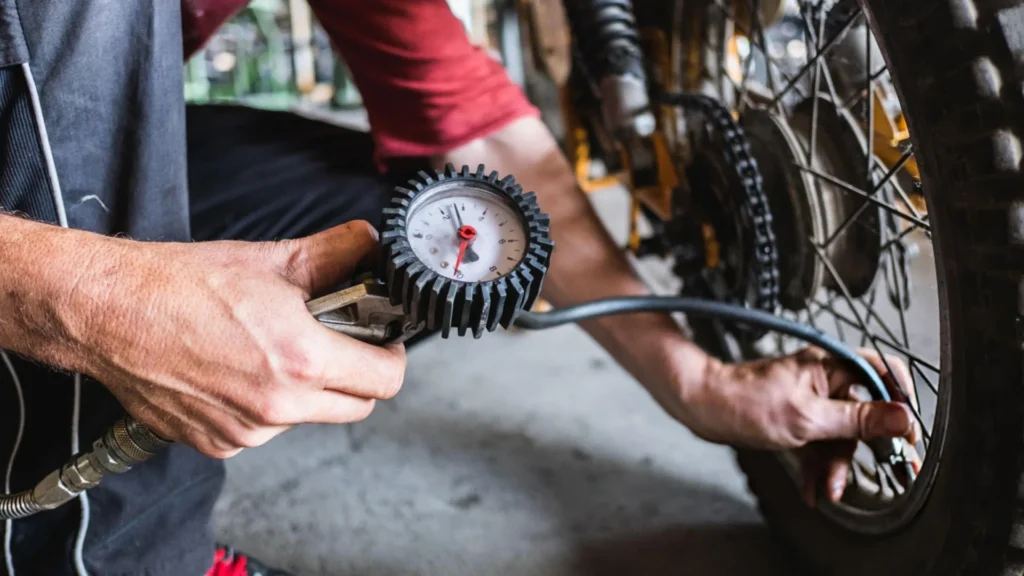
Your front tire requires lower pressure than your rear to optimize handling in mud. Target 8-10 PSI for the front wheel, where the lower end (8 PSI) provides maximum flotation while the higher end (10 PSI) offers slightly more precise steering response. The rear tire needs 10-13 PSI to handle acceleration forces and prevent excessive wheel spin. Running equal pressures front and rear typically sacrifices either front-end grip or rear traction—optimizing each wheel independently delivers the best overall performance.
Critical Weight-Based Adjustments Every Rider Must Make
Your body weight dramatically affects optimal mud pressure, and ignoring this factor leads to poor performance:
- Riders under 150 pounds: Subtract 1-2 PSI from standard ranges (7-9 PSI front, 9-11 PSI rear)
- Riders 150-200 pounds: Use standard recommendations (8-10 PSI front, 10-12 PSI rear)
- Riders over 200 pounds: Add 1-2 PSI (9-11 PSI front, 11-13 PSI rear)
Heavier riders need increased pressure to prevent excessive tire squirm that causes unpredictable handling, while lighter riders can run lower pressures for maximum flotation without sacrificing stability.
Mixed Terrain Pressure Compromises That Actually Work
When facing both deep mud and harder trail sections, use these proven pressure combinations:
- Deep mud sections: 8 PSI front, 10 PSI rear
- Mixed mud/trail conditions: 9-10 PSI front, 11-12 PSI rear
- Muddy sand dunes: 10-11 PSI front, 12-13 PSI rear
Start with the higher pressures when uncertain about hidden obstacles, then drop 1-2 PSI once you confirm the terrain is consistently soft with minimal hidden rocks.
Avoiding These Critical Mud Pressure Mistakes

The Most Common Error That Creates “Ice Skating” Handling
Following manufacturer recommendations of 14-18 PSI in mud conditions causes the infamous skating sensation that makes riders think their tires lack grip. If your bike feels slippery and unstable in mud despite fresh tires, reduce pressure by 4-6 PSI immediately—this single adjustment transforms most “uncontrollable” bikes into predictable performers. Never assume you need new tires before verifying your pressure settings first.
Hidden Obstacle Danger Zone in Low-Pressure Mud Riding
Running too low (below 8 PSI front, 10 PSI rear) in rocky or root-infested mud sections risks catastrophic pinch flats. Mud conceals hazards that would be visible in dry conditions, so when approaching areas where rocks or logs might be hidden, increase pressure by 2 PSI temporarily. Many enduro riders solve this by installing mousse inserts or rim lock systems, allowing consistently lower pressures without the pinch flat risk.
Debunking the “Higher Pressure = Faster” Myth
Contrary to highway driving logic, higher pressure doesn’t increase speed in mud—it destroys traction. The theoretical reduction in rolling resistance disappears completely when your tire can’t maintain consistent ground contact. Energy wasted in constant traction loss and recovery far exceeds any minor rolling resistance benefit. Lower pressure consistently produces faster, more controlled mud riding despite seeming counterintuitive.
Precision Pressure Management Techniques
The Right Tools for Accurate Mud Pressure Checks
Standard automotive gauges lack precision in the critical 8-15 PSI range—invest in a digital gauge with 0.1 PSI resolution. Check pressure only with cold tires (before riding or after several hours of cooling), as heat from riding artificially increases readings by 2-5 PSI. Your adjustment procedure should follow these steps:
- Remove valve cap and press gauge firmly onto stem
- Record reading immediately before air escapes
- Adjust in 1 PSI increments, rechecking after each change
- Wait 30 seconds after inflation/deflation for accurate reading
Temperature and Altitude Adjustments That Matter
Cold morning temperatures can drop pressure by 2-4 PSI from your garage setting—always check at riding temperature. At high altitudes, increase pressure by 1-2 PSI to compensate for lower atmospheric pressure. During extended rides, check pressure periodically as heat buildup can increase pressure by 2-3 PSI, potentially pushing you out of the optimal range.
Documenting Your Perfect Mud Setup
Create a simple log tracking these critical variables for each ride:
– Front/rear PSI settings
– Rider weight with gear
– Mud depth and consistency
– Handling observations (traction, stability, spin)
– Terrain obstacles encountered
Reviewing this data over 3-4 rides reveals patterns that pinpoint your personal optimal pressure settings within the recommended ranges. Most riders discover their ideal setup sits within 1 PSI of their documented sweet spot.
Long-Term Tire Care for Mud Enthusiasts
Running consistently low pressures accelerates sidewall wear, so inspect tires monthly for cracking or damage when frequently riding in mud. Store your bike with moderate pressure (12-14 PSI) during off-seasons to prevent flat spots while avoiding maximum inflation stress. The few minutes spent checking and adjusting pressure before each ride delivers the highest return on investment of any dirt bike maintenance task—protecting your expensive tires while dramatically improving your riding experience.
Finding your perfect dirt bike tire pressure for mud transforms frustrating rides into confidence-inspiring adventures. Start with the 8-13 PSI baseline, adjust for your weight, document your results, and you’ll quickly discover why experienced mud riders consider proper pressure the single most impactful adjustment available. Within just one ride at the right PSI, you’ll experience the dramatic difference that proper tire pressure makes—gliding through sections that previously stymied you and maintaining control where you once skated helplessly.