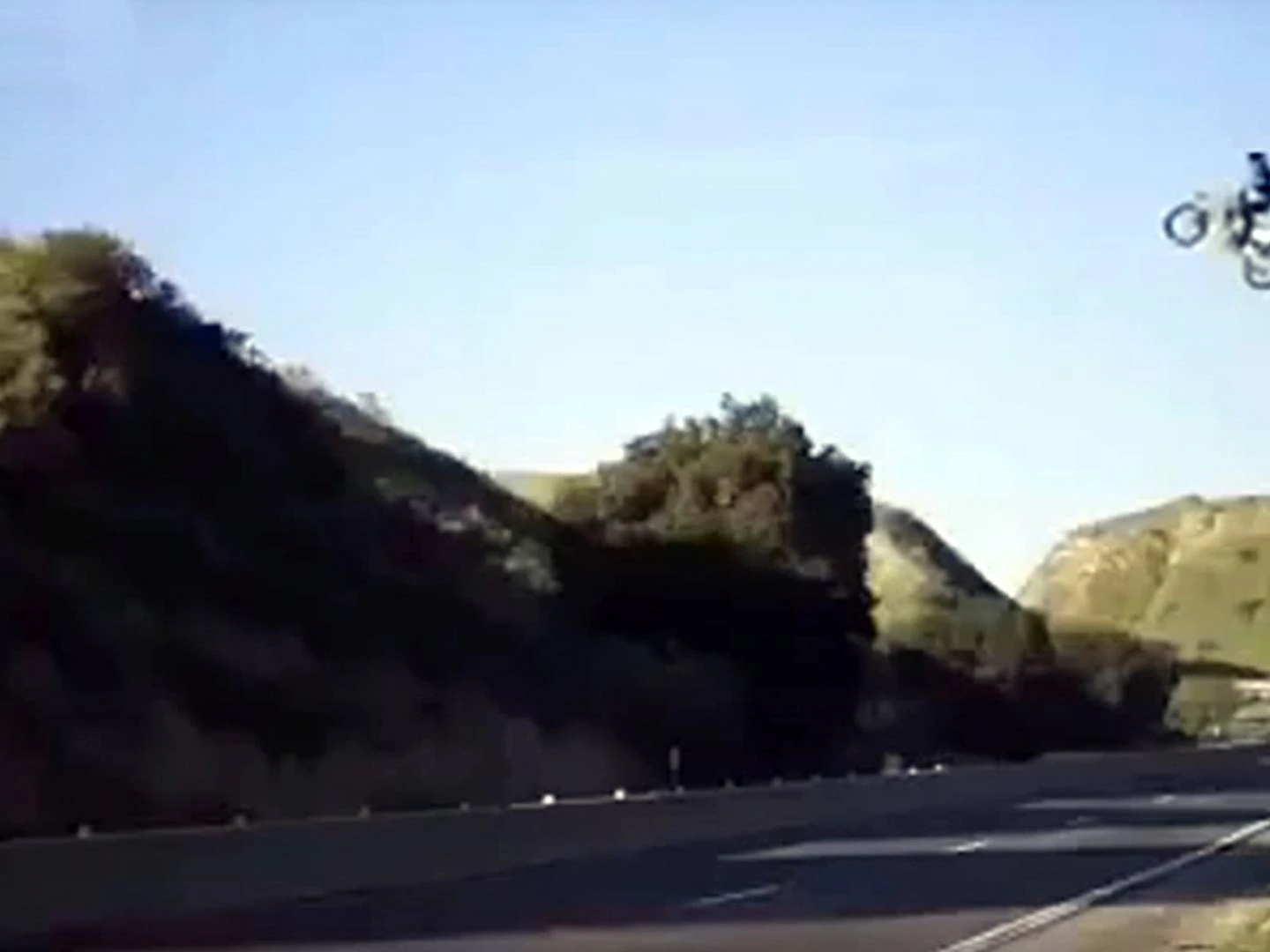
On March 3, 2017, a motorcyclist executed one of the most reckless stunts ever captured on video when he launched a dirt bike over all four lanes of active Highway 60 traffic near Moreno Valley, California. The viral footage showing Kyle Katsandris, a 24-year-old motocross enthusiast from San Clemente, soaring above vehicles traveling at highway speeds ignited nationwide debate about illegal motorcycle stunts. This dirt bike jumps 60 freeway incident required deliberate preparation, with makeshift dirt ramps constructed on elevated terrain adjacent to the freeway, transforming public infrastructure into a dangerous stunt playground. What began as a moment of viral fame would ultimately reveal a troubling pattern of escalating risk-taking behavior with life-threatening consequences.
The “Badlands” area east of Moreno Valley where the stunt occurred was already known for hazardous driving conditions, with California Highway Patrol officers noting “numerous crashes have occurred on this stretch of roadway by people just avoiding tumbleweeds and wild animals.” This context made Katsandris’ decision to jump across active traffic even more alarming, as drivers were already navigating challenging environmental conditions without expecting a dirt bike to suddenly appear overhead. The stunt demonstrated impressive physical skill but represented a complete disregard for public safety, creating a situation where any miscalculation could have resulted in multiple fatalities.
March 3, 2017: The Day a Dirt Bike Cleared All Four Lanes of Highway 60
Katsandris documented his motocross activities on Instagram under the handle @kylekatsandris, building a following within the extreme sports community before executing the dirt bike jumps 60 freeway stunt. The rider constructed makeshift dirt ramps on elevated terrain beside the freeway, engineering a launch point capable of propelling his motorcycle high enough to clear the entire width of Highway 60 while vehicles passed beneath him. Witnesses observed that the jump required precise timing to gauge oncoming traffic speeds and calculate the exact trajectory needed to avoid collision with vehicles traveling at highway velocities.
The visual impact of a dirt bike silhouetted against the sky as it cleared active highway traffic contributed to the video’s immediate viral spread. Within hours, the footage accumulated hundreds of thousands of views across Facebook, Instagram, and YouTube, transforming an illegal act into an internet sensation. This rapid dissemination created a dangerous paradox: while the exposure validated Katsandris’ skills within extreme sports circles, it simultaneously intensified law enforcement scrutiny and potentially inspired copycat attempts by other thrill-seekers.
California Highway Patrol’s Immediate Investigation of the Stunt
Officer Darren Meyer of the California Highway Patrol characterized the stunt as “certainly shocking” and emphasized the broader implications for public safety. The CHP launched an immediate investigation upon learning of the video’s circulation, focusing on identifying the rider and determining applicable criminal charges. Despite the viral nature of the evidence, the Simi Valley police did not officially confirm Katsandris’ identity in relation to the incident, creating complications for the formal charging process.
Meyer articulated the critical safety concern that motivated the investigation: “It would take just merely a second for someone to slam on their brakes or to swerve and cause a huge crash.” This statement underscored that the danger extended far beyond the stunt performer to every motorist using Highway 60 that day. The unexpected spectacle of a motorcycle jumping over traffic could have triggered panic responses from drivers unprepared for such a scene on a public highway, potentially causing chain-reaction collisions involving multiple vehicles.
Caltrans’ Emergency Response to Prevent Copycat Dirt Bike Jumps

Transportation officials reacted swiftly to the dirt bike jumps 60 freeway incident with physical modifications designed to prevent imitation attempts. Terri Kasinga, a Caltrans spokesperson, issued a forceful condemnation: “It was illegal and dangerous to motorists. It could have been a tragedy.” Caltrans crews immediately blocked access to the makeshift dirt ramps constructed adjacent to the freeway, implementing barriers specifically intended to prevent other thrill-seeking riders from attempting similar jumps on the same site.
Kasinga emphasized the potential severity of outcomes that the stunt could have produced: “This guy could have crashed into another vehicle, a semi, and killed someone or hurt someone really bad.” Her warning reflected the fundamental calculus that made the stunt so dangerous—the highway carried heavy trucks and passenger vehicles at high speeds, and a miscalculated jump could easily have resulted in a catastrophic collision affecting multiple families. The agency’s rapid response demonstrated the seriousness with which transportation authorities treated threats to highway safety, particularly those attracting significant public attention.
One Month Later: The Critical Off-Road Crash That Followed the Freeway Jump
Just 30 days after executing the Highway 60 jump without injury, Katsandris suffered critical injuries during another planned stunt on April 2, 2017. In the 500 block of W. Los Angeles Avenue, he attempted to jump over a steep hill characteristic of extreme motocross terrain. Colin Morrison, a friend and experienced stunt rider who had completed the same jump ten years earlier (including two occasions jumping over moving trains), had warned Katsandris about the difficulty: “He called me last week, asking me about this jump. And I told him, ‘Uh … you know, it’s big.'”
Despite receiving this explicit warning from an experienced source, Katsandris proceeded with the stunt attempt. Witnesses reported he successfully launched his motorcycle into the air but crash-landed on the opposite side after hitting a bump at the top of the hill during the jump sequence. The critical injury resulted from this terrain variation that seemed minor but proved catastrophic at high speeds. Following the crash, Katsandris was transported to a hospital where he was listed in critical condition, requiring extensive medical treatment.
December 2019 Train Track Incident: Another Near-Fatal Jump Attempt
Nearly three years after the initial dirt bike jumps 60 freeway stunt that made him famous, Katsandris was critically injured once again while attempting another dangerous maneuver. On December 5, 2019, he attempted to jump over train tracks as part of what appeared to be an ongoing pattern of increasingly risky behavior. Unlike the freeway jump that was captured on video and widely shared, this incident resulted in severe injuries requiring immediate medical attention when Katsandris landed poorly after attempting to clear the tracks.
The December 2019 crash reignited public conversations about the dangers of extreme stunts and the risks associated with performing high-risk maneuvers in public spaces. This incident demonstrated a troubling pattern of escalating dangerous behavior, with Katsandris continuing to attempt increasingly risky jumps despite having already experienced one serious injury from a similar stunt. The sequence of events illustrated how viral fame can create dangerous incentives for performers to push beyond safe limits in pursuit of greater attention.
Why Dirt Bike Jumps on Freeways Create Catastrophic Safety Risks

The dirt bike jumps 60 freeway incident exemplifies multiple critical safety failures that make such stunts exceptionally dangerous:
- Unpredictable driver reactions: Motorists have no opportunity to prepare for unexpected aerial obstacles, potentially triggering panic braking or swerving
- Zero margin for error: A miscalculation of just inches in trajectory could result in collision with vehicles traveling at 65+ mph
- Environmental hazards: The “Badlands” area already presented challenges with tumbleweeds and wildlife, compounding existing risks
- No emergency protocols: Unlike sanctioned events with medical personnel on standby, public highways lack safety infrastructure for stunts
- Chain reaction potential: A single collision could trigger multi-vehicle pileups involving commercial trucks
Officer Meyer’s warning about how “merely a second” could cause “a huge crash” underscores that highway stunts transform ordinary commutes into potential death traps for unsuspecting drivers. The physics of motorcycle jumps at highway speeds create scenarios where even skilled riders cannot eliminate fundamental risks.
The Legal Fallout from Performing Illegal Highway Stunts in California
Authorities determined that the dirt bike jumps 60 freeway stunt violated multiple California state laws, creating substantial legal exposure:
- Trespassing on state property: The ramps were constructed on land adjacent to the highway without authorization
- Reckless endangerment: The stunt created substantial risk of serious physical injury to other highway users
- Lack of film permit: The video documentation itself was produced without proper authorization
Both trespassing and reckless endangerment are classified as misdemeanor offenses under California law, though the combination of violations could have resulted in significant consequences if formal charges were pursued. The absence of documented resolution suggests practical challenges in pursuing proceedings, but the investigation sent a clear message that law enforcement takes such stunts seriously.
What the Dirt Bike Jumps 60 Freeway Incident Teaches Us About Stunt Culture
Katsandris’ story serves as both a testament to human capability and a warning about the consequences of pushing beyond safe limits. His ability to execute the Highway 60 jump demonstrated genuine skill, yet subsequent injuries revealed that even talented riders cannot eliminate the inherent risks of increasingly dangerous stunts. The pattern of escalating behavior—from freeway jumps to train track attempts—illustrates how viral fame can create dangerous incentives for performers seeking greater recognition.
For transportation authorities, the incident reinforced the need for rapid physical interventions to prevent copycat attempts. For the motocross community, it highlighted the complex relationship between viral attention and stunt safety, with critics arguing that such stunts invite regulatory crackdowns affecting legitimate riding activities. Most significantly, Katsandris’ experiences demonstrate that skill alone cannot overcome the fundamental physics of dangerous stunts—each attempt carries potentially life-altering consequences that far outweigh momentary viral fame.