Nothing kills the thrill of trail riding faster than a dirt bike that runs perfectly when cold but suddenly dies as soon as the engine reaches operating temperature. You’re cruising through your favorite single track, adrenaline pumping, only to have your engine cut out unexpectedly, leaving you stranded. This frustrating issue affects riders of all skill levels and bike models, but the good news is it’s usually fixable with systematic troubleshooting. When your dirt bike shuts off when hot, the problem almost always traces back to one of three systems—ignition, fuel, or electrical connections failing under thermal stress. Understanding which component is failing saves you from replacing parts unnecessarily and gets you back on the trail faster.
The pattern of failure provides critical diagnostic clues. Some riders experience an immediate shutdown like someone flipped a kill switch, while others notice sputtering and hesitation before complete failure. The timing matters too—does your bike die after five minutes of hard riding or twenty minutes of casual trail work? Ambient temperature plays a role as well, with failures occurring more frequently on hot days. By methodically testing each potential cause, you can identify the exact culprit without wasting time or money on unnecessary repairs.
Decode Your Dirt Bike’s Shutdown Pattern Before Troubleshooting
Before grabbing tools, carefully document how your bike fails when hot. This diagnostic step prevents wasted effort on the wrong system and quickly narrows your search.
Analyze whether your engine dies instantly or sputters first. An immediate shutdown—like someone flipped the kill switch—points directly to an electrical failure where spark disappears completely. This typically indicates a failing ignition coil, CDI unit, or broken ground connection that can’t maintain circuit integrity when components expand with heat. If your engine sputters, hesitates, and gradually loses power before dying, you’re likely facing a fuel delivery issue where the mixture becomes too lean as temperatures rise. This distinction alone eliminates half the potential causes before you touch a wrench.
Track precisely when during your ride the failure occurs. A bike that dies within 5-10 minutes of hard riding usually has a severe problem like a completely clogged pilot jet or failing stator. One that runs reliably for 20-30 minutes before shutting down likely has a marginal component slowly drifting out of specification. Note whether the bike restarts immediately after dying or requires cooling time first—restart delay strongly indicates a heat-sensitive ignition component rather than fuel starvation. Keep a log of ambient temperature too, as failures often accelerate in extreme heat conditions.
Diagnose Ignition System Failures Causing Hot Shutdowns

Ignition system failures account for over 60% of hot-shutdown cases in dirt bikes, with components losing spark as internal windings expand and connections degrade under heat.
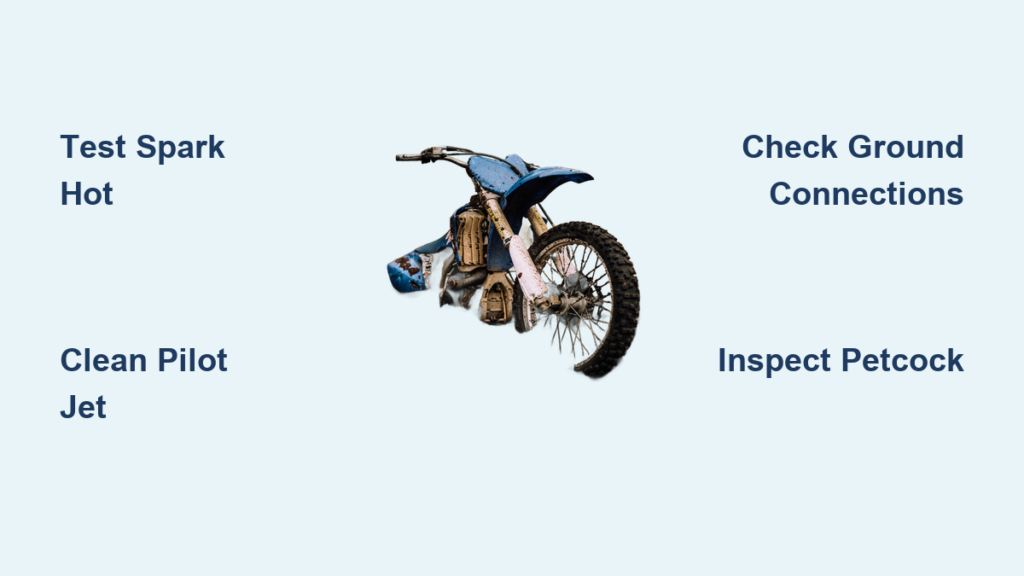
Test for spark both cold and hot using proper procedure. Start with a cold engine: remove the spark plug, reconnect it to the boot, ground the base against the cylinder head, and kick through while observing for spark. A strong, consistent blue-white spark confirms baseline ignition function. Now ride until failure occurs, then immediately check for spark again—do this while the engine is still hot. If you have spark when cold but none when hot, you’ve isolated an ignition system failure. This simple test eliminates fuel system concerns and directs your focus to electrical components.
Inspect CDI box and coil connections for heat damage. These components are prime suspects, especially on four-stroke machines. Heat causes internal solder joints to crack and connections to become intermittent. Check all connectors for green corrosion, looseness, or visible heat discoloration—particularly those near the engine or exhaust. The stator, which generates the spark energy, often fails as it heats up. Test stator resistance with a multimeter when cold, then repeat immediately after failure; significant resistance changes indicate a winding breaking down under thermal stress.
Bypass the kill switch to rule out switch failures. This simple diagnostic often solves the problem instantly. Disconnect the kill switch wiring harness and connect the wires directly together. If your bike now runs reliably even when hot, you’ve identified the culprit. The same test applies to the ignition switch—heat causes expanded metal in worn switches to lose contact. Pro tip: carry electrical tape on rides to temporarily bypass a failing switch and get home.
Solve Fuel System Issues That Cause Hot Engine Shutdowns
Fuel system problems create lean running conditions that worsen as the engine heats, typically presenting as sputtering shutdowns rather than instant kills.
Verify fuel quality and flow with systematic checks. Drain existing fuel into a clean container and inspect for cloudiness, separation, or contaminants—old fuel causes inconsistent combustion that intensifies with heat. Replace with fresh, properly mixed fuel if your bike requires premix. Next, check your inline fuel filter and lines for restrictions. A partially clogged filter flows adequately when cold but vapor locks or further restricts as temperatures rise. Replace the filter and inspect lines for kinks or heat degradation near the engine.
Clean the carburetor pilot circuit thoroughly—the most common fix. Remove the carburetor and disassemble completely, focusing on the pilot circuit’s tiny passages that supply fuel at idle and low throttle. Even microscopic debris here causes lean conditions that only manifest when hot. Soak components in quality carb cleaner, use compressed air through every passage (including the often-overlooked pilot air jet), and inspect with a magnifying glass. While cleaning, verify float height and needle condition—worn components cause temperature-dependent fuel delivery issues.
Test the petcock and vacuum lines for heat-related failures. Vacuum-operated petcocks can fail in ways that only appear at certain temperatures. Remove the petcock and inspect the diaphragm for tears or hardening—heat accelerates rubber degradation. Check all vacuum lines for cracks or disconnections, especially those exposed to engine heat. A failing petcock may flow adequately when cold but lose vacuum seal as temperatures rise. Pro tip: temporarily connect a fuel line directly from tank to carb (bypassing the petcock) for a test ride—if the problem disappears, replace the petcock.
Check Electrical Grounds That Fail When Hot
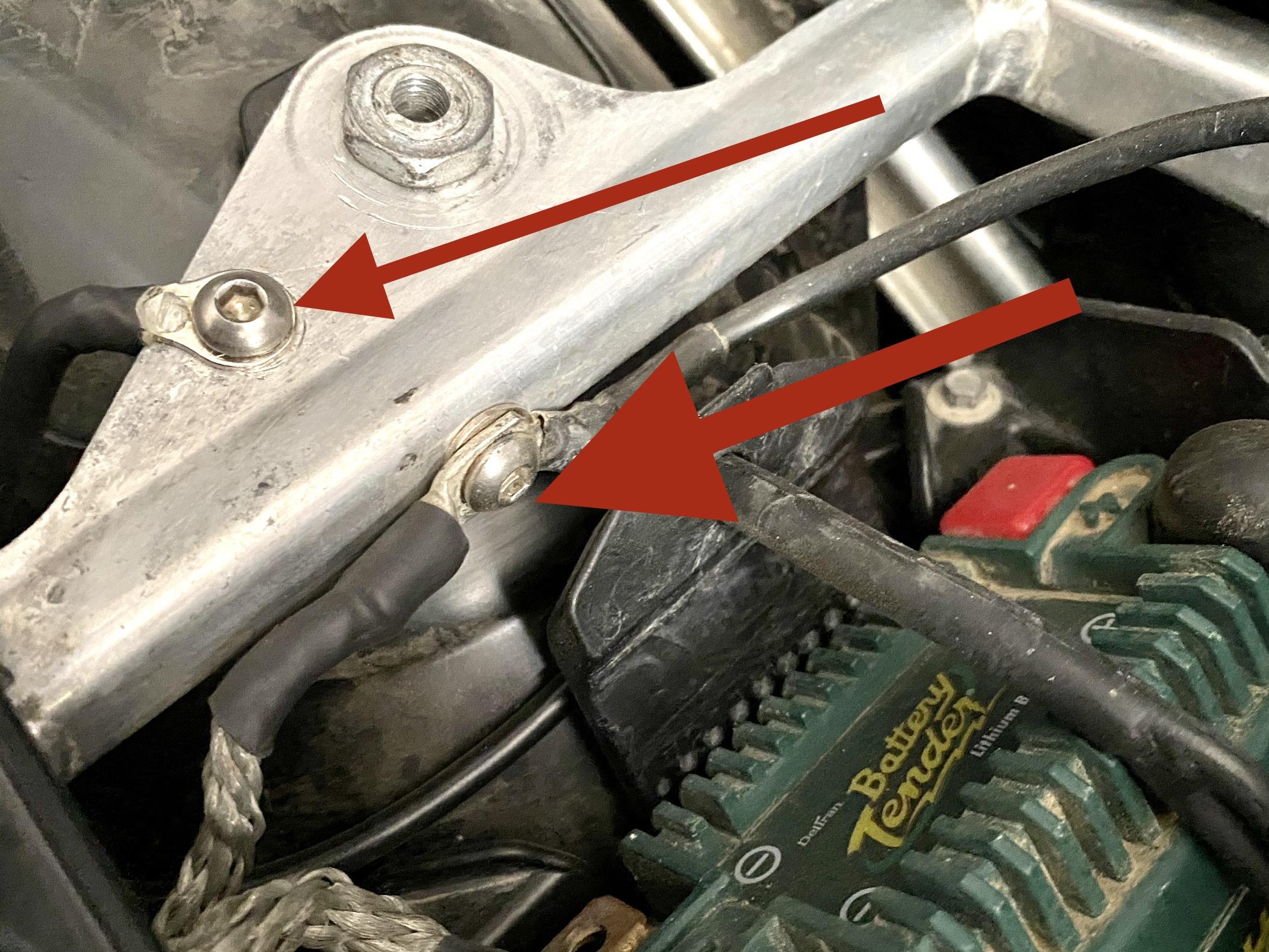
Heat causes metal expansion that breaks ground connections, creating intermittent electrical faults that kill your engine precisely when you need power most.
Inspect all ground connections with special attention to the frame-to-engine strap. Start at the battery negative terminal and follow each ground wire to its attachment point. Look for corrosion, loose bolts, or damaged wires—particularly where vibration and heat combine to loosen connections over time. Disconnect each ground connection, clean contact surfaces with a wire brush until shiny metal appears, apply dielectric grease, and torque to specification. Many riders solve hot-shutdown issues simply by tightening and cleaning the main engine ground strap.
Examine high-heat electrical connectors for hidden damage. Pull apart connectors for the CDI, coil, stator, and other ignition components. Look for green corrosion (especially in humid climates), bent pins, or loose female terminals that appear connected but have high resistance when hot. Heat accelerates connector degradation, and an apparently solid connection may fail under thermal expansion. Clean contacts with electrical contact cleaner, ensure each connector clicks fully into place, and secure with zip ties to prevent vibration-induced disconnection.
Test the kill switch circuit with precision. Set your multimeter to continuity mode and check resistance through the kill switch while cold—it should show near-zero resistance. Now heat the switch with a hair dryer while monitoring resistance; a good switch maintains low resistance throughout. If resistance spikes or the circuit opens when heated, replace the switch immediately. This test prevents misdiagnosis—you’d be surprised how many riders replace CDI units when a $15 kill switch was the actual culprit.
Prevent Future Hot-Shutdown Problems With Proactive Maintenance
Once you’ve fixed the immediate issue, implement these maintenance practices to prevent recurrence and ensure reliable trail performance.
Schedule carburetor service every 20-30 hours. Even with quality fuel, small particles accumulate in jets over time. Focus on the pilot circuit during each service, as this is where most heat-related shutdowns originate. Install an inline fuel filter to catch contaminants before they reach your carburetor. Pro tip: carry a spare pilot jet on long rides—swapping it takes five minutes and might save your day.
Maintain electrical connections with each oil change. At minimum maintenance intervals, disconnect and reconnect major electrical connectors, cleaning contacts as needed. Apply dielectric grease to prevent corrosion and ensure solid connections. Pay extra attention to grounds, which cause more intermittent electrical problems than any other component. Use anti-seize compound on ground strap bolts to prevent corrosion that creates resistance.
Use quality fuel and maintain cooling systems diligently. Old or low-octane fuel creates carburetor varnish that clogs jets. Use fresh fuel with correct octane rating and proper oil mix ratio. For liquid-cooled bikes, check coolant levels regularly and replace per manufacturer schedule. Inspect radiator fins for damage—bent fins reduce cooling efficiency, causing engine temperatures to rise faster and triggering heat-sensitive failures.
When your dirt bike shuts off when hot, remember that systematic troubleshooting beats random part replacement every time. Start by characterizing the failure pattern, then methodically test ignition, fuel, and electrical systems. Most hot-shutdown issues resolve with simple carburetor cleaning, connection tightening, or ignition component replacement. Once fixed, maintain your bike diligently to prevent recurrence. The satisfaction of diagnosing and fixing this classic dirt bike problem makes every frustrating shutdown worth it when you finally hear your engine purr reliably through a full ride.