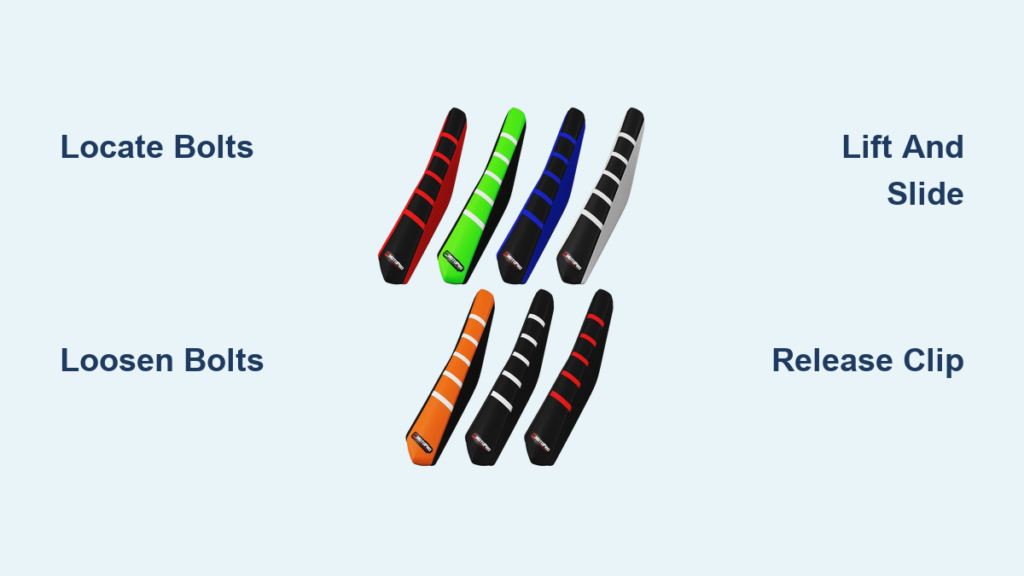
Your dirt bike seat feels stuck no matter how hard you pull? You’re not alone. Every rider faces this frustrating moment when trying to access the air filter after a muddy ride or perform basic maintenance. Knowing how to remove dirt bike seat properly separates casual riders from those who handle their own maintenance. The process seems simple but hides critical nuances—hidden mounting bolts, retention clips that require specific release techniques, and model-specific variations that can leave you wrestling with your motorcycle. Whether you’re cleaning your air filter, inspecting electrical components, or preparing for a wash, this guide gives you the precise steps to remove your seat efficiently every time.
The secret to successful seat removal isn’t brute force—it’s understanding the two-point mounting system used by nearly all dirt bikes. Most seats secure with two rear mounting bolts plus a front retention clip that engages with the gas tank. The real challenge comes in mastering the counterintuitive upward-then-backward motion required to release this front clip. Many riders waste valuable time yanking straight up when they should be lifting while simultaneously sliding the seat toward the rear fender. This guide walks you through every step—from identifying your specific bolt locations to handling stubborn seats on new motorcycles—and provides model-specific techniques so you never struggle with seat removal again.
Gather Essential Tools Before Starting
Having the right tools ready prevents frustration mid-procedure and ensures you don’t lose small components during seat removal. Most dirt bike seat extraction jobs require minimal equipment, but being unprepared can turn a five-minute task into a lengthy headache.
Select Proper Socket and Wrench Sizes
Your primary tool needs a properly sized socket or wrench for the mounting bolts—typically 8mm, 10mm, or 12mm depending on your motorcycle brand. Check your owner’s manual or visually inspect the bolts first to confirm the exact size. Using an ill-fitting tool risks rounding off bolt heads, creating a much bigger problem than simple seat removal. Keep both metric and standard sizes available if you’re uncertain, as some older models use imperial measurements.
Prepare Secondary Tools for Stubborn Seats
Maintain a flathead screwdriver within reach for seats that refuse to budge—this becomes your precision prying tool for releasing stiff retention clips without damaging plastic components. Needle-nose pliers prove invaluable for retrieving small washers or spacers that might fall during bolt removal. A clean rag prevents debris from entering the airbox once the seat comes off and helps wipe down mounting surfaces before reinstallation. Most experienced riders complete the entire process in under five minutes once familiar with their specific model, but first-timers should budget 10-15 minutes to avoid rushing critical steps.
Locate and Release Mounting Bolts Correctly

Finding and properly removing the mounting bolts represents the make-or-break step in successful seat extraction. Many riders struggle because these bolts hide in unexpected locations or serve dual purposes with aftermarket accessories.
Identify Bolt Placement on Your Specific Model
Most dirt bikes feature two primary mounting bolts positioned on the rear sides where the seat meets the frame, often precisely where the rear rack connects to side racks if your bike has accessories installed. KTM models typically use 10mm bolts, while Honda and Yamaha commonly employ 8mm hardware. Carefully inspect both sides before loosening anything—you’ll notice these bolts secure the seat to frame mounting points, not the seat itself. If your bike has a rear rack system, the same bolts may secure both the rack and seat.
Proper Bolt Loosening Technique
Loosen each bolt completely by turning counterclockwise, but don’t remove them entirely just yet. Back each bolt out two or three full revolutions—enough to clear the mounting points while keeping the bolt from getting lost. Some riders prefer loosening bolts just enough to manipulate by hand, which works well for routine maintenance. Pay close attention to any washers or spacers that might fall out during this process; note their original positions for correct reinstallation. Never force bolts that feel stuck—apply penetrating oil and allow it to work for 5-10 minutes before trying again.
Master the Critical Lift-and-Slide Motion
The actual seat extraction requires a specific combination of movements that feels unnatural to first-time users. Understanding this technique prevents damage to retention clips and saves you from unnecessary frustration.
Execute the Upward-Then-Backward Release
Grab the seat firmly by the sides at the rear section, then lift upward approximately one inch while simultaneously applying forward pressure toward the gas tank. This dual-direction motion releases the front retention clip from its mounting point. You’ll typically feel or hear a distinct “snap” as the clip disengages—this is the critical release moment many riders miss when simply pulling straight up. Once you feel this release, immediately slide the seat backward two inches toward the rear fender to fully disengage from the gas tank area.
Troubleshoot Common Motion Mistakes
If the seat doesn’t release on your first attempt, avoid the common mistake of pulling harder in the same direction. Instead, adjust your grip to the very rear corners of the seat and apply steady, increasing pressure while gently wiggling side to side. New motorcycles or seats that have never been removed often feel exceptionally tight because the retention clips haven’t been flexed yet—this is completely normal. Maintain consistent pressure for 5-10 seconds rather than jerking motions, which can damage plastic mounting tabs. The seat will typically work loose with patient, deliberate force.
Solve Stubborn Seat Removal Challenges
Some seats resist standard removal techniques, particularly on new motorcycles or those with stiff seat materials. When conventional methods fail, these specialized approaches safely release even the most stubborn seats.
Apply Controlled Screwdriver Prying
For seats that won’t budge, gently insert a long flathead screwdriver at the seat-to-gas-tank junction where the retention clip engages. Apply careful leverage with incremental pressure—never force the screwdriver abruptly. Work the tool gradually around the clip’s circumference while simultaneously applying upward seat pressure with your other hand. This metal-on-metal approach provides precise force application that pulling on plastic components cannot match. Many riders report that particularly stiff seats become progressively easier to remove after the first successful extraction as the clips loosen with use.
Adjust Force Application for Maximum Effectiveness
When standard lifting fails, concentrate your force application at the sides near the mounting points rather than pulling from the seat center. Rock the seat slightly from side to side while maintaining upward pressure—this lateral movement helps work stiff retention clips free. Some riders find success by applying downward pressure first to “reset” the clip engagement, then executing the standard upward-then-backward motion. Remember that patience pays off; excessive force rarely helps and often creates problems that didn’t exist before.
Remove KTM Seats Without Damage
KTM 250/350/450/505 SX-F and XC-F models follow universal removal principles but require specific techniques due to their uniquely stiff retention mechanisms. Knowing these model-specific nuances prevents unnecessary force that could damage mounting points.
Execute the KTM-Specific Removal Technique
Grab the seat by the absolute rear corners—where the seat meets the rear fender—then apply an upward wiggling motion while simultaneously pulling upward. Avoid lifting from the middle or front sections first, as KTM seats engage more firmly in these areas. Apply consistent, firm pressure while gently working the seat side to side; the retention clip will gradually release with deliberate effort. Some KTM riders report success by placing one hand under the seat’s front edge to help guide the release motion while pulling upward with the other hand.
Ensure Proper KTM Seat Reinstallation
KTM seats require deliberate force during reinstallation to ensure proper engagement. After positioning the seat, push down firmly—particularly at the rear mounting point—until you hear a distinct snap indicating full engagement with the rear fender nut and seat mounting point. Only after confirming this snap should you reinstall and tighten the mounting bolt. Skipping this firm downward pressure results in seats that feel loose or rattle during operation, requiring removal and reinstallation to correct.
Clear Rack Interference Issues Quickly

Aftermarket or factory-installed racks frequently block the necessary rearward sliding motion for seat extraction. Identifying and resolving rack interference prevents unnecessary frustration during removal.
Determine Rack Mounting Configuration
First, inspect whether your rack shares mounting points with the seat—common on dual-sport and adventure-style dirt bikes. If the rear rack connects to side racks using the same bolts securing the seat, simply removing these connection bolts on each side provides sufficient clearance. Some riders with minimal rack systems report that loosening these bolts rather than complete removal gives enough movement for successful seat extraction.
Remove Obstructive Rack Systems Temporarily
For full rack systems that completely block seat movement, temporary rack removal becomes necessary. Remove all mounting bolts securing the rack to the frame, set the assembly aside carefully, then proceed with standard seat removal. While this adds time to the job, it provides complete clearance and prevents damage from forcing components. Reinstall the rack after seat reinstallation, ensuring all mounting hardware is properly torqued to prevent vibration-related issues during riding.
Reinstall Seat to Prevent Rattles and Damage
Proper seat reinstallation ensures secure fitment and prevents annoying rattles or premature hardware wear. The process reverses removal but requires attention to specific alignment points many riders overlook.
Align and Engage Retention Clips Properly
Position the seat so the front mounting point aligns precisely with the gas tank receiver. Slide the seat forward slightly to engage this connection, then push down firmly—particularly at front and rear mounting points—until you hear or feel the retention clip snap into place. This snap confirms full engagement; skipping this step results in loose seats that shift during aggressive riding. Apply downward pressure with the heel of your hand for maximum effectiveness, focusing on the seat’s rear mounting point where engagement often fails.
Torque Mounting Bolts to Manufacturer Specifications
Reinstall and tighten mounting bolts to the manufacturer’s specified torque settings—typically 8-10 Nm for most dirt bikes. Overtightening risks stripping frame threads or cracking plastic mounting tabs, while undertightening allows seat movement during operation. If you lack a torque wrench, tighten bolts until snug without resistance, then apply approximately a quarter-turn more. Double-check bolt tightness after your next ride, as vibrations can sometimes loosen hardware during initial operation.