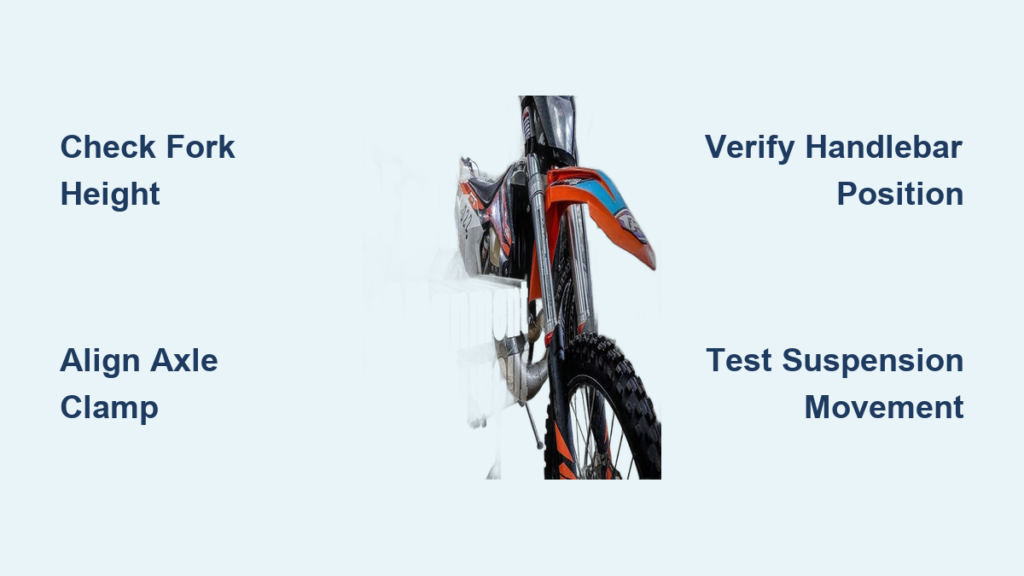
Your dirt bike pulls to one side during hard braking, feels vague in corners, or develops annoying seal leaks after a simple tire change. These frustrating issues often trace back to one overlooked maintenance task: dirt bike fork alignment. When your front forks sit perfectly parallel, your suspension operates as designed, steering stays predictable, and components last significantly longer. Misaligned forks bind during compression, causing premature wear on bushings, seals, and axle clamps that can cost hundreds in repairs. Whether you’ve just changed your front tire or survived a hard crash, mastering fork alignment techniques gives you the confidence to diagnose and fix these problems yourself. This guide covers proven methods from basic home mechanics to factory race team procedures that ensure your front end works flawlessly.
Front-end misalignment happens more often than riders realize—especially after routine wheel removal. The complex interplay between fork tubes, triple clamps, axle, and wheel means even minor disruptions affect handling dramatically. Professional mechanics emphasize that proper alignment isn’t just for post-crash repairs; it’s essential after every tire change. The good news? Most alignment procedures require only basic tools and mechanical aptitude. By the end of this guide, you’ll know exactly how to verify and correct fork alignment using techniques that work on any dirt bike model.
Essential Tools for Precision Fork Alignment

Skipping proper tools guarantees frustration during fork alignment. Having these specific items ready makes the process significantly faster and more accurate.
Must-have hand tools include a complete metric socket set with 8mm, 10mm, and critical 32mm sockets for steering stem nuts. You’ll need open-end wrenches for axle nuts, large hex keys for pinch bolts, and a small flathead screwdriver for the screwdriver alignment method. Don’t attempt this job with worn or incorrect tools—damaged fasteners complicate alignment exponentially.
Torque wrench non-negotiables separate proper mechanics from casual riders. Most manufacturers specify precise torque values: top triple clamp bolts at 18-20 ft-lbs, lower clamps at 14-15 ft-lbs, and axle nuts at 75 ft-lbs. Under-torquing risks component failure mid-ride, while over-torquing distorts clamps and causes binding. Invest in a quality click-type torque wrench—it pays for itself by preventing costly repairs.
Support equipment checklist requires either a rear stand that lifts the front wheel completely off the ground or a helper who can hold the bike upright. Proper suspension movement during alignment procedures is impossible with the front tire bearing weight. For inverted forks like WP 48s, additional tools include calipers for precise fork height measurement and a straightedge to verify handlebar mount straightness.
Critical Pre-Alignment Inspection Checklist
Rushing into alignment without inspection wastes time—often fixing symptoms rather than causes. This 3-step inspection identifies damage that would sabotage your alignment efforts.
Visual damage assessment starts with examining fork tubes for dents or bends by rolling the bike forward slowly while watching for wobble. Inspect axle clamp areas on lower legs for mushrooming—a common issue when hammering axles during installation. Check triple clamps for hairline cracks around pinch bolt holes, which compromise alignment stability. Pro tip: shine a flashlight across surfaces at a low angle to reveal subtle deformations invisible under normal lighting.
Bushing and seal inspection requires grabbing each lower fork leg near the axle and attempting to move it side-to-side. Any noticeable play indicates worn bushings that must be replaced before alignment. While seal leaks often get blamed on misalignment, experts confirm forks need extreme misalignment plus 50,000+ miles of wear before binding causes leaks. Most seal issues stem from contaminated fork tubes or dried mud—clean thoroughly before assuming alignment problems.
Component straightness verification uses a simple straightedge against handlebar mounts. Remove bars and lay them on a glass surface, rotating to check for consistent contact. Bent mounts cause handlebar misalignment even with perfect fork positioning. For triple clamps, place them on a machined surface plate (or high-quality granite countertop) to check for warping—any rocking indicates distortion requiring professional straightening.
Fork Height Setup: The Foundation of Proper Alignment
Incorrect fork height in triple clamps creates handling imbalances that mimic serious alignment issues. Getting this right prevents wasted effort on unnecessary adjustments.
Precise height measurement requires calipers or digital rulers to measure from the top of the upper triple clamp to the fork tube top. Both sides must match within 1mm—even 2mm difference creates noticeable handling quirks. The owner’s manual specifies exact dimensions, but consistency matters more than absolute values. Set height with top clamp bolts finger-tight, then verify after final torque.
Critical orientation details include positioning bleed screws forward for easy air bleeding and ensuring directional markings on fork caps face outward. For inverted forks like WP units, align the “FRONT” markings correctly—a common oversight during reassembly. Misoriented components create subtle binding that affects suspension action.
Clamp torque sequence mistakes cause more alignment failures than any other factor. Always tighten top clamp bolts first to 18.3 ft-lbs using an alternating pattern, then lower clamp bolts to 14 ft-lbs. Warning: over-torquing lower pinch bolts by just 5 ft-lbs pre-loads the fork tube, creating mid-stroke harshness that feels like binding. Use a torque wrench—never guess.
Axle Clamp Alignment: Three Proven Techniques
These factory-tested methods eliminate the most common fork alignment issue—binding at the front axle—using techniques ranging from simple to race-prep precision.
The Screwdriver Method for Quick Binding Fixes
This technique provides immediate visual confirmation of proper alignment and works on most dirt bike models.
Begin by setting identical fork heights and tightening top clamp bolts to 18 ft-lbs, lower clamps to 15 ft-lbs. Install the wheel and axle, tightening the axle nut to 75 ft-lbs (use one right-side pinch bolt if axle spins). Tighten left-side pinch bolts to 17 ft-lbs, then loosen right-side pinch bolts completely. Insert a small flathead screwdriver into the right axle clamp slot to slightly open the hole. Push and pull the right fork leg—it will settle into its natural position without binding. Remove the screwdriver and torque right-side bolts to 17 ft-lbs.
Critical pre-check: inspect the axle end and clamp hole for burrs. Hammer-damaged axles or mushroomed clamp holes cause binding regardless of technique. Use a deburring tool to clean edges before alignment.
Dynamic Braking Method for Perfect Parallel Position
Factory teams use this technique because braking forces naturally align forks during real-world operation.
With the bike on a stand, install forks at equal height with bleed screws forward. Torque top clamp bolts to 220 in-lbs in alternating pattern, lower clamps to 168 in-lbs. Install the wheel (pry brake pads apart first if needed), tighten axle nut fully. Spin the wheel and abruptly apply the front brake 5-6 times. Release brake and torque left-side (caliper side) pinch bolts. Spin again, brake abruptly, then torque right-side pinch bolt.
This method ensures forks find their natural parallel position through dynamic forces similar to actual riding conditions. Time required: under 5 minutes with practice.
Factory Race Team Centering Technique
Nick Saylor, mechanic for FMF KTM Factory Racing, uses this foolproof method for championship-level precision.
With all four fork lug pinch bolts loose, install axle through fork lugs and wheel. Torque the axle normally while observing the left side. When properly torqued, the axle end should sit flush with the fork lug—neither sunken nor protruding. This flush position confirms the wheel is centered between fork legs. Only then tighten all pinch bolts to spec.
Saylor avoids methods that tighten one side first then compress forks, calling them “inconsistent for race applications.” This centering technique provides repeatable results critical for professional racing.
Triple Tree Alignment for Twisted Front Ends

When your handlebars point left while the wheel tracks right, you’ve got triple tree misalignment—a common result of hard crashes that requires specific correction.
Proper loosening sequence starts with the top triple tree nut (may require removing handlebars). Loosen until finger-tight—enough to free movement but not so loose that components flop. Next, loosen lower triple clamp bolts, fender bolts, caliper bolts, axle pinch bolts, and axle. Critical: never loosen top triple clamp bolts—they must remain tight to support the front end.
Alignment execution requires the bike upright. Have a helper hold the rear vertically or use a stand. Stand on pegs and forcefully compress the suspension 5-6 times—like performing mechanical CPR. The fork tube length and tight clamp fit naturally guides components back into alignment. This mechanical action eliminates the “twist” between upper and lower clamps.
Correct reassembly order begins with lightly snugging the top triple nut to stack bearing-preload collars properly. Then gently tighten lower clamp bolts, fender bolts, calipers, axle, and pinch bolts. Finally, go back through everything with a torque wrench in manufacturer-specified sequence. Skipping this order reintroduces twisting.
WP Inverted Fork Special Alignment Procedures

Modern WP 48 forks rarely bend but develop unique alignment challenges requiring specialized techniques.
With the wheel off, reinstall the axle through fork clamps—it should slide through smoothly. If not, adjust right fork height until axle glides freely. This pre-alignment step simplifies final positioning. Pry brake caliper pistons fully open before wheel installation and leave them extended during alignment.
Tighten upper triple clamp bolts firmly but keep lowers snug—not fully tight. Address the right axle clamp last: push and pull the fork along the axle to feel for binding. With brakes open and axle pre-aligned, movement should be smooth. Center the fork in its travel range, then tighten. Only after final tightening should you pump up the brakes and recheck handlebar mounts.
Post-Alignment Verification Protocol
Never ride without verifying alignment—these 4 checks confirm your work succeeded.
Visual wheel centering check positions the bike on level ground. The front wheel should sit perfectly centered between fork tubes with equal clearance on both sides. From the front, imagine a line from fender tip through axle center—it should align precisely with wheel center.
Handlebar-wheel alignment requires straight handlebars when the front wheel points directly forward. Steering should move smoothly lock-to-lock without binding. Any tight spot indicates residual misalignment or damaged steering bearings.
Suspension movement test compresses each fork independently. Both sides should offer identical resistance and rebound speed. Binding on one side means repeating the alignment process—don’t ignore this warning sign.
Test ride progression starts with slow-speed figure-eights to check for pulling. The bike should track straight during progressive braking. Cornering should feel predictable with even front-end feedback. If issues persist, revisit the alignment process before assuming component damage.
Long-Term Fork Alignment Maintenance
Proper alignment isn’t a one-time fix—it’s an ongoing maintenance practice that extends component life.
Routine inspection schedule includes checking pinch bolt torque after every hard ride and verifying fork height during tire changes. Any time the front wheel comes off, perform a quick alignment check—this prevents 90% of handling issues.
Component protection measures involve installing fork guards to prevent rock damage, cleaning fork tubes after muddy rides (dried mud compromises seals), and addressing seal leaks immediately to prevent bushing contamination.
Maintenance documentation records fork height settings, torque values used, and any anomalies noticed during procedures. This history helps identify developing problems early—like gradually increasing binding indicating bushing wear.
Mastering dirt bike fork alignment transforms your riding experience. These techniques prevent costly repairs while ensuring your suspension performs exactly as designed. When your front end works flawlessly, you’ll notice immediate improvements in handling precision and confidence through challenging terrain. The next time you pull that front wheel for a tire change, take the extra 10 minutes to verify alignment—you’ll reap the rewards every time you twist the throttle.