You’re considering a motor scooter but overwhelmed by the options? You’re not alone. With everything from tiny 50cc city runabouts to 750cc maxi-tourers, motor scooter types span a surprisingly wide spectrum. Whether you’re a beginner seeking an affordable commuter or a seasoned rider wanting weather-protected highway capability, there’s a scooter designed for your needs.
Unlike traditional motorcycles, scooters offer step-through frames, automatic transmissions, and built-in storage, making them ideal for urban mobility, errands, and even long-distance travel. This guide breaks down every major motor scooter type by size, purpose, design era, and performance, so you can choose the right one with confidence.
Scooter Design Fundamentals
Step-Through Frame Advantage
The defining trait of any scooter is its step-through frame. Unlike motorcycles that require you to straddle the tank, scooters let you swing your leg over and stand or sit with ease. This design improves low-speed stability, especially when stopping at traffic lights. It also allows for a flat floorboard, giving riders room to stretch legs, carry bags between their feet, or even wear non-riding footwear.
This architecture works because the engine and drivetrain are typically mounted on the rear axle or tucked under the seat. That means no bulky frame tubes between your legs, just open access and rider-friendly ergonomics.
CVT: The Twist-and-Go Transmission
Modern scooters use Continuously Variable Transmission, which eliminates clutch work and gear shifting. Just twist the throttle and go. Inside, a belt-driven system automatically adjusts ratios based on speed and load, delivering smooth acceleration without jerks or shifts.
This makes scooters ideal for stop-and-go traffic. No stalling, no missed gears, just seamless power delivery. Some premium models like the Honda Forza 750 add Dual Clutch Transmission, offering paddle shifters for manual control while retaining clutchless operation.
Integrated Storage and Bodywork
Scooters come with built-in storage, usually under the seat. Smaller models fit a helmet or groceries. Maxi-scooters can swallow two full-face helmets. Some include front glove boxes or legwell compartments.
Full bodywork conceals mechanical parts, protecting them from weather and debris. It also adds aerodynamic efficiency and gives scooters their sleek, clean look. Unlike exposed motorcycles, scooters keep oil and chain grime out of sight and off your clothes.
Historical Scooter Generations
Early Innovations (1894–1914)
The roots of the scooter go back to the Hildebrand and Wolfmuller (1894), the first mass-produced motorized two-wheeler. It had a step-through design, low-mounted engine, and rod-driven rear wheel. Though it only reached 25 mph, its layout foreshadowed modern scooters.
The Auto-Fauteuil (1902) took a radical approach with an armchair-style seat, blending comfort with early motorization. These pioneers proved the concept but were too expensive or unreliable for mass adoption.
First Wave: 1915–1930
The Autoped (1915) was likely the first true motor scooter. Made in New York and Germany, it used a handlebar column to engage the engine. Push forward to go, pull back to brake. Compact and portable, it appealed to urban workers.
Other early entrants included the Skootamota, known for economy, and the Reynolds Runabout, which featured front suspension and a two-speed gearbox. By the mid-1920s, most failed due to poor build quality or high cost.
Second Generation: 1936–1965
The Salsbury Motor Glide (1936) introduced the first CVT transmission, setting the template for modern scooters. Its enclosed drivetrain and rear-mounted engine improved reliability and ease of use.
Cushman became a major US player, producing fuel-efficient scooters like the Auto Glide Model 53, which was parachute-dropped for Army troops. Meanwhile, Japan’s Fuji Rabbit (1946) and Mitsubishi Silver Pigeon used surplus aircraft parts to launch post-war mobility.
Third Generation: Vespa and Lambretta Era
Post-WWII Europe saw the rise of the iconic Piaggio Vespa (1946), designed by aircraft engineer Corradino D’Ascanio. Its monocoque steel body, rear engine, and protective leg shield made it practical and stylish. The name came from “Sembra una vespa,” meaning “It looks like a wasp.”
The Innocenti Lambretta (1947) followed, offering shaft drive and later chain-driven swingarm engines. Both brands were licensed globally, from Messerschmitt in Germany to Bajaj in India, sparking a scooter revolution.
German brands like Heinkel Tourist and Zundapp Bella built heavy, reliable touring scooters capable of 70 mph. The UK produced the Triumph Tigress, a 250cc twin with a 4-speed gearbox. These models proved scooters could be serious transportation.
Classification by Engine Size
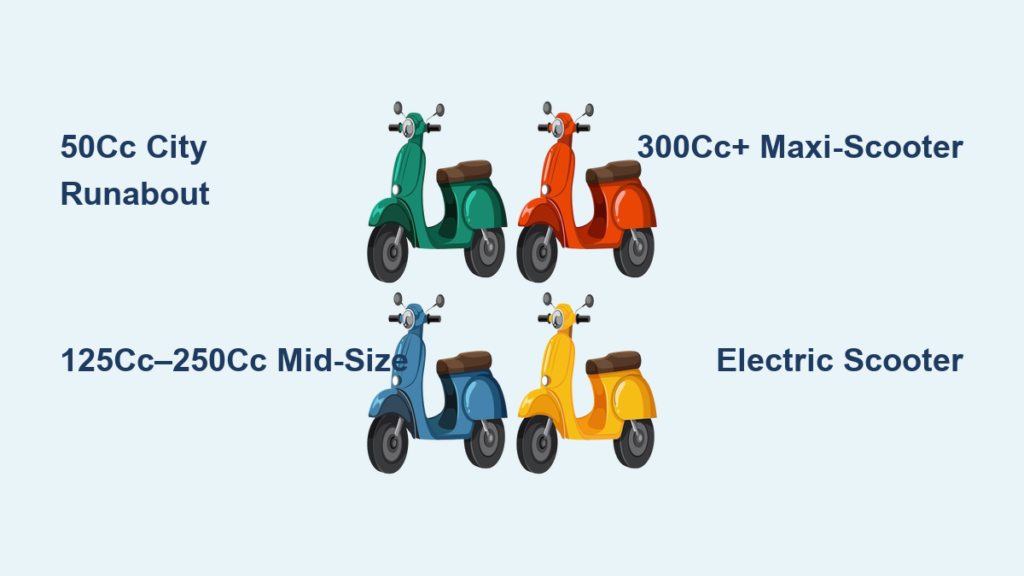
50cc Micro Scooters
Perfect for city commuting, 50cc scooters are often classified as mopeds. In many places, they require no motorcycle license, just insurance and registration.
• Top speed: 30–40 mph
• Fuel economy: 100+ mpg
• Ideal for: Short commutes, learners, campus travel
Popular models include the Honda Metropolitan, Yamaha Zuma 50, and Honda Ruckus (49cc). The Ruckus stands out with rugged styling, fat tires, and a low 28.8-inch seat height, great for shorter riders.
Emissions Note: Two-stroke 50cc engines emit 10–30 times more pollution than cars. Many cities like Genoa and Shanghai have banned them. Four-stroke versions are cleaner and more common today.
125cc–250cc Mid-Size Scooters
This is the sweet spot for most riders. These scooters handle city streets and highways with ease.
• Top speed: 50–70 mph
• Fuel economy: 80–100 mpg
• Ideal for: Daily commuting, delivery work, mixed traffic
Top performers include the Honda PCX 150 (liquid-cooled, fuel-injected, ABS-equipped), the Yamaha Zuma 125 (rugged build, high resale value), and the Aprilia SR 50 R Factory (sporty styling, sharp handling). The Triumph Tigress 250cc twin once hit 70 mph, proof that mid-size scooters can deliver real performance.
300cc+ Maxi-Scooters
Built for long distances, maxi-scooters rival touring motorcycles in comfort and tech, but without the clutch.
• Top speed: 90–110+ mph
• Weight: 200kg+
• Features: Full fairings, cruise control, heated grips, DCT, smartphone connectivity
Entry-level used maxi-scooters include the Suzuki Burgman 650 (2005–2012), durable and low maintenance, and the Honda Silverwing 600, smooth and reliable. Mid-range options include the Honda Forza 350 (ABS, traction control, large windscreen), Yamaha X-Max 300 (sporty handling, premium feel), and BMW C400 GT, called a “two-wheeled armchair” with heated grips and keyless start.
Premium touring models include the Honda Forza 750 DCT (745cc engine, dual-clutch transmission, riding modes) and Yamaha T-Max 560 (110 hp, sport-touring agility, top-tier brakes). These scooters handle motorways effortlessly and offer superior weather protection, ideal for year-round riding.
Specialized Scooter Types
Adventure and Off-Road Scooters
Blending scooter convenience with adventure bike looks, these models feature higher ground clearance, upright riding position, and rugged tires and suspension.
The Honda ADV 160 and ADV 350 lead this category. The ADV 350 has a 330cc engine, ABS, and enough power for gravel paths. It is not a dirt bike, but perfect for urban explorers wanting a tougher look.
Retro and Classic Styles
Nostalgia sells. These scooters mimic 1950s–60s designs with modern reliability.
• Vespa Sprint and Primavera: Steel body, round headlight, Italian flair
• LML Stella: Modern version of the classic P-series, available in 2-stroke or 4-stroke
• SYM Symba: Affordable retro styling, air-cooled engine
They are slower than modern scooters but turn heads and build community.
Three-Wheel Scooters
For added stability, especially in slippery conditions, three-wheelers are growing in popularity.
• Piaggio MP3: Tilting front wheels for cornering stability
• Yamaha Tricity: Lean-steer design, great for city riding
• Honda Gyro Canopy: Rare, enclosed trike with weather protection
These are ideal for riders with balance concerns or those carrying cargo.
Minimalist and Rugged Designs
The Honda Ruckus is the king of this category. With its exposed frame, industrial look, and 49cc engine, it is built for urban survival. Low seat, fat tires, and a tiny turning radius make it perfect for weaving through traffic.
It is not fast, but it is fun, affordable, and nearly impossible to park badly.
Electric Scooter Revolution
Why Go Electric
Electric scooters are surging, especially in Asia and Europe. Benefits include lower operating cost (one-sixth the cost per mile versus gas), zero emissions (no tailpipe pollution), quiet operation (minimal noise), and instant torque (quick acceleration from stop).
China already bans petrol scooters in cities like Shanghai. India expects 74% of scooter sales to be electric by 2040.
Top Electric Models
• NIU NQi Series: Long range, smart features, app connectivity
• Zero Motorcycles FXE: Off-road capable, dual-sport style
• Vmoto SOCO TS and TC: Affordable, stylish, growing global presence
Battery range varies (40–100 miles), and charging takes 3–8 hours. For city use, they are unbeatable.
Buying Guide: How to Choose
Match Scooter to Your Needs
Ask yourself these questions before buying. Where will you ride? City only means 50cc or electric. Highways means 250cc+. How far? Short trips call for a small scooter. Long commutes call for a maxi-scooter. Storage needs? Check under-seat space if you carry a helmet or groceries. Comfort? Tall riders should look for adjustable seats or higher models.
Avoid Common Mistakes
Do not start with a 750cc T-Max. They are heavy (500+ lbs), expensive to insure, and hard to pick up if dropped. Do not ignore seat height. If you cannot plant both feet, confidence drops. Test ride with full gear. Do not skip inspection. Used scooters may have worn belts, frame damage, or accident history. Pay around $100 for a Pre-Purchase Inspection.
Test Ride Checklist
Wear full gear (helmet, jacket, gloves, boots). Check low-speed handling in a parking lot. Ride at highway speed if applicable. Test brakes, both normal and emergency stops. Assess comfort after 30+ minutes. Listen for unusual noises like belt squeal or suspension clunks.
Ownership Costs and Maintenance
Upfront Pricing (New)
• Entry-level: $2,149–$2,999 (Ruckus, SYM Symba)
• Mid-range: $3,000–$4,700 (PCX 150, Zuma 125)
• Premium: $6,400+ (X-Max, Forza 750)
Long-Term Costs (Annual)
• Insurance: $300–$800 (depends on age, location, model)
• Service: $200–$500 (oil, filter, belt, rollers)
• Tires: $200–$400 per set (last 15,000–20,000 miles)
• Gear: $750–$1,500 (helmet, jacket, gloves, boots)
• Depreciation: $1,000+ in first year for premium models
Warning: A $4,000 scooter can cost over $55,000 in lifetime ownership if you factor in 20+ years of gear, fuel, and maintenance.
Maintenance Tips
Replace CVT belt and rollers every 15,000–20,000 miles. Check tire pressure monthly because small wheels lose pressure faster. Flush coolant every 2–3 years on liquid-cooled models. Clean air filter regularly, especially in dusty areas.
Japanese brands (Honda, Yamaha) are known for long-term reliability. German classics (Heinkel, Zundapp) were legendary for durability.
Final Recommendations
Best for Beginners
The Honda Metropolitan 50 offers a low seat, light weight, quiet engine, easy handling, cheap running costs, and fits in small garages. It is great for campus and city riding.
Best for Daily Commuting
The Honda PCX 150 delivers fuel efficiency, reliability, ABS, large under-seat storage, smooth CVT, and handles highway speeds with ease.
Best for Long-Distance
The Honda Forza 750 or Yamaha T-Max 560 offer touring comfort, cruise control, weather protection, powerful engines, advanced electronics, and high resale value.
Best Value (Used)
The Suzuki Burgman 400 or 650 provides durable, simple mechanics, large fairing, lower cost than newer rivals, and excellent fuel economy for size.
Best for Style and Nostalgia
The Vespa Primavera 150 delivers iconic Italian design, steel body, premium finish, strong community, and strong resale value.
Frequently Asked Questions About Motor Scooter Types
What is the difference between a scooter and a motorcycle?
The main difference is the step-through frame. Scooters have a flat floorboard where riders place their feet, while motorcycles require you to straddle the tank. Scooters also typically have automatic transmissions (CVT) and built-in storage under the seat.
Do I need a license to ride a 50cc scooter?
Requirements vary by location. In many US states and European countries, 50cc scooters are classified as mopeds and may not require a motorcycle license. However, you typically need insurance and registration. Check your local regulations.
Are scooters good for highway riding?
Smaller scooters (50cc–125cc) are not suitable for highways. Mid-size scooters (125cc–250cc) can handle highway entry speeds. Maxi-scooters (300cc+) are designed for highway travel, with top speeds of 90–110+ mph and features like windshields and fairings for weather protection.
How long do scooter engines last?
With proper maintenance, scooter engines can last 100,000+ miles. Japanese brands like Honda and Yamaha are particularly known for longevity. Regular oil changes, belt replacements, and valve adjustments extend engine life significantly.
Are electric scooters worth it?
Electric scooters offer lower operating costs (about one-sixth the cost per mile of gas), zero emissions, and quiet operation. They are ideal for city commuting. However, range limitations (typically 40–100 miles) and charging time (3–8 hours) make them less suitable for long-distance travel.
What is the best scooter for a beginner?
The Honda Metropolitan 50 or Honda Ruckus are excellent for beginners. They are lightweight, easy to handle, have low seats, and are affordable to operate. The Honda PCX 150 is also a great option if you need highway capability.
Key Takeaways for Choosing Motor Scooter Types
The world of motor scooter types is more diverse than ever. From 50cc runabouts to 850cc electric tourers, there is a scooter for every rider, budget, and lifestyle. Focus on engine size, ergonomics, and intended use when making your decision.
Always test ride before buying. Check that you can plant both feet flat on the ground with full gear. Verify storage capacity fits your helmet and daily needs. Consider the total cost of ownership, not just the purchase price.
With the right choice, your scooter will not just be transportation. It will be freedom.