You’ve seen the bold claims: “90 miles on a single charge!” But when you actually ride your electric scooter, the battery dies far sooner than promised. You’re not alone. Most riders quickly discover that the average real-world range of electric scooters falls between 15 to 50 miles—a significant drop from advertised figures. Whether you’re commuting, running errands, or exploring your city, understanding true range is essential for avoiding mid-ride shutdowns and maximizing value.
This gap exists because manufacturers test under ideal lab conditions: light riders, flat roads, slow speeds, and perfect weather. Real life brings hills, traffic, wind, heavier loads, and winter chills—all of which slash battery life. In fact, expect 30% to 50% less range than what’s listed on the box. A scooter claiming 40 miles may only deliver 20–28 miles in daily use.
Why Advertised Range Differs From Reality

Lab Conditions vs. Real-World Riding
Manufacturers calculate maximum range using unrealistic standards: a 130–165 lb rider, flat terrain, constant 9–12 mph speed, eco-mode, and perfect 70°F weather. There are no stops, no hills, and no wind. Under these conditions, even modest scooters can stretch their batteries to extremes.
But real-world riding includes stoplights, acceleration bursts, uphill climbs, and variable speeds. These factors dramatically increase power draw. For example, a scooter tested at 40 miles in ideal conditions typically delivers only 24–28 miles in mixed urban environments. Stop-and-go traffic alone reduces efficiency by 15–25% compared to steady cruising.
Some brands now offer ride-mode-specific estimates (eco vs. sport), but “up to” ranges remain misleading. Always assume the advertised number is best-case and plan accordingly.
Estimating Your Actual Range
A reliable rule: subtract 30% from the manufacturer’s claim to estimate real-world usability.
• Claimed 40 miles → Realistic: ~28 miles
• Claimed 60 miles → Realistic: ~42 miles
• Claimed 90 miles → Realistic: ~50–60 miles (optimal conditions only)
This buffer accounts for rider weight, terrain, temperature, and riding style. If you’re over 180 lbs or live in a hilly area, consider subtracting up to 50%.
Key Factors That Reduce Scooter Range

Speed and Wind Resistance
Speed is the biggest drain on battery life. Energy consumption rises exponentially with velocity due to wind resistance. At 15 mph, a scooter might use 14 Wh/mile. But at 25 mph, that jumps to 20–22 Wh/mile—a 50% increase in energy use for just 10 mph more.
Pro tip: Riding at 20 mph instead of 25 mph can extend your range by 20–30% without significantly increasing travel time. Use cruise control when available to maintain steady speeds.
Rider Weight and Cargo Load
Standard tests assume a rider under 165 lbs. Heavier riders increase motor load, especially during acceleration and uphill climbs. Riders over 200 lbs can expect a 10–25% reduction in range.
Backpacks, groceries, or towing accessories add further strain. Combined loads over 250 lbs may cut range by up to 30%, depending on motor power and battery size.
Hills and Elevation Changes
Even small inclines demand extra energy. A half-mile hill at 5% grade can consume 10% of your total battery. While regenerative braking recovers some energy on the way down, it typically returns only 10–20% of what was used to climb.
If your route includes frequent elevation changes, prioritize scooters with dual motors, high torque, and large batteries (1000Wh+).
Riding Style and Traffic Patterns
Aggressive acceleration pulls massive power from the battery. Frequent stops and starts—common in city traffic—reduce efficiency by 15–25% compared to smooth, consistent riding.
To maximize range, use gentle throttle control, enable eco-mode, use kick-to-start to get moving before engaging the motor, and maintain momentum through intersections when safe.
Cold Weather and Battery Performance
Lithium-ion batteries lose efficiency in cold temperatures. At 41°F (5°C), expect a 15–25% drop in range. Below freezing, losses can exceed 30%, and charging becomes slower.
Best practices for cold climates:
• Store your scooter indoors
• Pre-warm the battery before riding
• Avoid full discharges in winter
• Plan shorter trips or carry a spare battery
Battery Capacity: The True Measure of Range

Why Watt-Hours Matter More Than Miles
When comparing scooters, watt-hours (Wh) is the most accurate predictor of range. It measures total energy stored in the battery. Unlike mileage claims, Wh is a fixed, comparable number.
General Wh-to-range benchmarks:
• 250Wh → 15–20 miles
• 360Wh → 17–18 miles
• 500–600Wh → 25–30 miles
• 800–1000Wh → 25–35 miles
• 1200Wh+ → 30–50+ miles
• 2300Wh+ → 50–55+ miles (real-world aggressive riding)
For most commuters, a 500–700Wh battery covers daily needs. Long-distance riders or those in hilly areas should aim for 1000Wh or higher.
How to Calculate Watt-Hours
If Wh isn’t listed, calculate it using this formula: Voltage (V) × Amp-hours (Ah) = Watt-hours (Wh). Example: A 48V 10Ah battery equals 480Wh.
Always verify Wh from trusted reviews—some brands inflate specs.
Top Scooters by Real-World Range
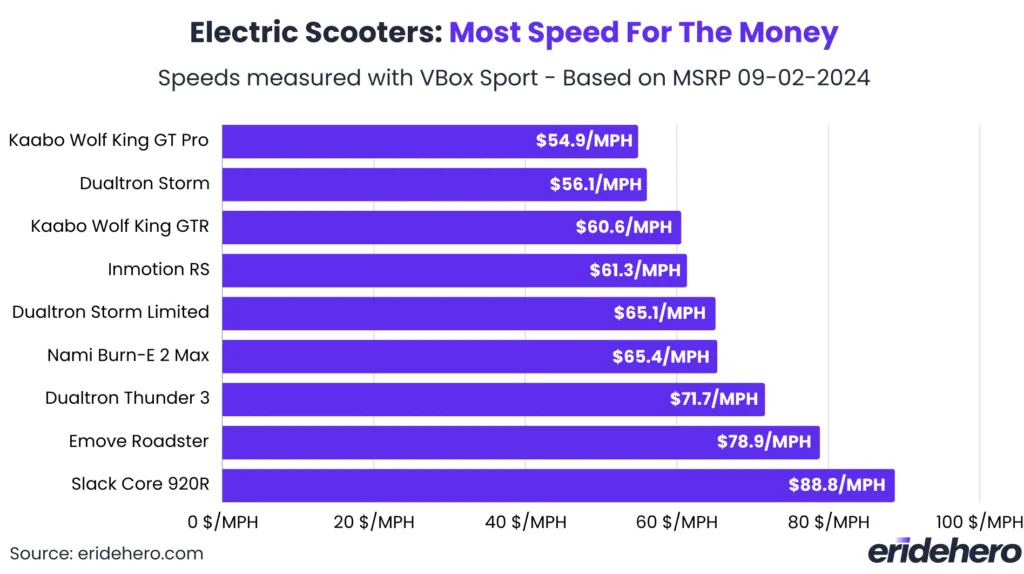
Best Entry-Level Commuters (15–28 Miles)
These scooters balance affordability, portability, and practical range for short trips.
TurboAnt X7 Max offers 18 miles tested range with a 360Wh swappable battery. Weight is 34.6 lbs and top speed reaches 30 mph. Best for budget riders needing quick battery swaps.
Apollo Air Pro delivers 17.7 miles with a 374Wh battery. Weight is 37.3 lbs and top speed is 30.3 mph. Best for safety-focused urban commuting.
Segway Ninebot Max provides 28 miles tested range with a 551Wh battery. Weight is 43.4 lbs and top speed reaches 30 mph. Best for reliable daily commutes that often exceed claims.
Fluid FreeRide Horizon achieves 26 miles with a 624Wh battery. Weight is 40.8 lbs and top speed is 35.1 mph. Best for hill climbing on a budget.
Best Mid-Range Performers (25–47 Miles)
Ideal for longer commutes, varied terrain, or riders who want extra range without extreme cost.
EMOVE Cruiser S leads with 47 miles tested range from a massive 1560Wh LG 21700 cell battery. Weight is 59 lbs and top speed is 37 mph. Best for long-distance commuters with best-in-class real-world range.
VMAX VX4 GT delivers 32.1 miles with a 504Wh battery. Weight is 47 lbs and top speed reaches 37.7 mph. Best for portability with solid range.
GOTRAX GX2 offers 24.7 miles on hilly terrain from a 960Wh battery. Weight is 76 lbs and top speed is 30 mph. Best for riders in hilly areas needing dual motors.
Solar P1 3.0 achieves 27.7 miles with estimated 800Wh capacity. Weight is 67.2 lbs and top speed reaches 41.5 mph. Best for speed seekers under $1,300.
Best High-Performance Long-Range (40–55+ Miles)
Built for extreme distance, off-road use, or riders who refuse to charge daily.
Nami Burn-E 2 Max delivers 50 miles tested with a 2304Wh (72V 32Ah) battery. Weight is 103 lbs and top speed reaches 60 mph. Best for ultra-long rides with massive battery capacity.
Kaabo Wolf King GT achieves 55 miles tested from a 2520Wh battery. Weight is 125.7 lbs and top speed hits 98 mph. Best for power and range, though overkill for city use.
Kaabo Mantis V2 offers 45+ miles in eco mode from a 1470Wh battery. Weight is 55 lbs and top speed reaches 40 mph. Best for balanced performance with strong efficiency.
Apollo Phantom V2 delivers 28.4 miles from a 1216Wh battery. Weight is 71.7 lbs and top speed reaches 63 mph. Best for sport riders wanting suspension and speed.
How to Maximize Your Scooter Range

Optimize Riding Habits
Small changes in behavior yield big gains. Use eco-mode whenever possible to cut power draw by 30–40%. Avoid full throttle starts and accelerate gradually instead. Maintain 15–20 mph for best efficiency. Use cruise control to prevent speed fluctuations. Coast to stops instead of braking hard.
Maintain Your Scooter
A well-maintained scooter runs more efficiently. Keep tires inflated to recommended PSI since under-inflation increases rolling resistance. Lubricate moving parts like folding joints and brakes. Clean the deck and motor vents to prevent overheating. Check brake drag since stuck brakes waste energy.
Use Swappable Batteries
Models like the TurboAnt X7 Max, ANYHILL UM-2, and EMOVE Cruiser offer removable batteries. Carry a spare and swap mid-ride to double your range with no charging wait.
Pro tip: Charge one battery while using the other. Ideal for delivery riders or long explorers.
Choosing the Right Range for Your Needs
Match Range to Your Daily Use
Most urban trips are under 8 miles round-trip. For this, a scooter with 20–25 miles real range is sufficient.
Use this guide:
• Under 5 miles/day → 250–500Wh battery
• 5–10 miles/day → 500–800Wh battery
• 10–20 miles/day → 1000Wh+ battery
• Over 20 miles/day or hilly terrain → 1200Wh+ with dual motors
Plan for the Worst-Case Scenario
Always build in a 30–50% buffer. If your commute is 15 miles, choose a scooter that can do 20–25 miles reliably.
Consider whether you can charge at work or school, if there are hills or headwinds, and if you ride in cold weather. If charging isn’t available, a larger battery or swappable system is critical.
Balance Range and Portability
More range equals bigger battery equals heavier scooter. The EMOVE Cruiser S (59 lbs) offers 47 miles but is hard to carry upstairs. The Uscooters GT SE (30 lbs) is light but only goes 15 miles.
Ask yourself if you need to carry it on transit, will you store it indoors, and is folding ease important. There’s no perfect balance—prioritize based on your lifestyle.
Frequently Asked Questions About Average Range of Electric Scooters
How far can an electric scooter actually go on one charge?
The average real-world range of electric scooters falls between 15 to 50 miles on a single charge. This is significantly less than manufacturer claims due to ideal lab testing conditions that don’t reflect actual riding.
Why do electric scooter range claims seem exaggerated?
Manufacturers test under unrealistic conditions: light riders (130–165 lbs), flat terrain, constant low speeds (9–12 mph), eco-mode, and warm weather. Real-world riding includes hills, stop-and-go traffic, higher speeds, and weather variations that reduce range by 30–50%.
How can I calculate my actual scooter range?
Subtract approximately 30% from the manufacturer’s claimed range. For example, a scooter advertised as 40 miles will realistically deliver around 28 miles. If you weigh over 180 lbs or ride in hilly areas, subtract up to 50% instead.
What battery size do I need for my daily commute?
For commutes under 5 miles each way, a 500–700Wh battery suffices. For 5–10 miles, aim for 800–1000Wh. For 10–20 miles or hilly terrain, choose 1000Wh or higher. Most urban trips under 8 miles round-trip are covered by 20–25 miles of real-world range.
Does cold weather affect electric scooter battery range?
Yes. At 41°F (5°C), expect a 15–25% drop in range. Below freezing, losses can exceed 30%. Store your scooter indoors, pre-warm the battery before riding, and avoid full discharges in winter months.
What is the best high-range electric scooter for commuting?
The EMOVE Cruiser S offers the best real-world commuter range at 47 miles tested with its 1560Wh battery. For long-distance riding, the Nami Burn-E 2 Max (50 miles) and Kaabo Wolf King GT (55 miles) deliver extreme range at higher price points.
Key Takeaways for Understanding Electric Scooter Range
The average electric scooter delivers 15 to 50 miles in real-world use, far below the inflated claims you’ll see on packaging. Speed, weight, terrain, weather, and riding style all cut into battery life significantly. To avoid mid-ride surprises, focus on watt-hours as your primary comparison metric rather than advertised mileage, subtract 30% from claimed range when planning trips, and choose models with verified real-world testing from trusted reviews.
For most riders, a 500–1000Wh scooter covers daily needs adequately. Long-distance commuters or those navigating hilly terrain should target 1200Wh or more with dual motors for reliable performance. Swappable battery systems offer flexibility for extended rides without requiring larger, heavier single batteries.
With the right knowledge and equipment, you can ride farther, smarter, and with full confidence in your battery’s actual capabilities.