If you’re trying to understand the different types of scooters available today, the variety can feel overwhelming. From lightweight 50cc commuters built for quick city trips to powerful maxi-scooters designed for highway touring, the scooter world has expanded far beyond the classic Vespa design. Whether you need an affordable daily commuter, a sporty weekend ride, or an eco-friendly electric option, there is a scooter built for your specific needs and lifestyle. This guide breaks down every major category of scooter, explaining the key differences in engine size, design philosophy, and intended use so you can make an informed decision.
Scooters vs. Underbones: Understanding the Fundamental Difference
Before exploring the various types of scooter, it is important to understand how true scooters differ from underbones, a distinction that causes confusion especially in Asian markets.
What Makes a Scooter a Scooter
True scooters feature a step-through frame with a flat floorboard where the rider places their feet. The engine typically mounts on the rear swingarm, allowing it to move with the rear wheel for better suspension response. This design creates a low center of gravity that makes the scooter easy to ride and maneuver. Most scooters use a belt-driven CVT system enclosed in an oil bath, which provides smooth automatic shifting without requiring the rider to operate a clutch.
How Underbones Differ
Underbones have engines fixed to the chassis beneath the seat, giving them more centralized weight distribution and handling similar to motorcycles. They lack a full floorboard, requiring riders to straddle the frame rather than step through. Chain drives and larger spoked wheels are common on underbones, distinguishing them from the typical scooter design.
Common Examples in the Market
In the Philippines, the Yamaha Mio i125 is technically an underbone despite being marketed like a scooter. True scooters like the Honda Click 125i and Yamaha Aerox follow classic scooter architecture with step-through frames and swingarm-mounted engines.
Classifying Scooters by Engine Displacement
Engine size is the most common way to categorize scooters and directly affects speed, licensing requirements, and overall performance.
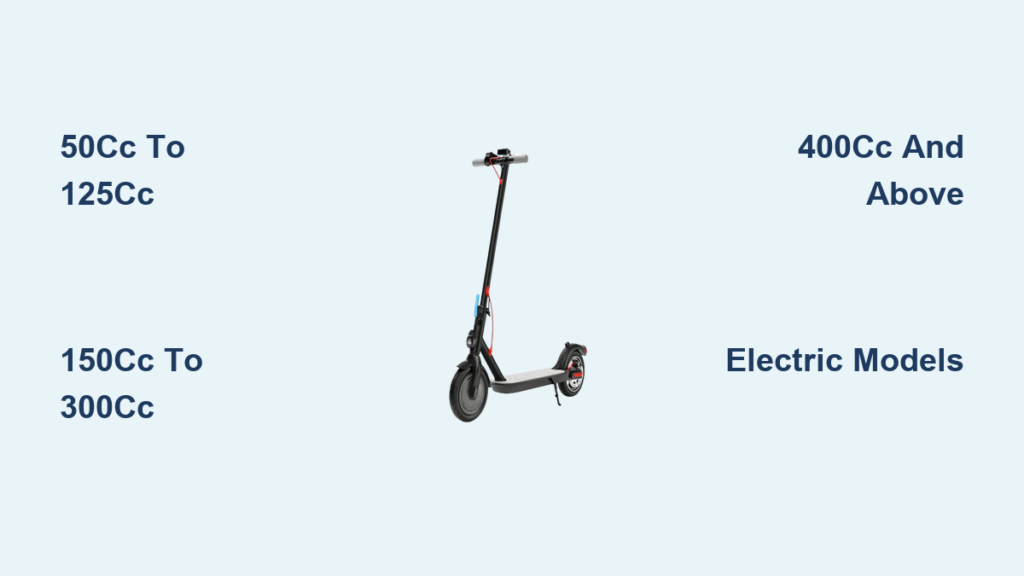
Small-Bore Scooters: 50cc to 125cc
These compact scooters dominate urban streets due to their agility and exceptional fuel economy.
Ideal for City Commuting
Scooters in this range offer top speeds between 28 mph for 50cc models and 65 mph for 125cc versions, making them perfect for short urban trips under 10 miles. The Honda BeAT 110cc and Honda Click 125i are leading choices, delivering excellent maneuverability through traffic and easy parking in tight spaces.
Licensing Benefits
In many regions, 50cc scooters qualify as mopeds and can be operated with a standard car drivers license. In Denmark, adults can ride 50cc scooters with only liability insurance. Models exceeding 125cc require a full motorcycle endorsement in most jurisdictions.
Fuel Efficiency Leaders
50cc scooters can achieve over 100 mpg, while 125cc versions still deliver 50 to 60 kmpl. The Honda Click 125i achieves approximately 54 kmpl, making these scooters incredibly economical to operate.
Mid-Range Scooters: 150cc to 300cc
This category bridges the gap between city commuters and touring machines, offering more power without sacrificing practicality.
Highway-Ready Performance
Models like the Yamaha Aerox 155cc and Honda ADV160 157cc produce 15 to 16 hp, reaching speeds of 70 to 80 mph. These scooters handle highway merging confidently and support two-up riding with luggage.
Premium Features
Expect larger 15 to 16 inch wheels, disc brakes, LED lighting, and digital dashboards in this segment. The Yamaha Xmax 292cc adds premium touches like traction control and advanced suspension, ideal for daily commuters seeking comfort and reliability.
Real-World Economy
Mid-range scooters still offer solid fuel economy around 45 to 55 kmpl. The Honda Click 160 claims approximately 47 kmpl, balancing power and efficiency effectively.
Maxi-Scooters: 400cc and Above
For long-distance riders and touring enthusiasts, maxi-scooters deliver car-like comfort with motorcycle agility.
Touring-Capable Machines
Models like the Yamaha TMAX 530cc, Honda Forza NSS350, and Bristol Zontes 400M with 38 hp offer highway cruising, cruise control, adjustable windshields, and spacious storage capable of fitting two full-face helmets.
Advanced Technology
These scooters come equipped with ABS, traction control, riding modes, infotainment systems, and even heated seats. Some models like the Aprilia Mana 850 fix the engine to the frame rather than the swingarm to reduce unsprung weight and improve handling.
Premium Investment
Maxi-scooters command premium pricing. In the Philippines, the Yamaha TMAX Techmax costs approximately ₱849,000, positioning it as a luxury commuter vehicle.
Design-Based Categories: Purpose-Built Scooters
Beyond engine size, scooters are designed with specific purposes in mind, each shaping the riding experience.
Classic Urban Commuters
These represent the quintessential city scooter, designed for practical daily transportation.
Key Characteristics
The defining features include a step-through frame, flat floorboard, under-seat storage, small 10 to 14 inch wheels, and minimalist bodywork. Popular models include the Honda Click series and Yamaha Mio. Modern versions add USB charging ports, fuel injection, and combined braking systems for enhanced safety and convenience.
Sport and Performance Scooters
Built for riders who want excitement and dynamic handling rather than just practical transportation.
Aggressive Design and Handling
The Yamaha Aerox and Honda ADV160 feature sharp body lines, sport-tuned suspension, and larger wheels for better cornering grip. Their riding position is more forward-leaning, encouraging spirited rides on twisty roads.
Cooling Technology
High-performance models often use liquid cooling to manage heat during aggressive riding. The Aerox 155cc engine delivers 15.1 hp, making it a favorite among delivery riders and young commuters who value performance.
Adventure and Off-Road Scooters
These models blend scooter convenience with limited off-road capability.
Rugged Design Elements
Key features include increased ground clearance, long-travel suspension, block-pattern tires, upright riding posture, and crash protection bars. The Honda ADV160 and X-ADV models are designed for mixed terrain, perfect for rural areas or rainy-season commuting where roads deteriorate.
Retro and Vintage-Style Scooters
Style meets modern engineering in this nostalgic category that appeals to riders who value aesthetics.
Timeless Aesthetics
Round body panels, chrome accents, and classic color schemes evoke the 1950s Vespa and Lambretta era. The Vespa GTS Super 300 HPE and Honda Giorno represent modern takes on vintage designs.
Modern Reliability
Despite retro looks, these scooters use fuel injection, electric starters, and digital instrumentation. They appeal to riders who value personal expression and urban flair without sacrificing reliability.
Three-Wheeled Tilting Scooters
Innovation meets stability in this growing segment that offers enhanced safety.
Reverse Trike Configuration
Models like the Piaggio MP3 and Yamaha Tricity use two front wheels that tilt independently during turns. This keeps all three wheels in contact with the road, enhancing grip in wet conditions and during aggressive cornering.
Enhanced Safety
This configuration is ideal for new riders or those concerned about balance. The concept was pioneered by the Cushman Model 39 during WWII as a utility vehicle with a front storage bin.
Enclosed Scooters
Maximum weather protection defines this niche category for all-season commuting.
Full-Coverage Bodywork
The BMW C1 and Honda Gyro Canopy feature integrated roofs and windscreens, shielding riders from rain and wind. The BMW C1 even allowed helmet-free riding in some European countries due to its roll cage design.
Limited Market Presence
While innovative, enclosed scooters have not gained widespread adoption due to added weight and cost. However, they remain compelling for riders seeking all-weather urban commuting protection.
Electric Scooters: The Growing Future
Electric scooters are rapidly transforming the market, driven by emissions regulations and improving battery technology.
Why Electric Adoption Is Accelerating
Electric scooters offer lower operating costs at approximately one-sixth of gasoline scooters, zero tailpipe emissions, quieter operation, and minimal maintenance with no oil, filters, or clutches. In India, electric scooter sales are projected to rise from 1% to 74% of total sales by 2040. The Philippines market, valued at $1.9 million in 2020, is expected to grow at a 158.6% CAGR through 2030.
Performance and Range Capabilities
City-focused electric scooters offer approximately 45 mph top speed with around 60-mile range. High-performance models provide highway capability with 100+ mile ranges. Cold weather impacts lithium-ion batteries, which lose efficiency below 40°F, so indoor storage is recommended.
Leading Electric Brands
Gyroor offers UL-certified batteries, IPX5 water resistance, and a 1-year warranty, trusted by over 100,000 riders in North America and Europe. Other key players include Vmoto, Fonz Moto, and Benzina Zero from Australia, plus NWOW and MotorStar in the Philippine market.
Hybrid Scooters: The Bridge Technology
Petrol-electric hybrids are emerging as a transitional solution for riders not ready to go fully electric. The Yamaha Rayzr 125 FI Hybrid combines a 125cc engine with an electric assist system, claiming an impressive 71 kmpl fuel efficiency.
Environmental Impact and Emissions Standards
Scooters are not all created equal when it comes to environmental impact.
Two-Stroke vs. Four-Stroke Emissions
Pre-1999 two-stroke 50cc scooters emit 10 to 30 times more hydrocarbons and particulates than Euro 3 car standards. Four-stroke scooters are cleaner but still emit 3 to 8 times more pollutants than modern cars.
Regulatory Responses
Genoa, Italy banned pre-1999 two-stroke scooters in 2019. Shanghai, China only allows LPG or electric scooters. US and European emissions standards forced the industry to adopt four-stroke engines and fuel injection, drastically reducing pollution.
The Electric Advantage
Electric scooters produce zero direct emissions and have a much smaller carbon footprint over their lifecycle, especially as electrical grids shift toward renewable energy sources.
Global Market Trends and Regional Preferences
Scooter popularity varies significantly by region, shaped by infrastructure, culture, and economics.
Asia: The Scooter Capital
India sees scooters accounting for approximately 70% of gasoline consumption in two-wheelers, with Bajaj Chetak being iconic. Taiwan offers dedicated two-wheeler lanes and turn boxes. Thailand uses scooters as door-to-door taxis in congested cities.
Europe: Style and Practicality
Italy remains home of Vespa and Lambretta, where scooters carry cultural significance. The Netherlands and Belgium feature extensive cycle tracks that accommodate scooters, promoting mixed-mode urban mobility.
United States: Growing Market
Scooter sales have more than doubled since 2000 according to the Motorcycle Industry Council. They remain less common than in Asia but are gaining traction in cities with parking challenges and traffic congestion.
Maintenance and Ownership Costs
Understanding ongoing maintenance requirements helps you choose the right scooter type for your lifestyle.
Internal Combustion Engine Maintenance
Regular tasks include oil changes for engine and gear oil, air filter cleaning, spark plug replacement, CVT belt inspection, valve adjustments on some models, and coolant checks for liquid-cooled engines.
Electric Scooter Care
Electric scooters require much simpler maintenance, focusing on tire pressure checks, brake pad inspections, electrical connection cleaning, and battery health monitoring. The absence of oil, clutches, or complex transmissions means significantly lower long-term costs.
Safety Essentials
Always wear a DOT-approved helmet, abrasion-resistant jacket, gloves, pants, and boots, plus high-visibility gear. Look for models with ABS, CBS, TCS, and LED lighting to enhance safety on the road.
Frequently Asked Questions About Types of Scooters
What is the difference between a scooter and a moped?
A moped typically refers to a 50cc or smaller scooter classified as a motorized bicycle in many jurisdictions. It often requires only a car drivers license to operate. Scooters generally refer to vehicles with larger engines, step-through frames, and automatic transmissions that require motorcycle licensing.
Which scooter type is best for city commuting?
For city commuting, a 125cc to 160cc scooter offers the best balance of maneuverability, fuel efficiency, and highway capability. Models like the Honda Click 125i or Yamaha Aerox provide excellent city performance with easy parking and low operating costs.
Are electric scooters worth the investment?
Electric scooters offer significantly lower operating costs, minimal maintenance, and zero emissions. While the upfront cost is higher, the savings on fuel and maintenance make them increasingly worthwhile, especially as battery technology improves and charging infrastructure expands.
What is a maxi-scooter?
A maxi-scooter is a large-displacement scooter designed for long-distance touring and highway commuting. These models typically exceed 400cc and offer features like adjustable windshields, spacious storage, advanced suspension, and technology including traction control and cruise control.
How do I choose the right scooter for my needs?
Consider your typical riding distance, road conditions, licensing requirements, and budget. For short city trips, a 50cc to 125cc commuter works well. For mixed city and highway use, look at 150cc to 300cc models. For touring or premium commuting, a maxi-scooter provides the best comfort and capability.
What are three-wheeled scooters like the Piaggio MP3?
Three-wheeled scooters use a reverse trike configuration with two front wheels that tilt independently during turns. This design keeps all three wheels in contact with the road, providing superior stability in corners and wet conditions. They are ideal for new riders or those seeking extra confidence in handling.
Key Takeaways for Understanding Types of Scooters
The world of scooters offers remarkable diversity, from lightweight 50cc commuters perfect for short city trips to powerful maxi-scooters designed for highway touring and long-distance travel. Understanding the fundamental differences between engine sizes, design philosophies, and power sources helps you find the perfect match for your specific needs. Whether you prioritize fuel economy, performance, style, or environmental impact, there is a scooter category designed for your requirements. Consider your typical riding conditions, licensing requirements, and budget when making your decision, and remember that electric and hybrid options are rapidly improving as technology advances.