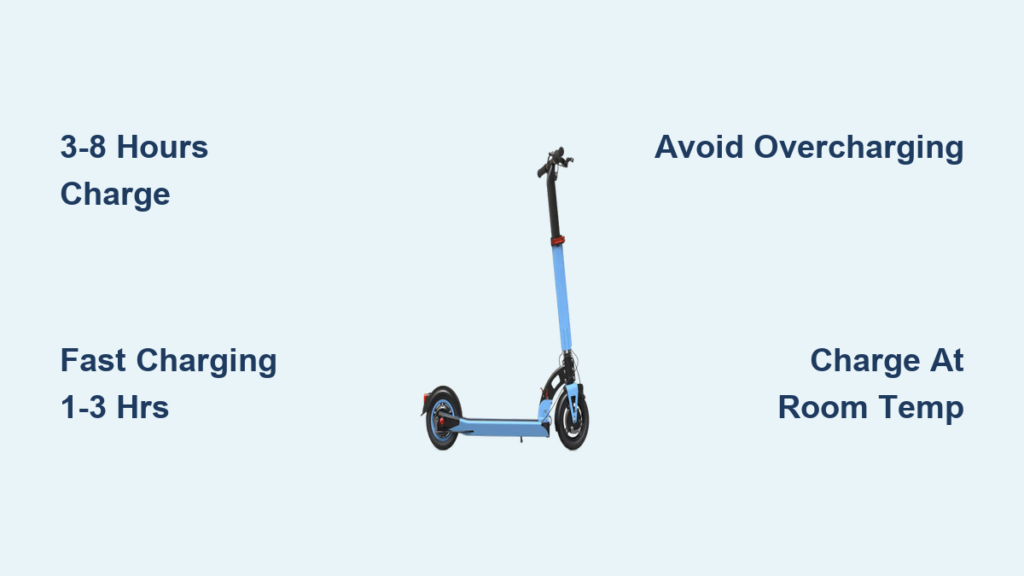
If you’re wondering how long does an e scooter take to charge, the answer is not one-size-fits-all. Most electric scooters need between 3 and 8 hours for a full charge, but this varies widely based on battery size, charger output, and other factors. Some fast-charging models can reach full capacity in just 1 to 3 hours, while large batteries with low-output chargers may take over 20 hours.
Understanding what affects charging time helps you plan your routine, protect your battery, and get the most out of your scooter. Whether you use your e scooter for daily commutes or weekend errands, knowing how to estimate and optimize charge time ensures you never get stranded. This guide covers everything from the factors that speed up or slow down charging to step-by-step safety protocols and troubleshooting tips.
Estimate Your E Scooter Charge Time

Use the Battery-to-Charger Formula
The most accurate way to estimate charging time uses a simple formula: Charge Time (hours) ≈ Battery Capacity (Ah) ÷ Charger Output (A). For example, a scooter with a 10 Ah battery using a 2 A charger will take approximately 5 hours to fully charge under ideal conditions.
This formula gives you a baseline, but real-world factors like temperature, battery age, and the final charging phase where the BMS slows down to balance cells all add time. Treat the result as a minimum estimate rather than a guarantee. The last 10 to 20 percent of charging typically takes disproportionately longer than the initial bulk charge.
Charge Times by Scooter Category
Different scooters fall into different charging time ranges based on their battery size and intended use:
• Lightweight or Entry-Level scooters (under 10 Ah) typically charge in 3 to 5 hours
• Mid-Range Commuter scooters (10 to 15 Ah) usually require 5 to 7 hours
• Long-Range or High-Performance scooters (15 Ah or larger) often need 6 to 10+ hours
The Acer Electric Scooter 5, for instance, takes approximately 4 hours on its standard charger. High-performance models like the Mantis or WolfWarrior pack massive batteries for long range, which means longer waits at the charging port.
Key Factors That Change Charging Speed

Battery Capacity: The Fuel Tank Size
Battery capacity, measured in amp-hours (Ah) or watt-hours (Wh), works like a car’s gas tank. A 20 Ah battery holds twice the energy of a 10 Ah one, so it naturally takes longer to fill. Larger capacity means more range, but also more charging time.
Long-range scooters designed for 40+ miles often have batteries exceeding 15 Ah, pushing charge times past 8 hours with standard equipment. If you need faster turnaround, look for models that support fast charging or consider upgrading your charger if the manufacturer allows it.
Charger Output: The Fill-Up Speed
Your charger’s output, measured in amps (A) or watts (W), determines how fast energy flows into the battery. A 3 A charger fills a battery significantly faster than a 1.5 A one.
Standard chargers typically provide 1.5 to 2 A, resulting in 6 to 8 hour charge times. Fast chargers at 3 A or higher can cut this time by up to 50 percent. However, only use a fast charger if your scooter’s BMS and manual explicitly support it. Mismatched chargers can overheat the battery, cause swelling, or trigger thermal runaway.
Starting Charge Level: 50% vs. 0%
Charging from 50 percent is faster than charging from 0 percent, but the relationship is not linear. The final 10 to 20 percent of charge takes disproportionately longer because the BMS reduces current to balance cells and prevent overheating.
Deep discharges also stress the battery. Avoid letting your scooter die completely. Aim to recharge when the battery hits 20 to 30 percent for optimal battery health.
Temperature: The Hidden Delay
Lithium-ion batteries perform best within a specific temperature range. Charging outside 0°C to 40°C (32°F to 104°F) causes the BMS to slow down or stop charging entirely.
In cold weather below 0°C, chemical reactions slow and the battery may refuse to charge or take much longer. In hot environments above 40°C, the BMS throttles input to avoid thermal runaway. Charge indoors at room temperature for the fastest and safest results. Never plug in a scooter right after riding in rain or snow. Wait 30 to 45 minutes for it to dry and warm up.
Battery Age: Slower Over Time
As batteries age, typically after 500 to 1000 charge cycles, they lose efficiency. Internal resistance increases, so they accept charge more slowly and hold less power.
An old battery that once charged in 5 hours might now take 7 hours. If you notice sudden slowdowns, check for physical damage or consider a replacement battery.
Step-by-Step Charging Guide

Pre-Charge Safety Steps
Before plugging in, follow these critical safety steps:
- Wait 15 minutes after riding to let the battery cool down
- Wipe the scooter dry if exposed to rain and wait 30 to 45 minutes for the port to dry completely
- Turn the scooter OFF before charging to improve efficiency
- Inspect all cables and the charging port for fraying, bent pins, or corrosion
- Place the scooter on a hard, flat, indoor surface away from flammable materials
How to Plug In Correctly
Follow the right connection order to prevent electrical surges:
- Plug the charger into the wall outlet first
- Then connect the charger to the scooter
- Check the indicator light: Red means charging, Green means full, No light means check the outlet or cable
Avoid leaving the scooter unattended for extended periods. While modern systems have protections, fires can still occur, especially with damaged batteries.
When to Unplug
Unplug as soon as the indicator light turns green. Do not leave the scooter plugged in overnight or for days.
Prolonged connection stresses the cells and can cause battery swelling, leading to permanent damage or safety hazards. For the Acer Scooter 5 specifically, do not exceed 24 hours of charging as this causes irreversible damage.
Unplug in reverse order: disconnect from the scooter first, then from the wall. Wait 5 minutes after charging before riding to let the battery stabilize and cool slightly.
Fast Charging: Speed vs. Battery Life
How Fast Charging Works
Fast chargers can deliver a full charge in 1 to 3 hours by providing higher current, cutting charge time in half. However, they generate more heat, which is the primary enemy of lithium-ion batteries.
Only use fast charging if your scooter’s BMS supports it, the charger is manufacturer-approved, and you truly need the speed for an urgent commute.
The Cost of Speed
Frequent fast charging accelerates battery wear through heat buildup, which damages cells and reduces the total number of charge cycles. Capacity loss over time means shorter range between charges.
Use standard charging for daily use and reserve fast charging for emergencies only.
Battery Health and Longevity Tips

Avoid These Charging Mistakes
• Charging in extreme temperatures
• Leaving the scooter on the charger after it reaches full charge
• Using non-OEM or damaged chargers
• Riding then charging immediately without waiting for cool down
• Letting the battery drop to 0% regularly
Ideal Storage Practices
If storing your scooter for weeks, charge the battery to 40 to 60 percent (never full or empty) and store in a cool, dry place between 15°C and 25°C (59°F and 77°F). Top up every 4 to 6 weeks to prevent deep discharge.
Maximize Battery Lifespan
Charge after every use if the battery is below 50 percent. Avoid deep discharges by staying above 20 to 30 percent. Partial charges are fine since lithium-ion batteries have no memory effect. Replace swollen, leaking, or damaged batteries immediately.
Troubleshooting Charging Problems
Scooter Won’t Charge? Check These
- Test the outlet with another device to verify it works
- Ensure the charger plug is fully seated in the port
- Check the indicator light: no red light could mean a faulty charger, port, or BMS
- Look for battery damage like swelling, leakage, or a burning smell. Stop immediately if present.
- Verify the scooter is not too hot or cold. Let it acclimate to room temperature.
If basic checks fail, contact the manufacturer. Never open the battery pack yourself.
Emergency Charging (Not Recommended)
In a true emergency, you can use a car battery and jumper cables, though this carries high risk. Remove the battery if possible, connect red to positive and black to negative, run the car for 15 to 30 minutes, then disconnect in reverse order. This method lacks voltage regulation and can fry the battery. Use only as a last resort.
Frequently Asked Questions About E Scooter Charging
How do I know when charging is complete?
Most chargers have an indicator light that shifts from red (charging) to green (full). Some models also beep or show a full battery icon on the display.
Can I use a different charger?
Only use a charger that is manufacturer-approved. Mismatched voltage or amperage can damage the battery or create fire hazards. Stick with OEM or certified replacements.
Is overnight charging safe?
Not recommended. Even with overcharge protection, leaving the scooter plugged in stresses the battery. Unplug when the light turns green.
Can I charge while riding?
No. Charging requires a stationary connection to a power source. Attempting to charge while moving is dangerous and can destroy the system.
How long do scooter batteries last?
Typically 500 to 1000 charge cycles, which equals 2 to 4 years of regular use with proper care.
Key Takeaways for Charging Your E Scooter
Charging time varies widely based on battery capacity, charger output, and environmental conditions. Most scooters fall between 3 and 8 hours for a full charge, but some configurations can take as little as 1 hour or as long as 20 hours.
Always estimate charge time using the battery capacity divided by charger output formula, and remember that the final 10 to 20 percent takes longer due to cell balancing. Charge indoors at room temperature, wait 15 minutes after riding before plugging in, and unplug immediately when the light turns green.
Following these practices protects your battery, extends its lifespan, and ensures your e scooter is ready when you need it. Smart charging habits make all the difference between a scooter that lasts years and one that degrades quickly.