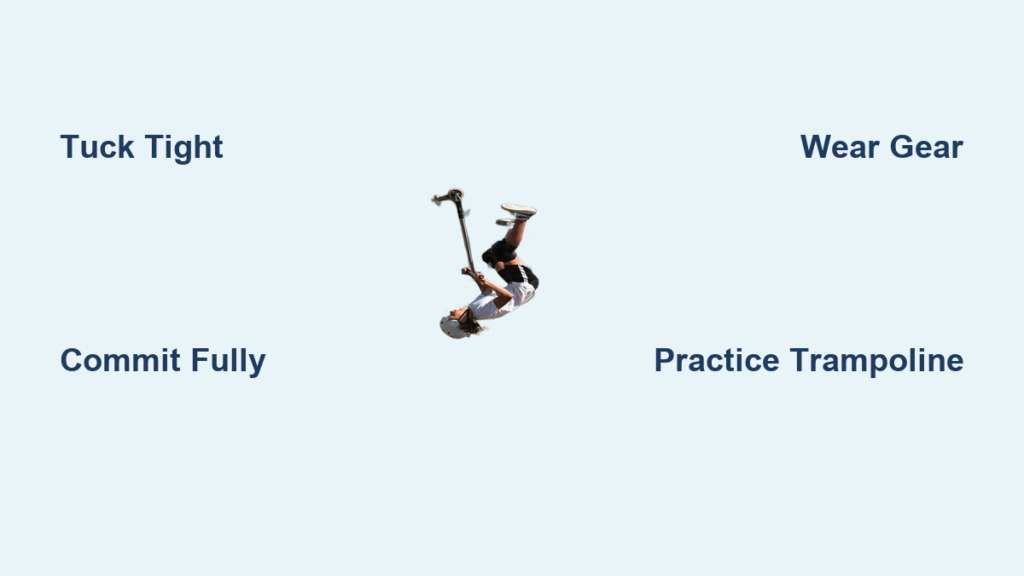
You’ve seen it at the skatepark or in viral videos: riders launching off ramps, spinning backward through the air, and landing smoothly on their scooters. The scooter backflip is one of the most impressive tricks in freestyle scootering, but it requires more than just courage. It demands proper technique, progressive training, and complete commitment. This guide walks you through exactly how to backflip on a scooter safely, starting from the basics and building up to your first clean landing.
This article covers everything you need, from mandatory safety gear and training progressions to the exact ramp setup and technique that pros use. Whether you’re practicing on a trampoline at home or ready to hit the quarter pipe, this roadmap will help you stick that first backflip.
Essential Safety Gear for Scooter Backflips

Full protective gear is non-negotiable before attempting any backflip. A certified helmet is the most critical piece of equipment because your head must be protected in case of a misjudged rotation or early landing. Beyond the helmet, you need knee pads with hard-shell recommended construction, elbow guards, wrist guards, and durable closed-toe shoes.
Wearing complete protective gear does more than protect you physically. It reduces fear significantly. When you know you’re protected, you can commit to the motion instead of hesitating mid-air, which is one of the most dangerous mistakes in backflip attempts.
Finding the Right Practice Environment
Your training location directly impacts your success rate and safety. Start in a controlled, soft-landing environment before moving to hard ramps.
• Foam pits are the safest option for first attempts, allowing you to experience full rotation without injury risk
• Trampolines are ideal for building muscle memory with high repetition of tucks and flips and soft landings
• INDO scooters (wheelless training scooters) let you practice body-scooter coordination without rolling variables
• Thick mattresses, foam pads, grass, or soft dirt can substitute if no pit or trampoline is available
• Avoid concrete or asphalt until you’re consistently landing the trick
Setting Up Your Ramp and Scooter

When transitioning to real ramps, ramp geometry is critical. The ideal learning ramp is a 4-foot quarter pipe with a smooth transition and clean coping. Four feet is the optimal height because shorter ramps lack sufficient pop, while taller ones increase over-rotation risk and make recovery harder.
Coping is essential because it provides a defined takeoff point and helps initiate backward rotation. Avoid flat banks or mini ramps without coping because they don’t generate the upward momentum needed for a backflip.
Your scooter must be in top condition to handle the stress of backflips. Use a standard freestyle scooter with tight clamps, headset, and compression. Check that handlebars are secure and grips are non-slip. Never attempt a backflip on a loose or damaged scooter because components can fail mid-air.
Mastering the Tuck on a Trampoline
The tuck is the engine of your backflip. Without a tight tuck, you won’t rotate fast enough to land cleanly. Practice by jumping high on a trampoline, then at the peak pulling your knees to your chest, tucking your chin, and throwing your head back. Spot the landing early and open up just before impact, then land with bent knees to absorb the force.
A tighter tuck produces faster rotation. Focus on making your body as compact as possible. The tuck involves pulling your chest in, tucking your chin tightly, and compressing your entire body into the smallest possible profile. This reduces your moment of inertia, allowing you to rotate faster with less initial force.
Building Comfort Being Upside Down
Fear of inversion is the number one mental barrier to learning backflips. Break it down with simple drills to get comfortable being upside down. Backward rolls on grass help you get used to the sensation of being inverted. Backward seat drops involve sitting at the edge of a bed or soft surface, falling backward into a roll, and practicing the tuck.
Trampoline backflips without a scooter build confidence in full rotation before you add equipment into the equation. The trick isn’t about strength; it’s about commitment and body control. Once you’re comfortable flipping on a trampoline, you can progress to holding the scooter during flips.
Practicing With the Scooter
Once you’re comfortable flipping, introduce the scooter to your training. Hold the handlebars with both hands and place the scooter between your legs or in front of you. Perform a backflip on the trampoline while holding the scooter, keeping your arms locked and body tight. The goal is to train your body to treat the scooter as part of your center of mass.
Next, practice one-foot takeoffs by placing one foot on the deck while holding the bars tightly. Bounce on the trampoline to generate lift, initiate the backflip with a head throw and tuck, and aim to land with both feet on the deck. Never release the handlebars during practice because letting go leads to loss of control and dangerous falls.
Executing the Full Ramp Backflip
Ride straight up the ramp with no flyouts yet because angling too early disrupts vertical lift. Build speed with two to three strong pushes, then as you hit the transition, crush down (compress your legs and torso) to preload. Aim to pop six to twelve inches below the coping.
At the sweet spot, explode upward with your legs. Sit back slightly as you leave the coping, tuck immediately by pulling your knees in and chin to chest, throw your head back to drive the rotation, and lock your elbows to keep the scooter close to your body. Your head should lead the flip by looking over your shoulder at the landing.
Once airborne, stay tight and focused. Keep the tuck compact and don’t open up too early. Grip the handlebars one hundred percent; hands stay on the bars no matter what. Align your head with your spine and don’t tuck too far or look down prematurely. A loose body slows rotation, so think of your body as a ball shape in the air.
As you near the end of rotation, spot the landing by finding the ground or ramp face with your eyes. Open up gradually by extending your legs to prepare for impact. Bend your knees just before landing to absorb the shock, then ride away clean. Staying on the scooter is the final test of a successful backflip.
Common Mistakes and How to Fix Them

Letting go of the handlebars is a common mistake with serious consequences. If you release the bars, the scooter drifts away and you experience an uncontrolled fall. Fix this by practicing grip strength drills and repeating flips while holding a scooter on the trampoline with hands staying on at all costs.
Not tucking tightly enough leads to slow rotation and landing on your back or shoulders. Fix this by drilling tuck and roll on grass, focusing on pulling your knees to your chest and chin down. Poor takeoff timing causes under-rotation or over-rotation, so ride all the way to the coping and pop six to twelve inches below the top.
Looking down too early causes your body to collapse and loses rotation. Keep your eyes on the landing spot; your head leads and your body follows. Throw your head back, not down. Hesitation and lack of commitment cause half-flips and dangerous landings. Build confidence progressively using foam pits and visualize success before each attempt. When you decide to go, send it one hundred percent.
Advanced Tips and Next Steps
Once you’re consistent on the quarter pipe, try banks to generate more pop with your legs since there’s no transition to help. Add flyouts by angling your takeoff away from the ramp for smoother landings. Backflip to fakie by landing backward and riding away in reverse.
After mastering the basic flip, progress to backflip 180s by adding a half-spin mid-air. Combine with a bar spin for a backflip tailwhip (advanced). Attempt double backflips only after full mastery and extreme confidence. Use an INDO scooter and trampoline year-round to maintain muscle memory during off-seasons.
Mental Preparation for Your First Backflip
Overcome fear with visualization by spending five minutes before practice visualizing the full trick. See yourself riding up the ramp, feel the pop and tuck, spot the landing, and ride away. Mental rehearsal builds neural pathways just like physical practice.
Build confidence through repetition because progress isn’t linear. You’ll have failed attempts, but each one teaches you something. Start small with rolls, then trampoline flips, then held scooter, then one foot, then full flip. Celebrate small wins like your first full tuck or first foam pit landing.
Half-hearted attempts are the most dangerous. If you’re not ready, go back a step. But when you are ready, commit one hundred percent. Hesitation kills momentum. The instruction to send it implies that once the decision to flip is made, there is no turning back.
Frequently Asked Questions About Backflipping a Scooter
What age is safe to learn a scooter backflip?
Children as young as six can learn with proper guidance and strict safety protocols. Starting young with consistent practice yields high proficiency, but the key is following progressive steps rather than rushing to advanced tricks.
How long does it take to learn a scooter backflip?
Progress depends on individual comfort with inversion and commitment level. Some riders land their first backflip within weeks of starting trampoline training, while others may take months. The key is volume of correct practice rather than rushing the progression.
Can I learn on a smaller ramp than 4 feet?
Ramps shorter than four feet often lack sufficient pop to complete the rotation safely. Using a shorter ramp increases the risk of under-rotation and harsh landings. A four-foot quarter pipe provides the ideal balance of height and controllability for learning.
What happens if I don’t tuck tightly enough?
A loose or incomplete tuck slows your rotation speed significantly. This often results in landing on your back or shoulders rather than on your feet. Focus on pulling your knees to your chest and making your body as compact as possible throughout the rotation.
Is the backflip dangerous?
Any aerial trick carries risk, but the backflip is manageable when proper safety protocols are followed. Using full protective gear, training progressively from trampolines to ramps, and committing fully to each attempt dramatically reduces injury risk.
Key Takeaways for Landing Your First Scooter Backflip

Learning how to backflip on a scooter is a journey, not a single jump. Start with mastering the tuck on a trampoline, progress through held scooter drills and one-foot takeoffs, then work your way up to the four-foot quarter pipe. Never skip steps in the progression because each stage builds the muscle memory and confidence needed for the next.
Safety gear is non-negotiable. A certified helmet, knee pads, and elbow guards must be worn for every attempt. Choose your training environment wisely, starting with foam pits or trampolines before moving to hard ramps. Remember that the trick is about timing and commitment, not strength.
When you finally stick that first clean landing, you’ll know every step was worth it. Respect the process, avoid shortcuts, and when you’re ready, send it with full commitment.