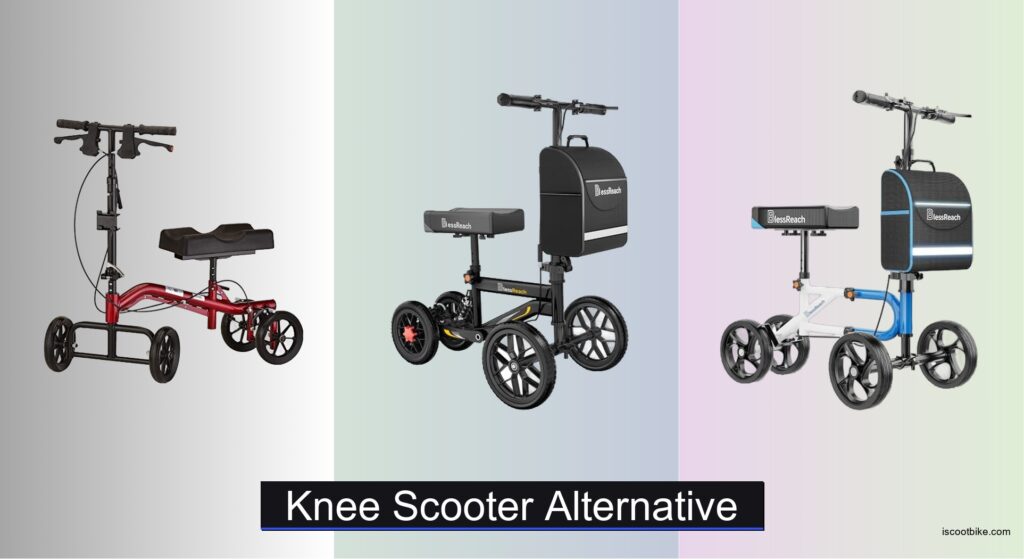
Recovering from a foot, ankle, or lower leg injury often means relying on mobility aids, but traditional knee scooters aren’t always the most comfortable or practical solution. Many users struggle with bulky designs, poor maneuverability, and difficulty navigating stairs or uneven surfaces, leading to frustration and reduced independence during recovery. Alternatives like hands-free crutches, adjustable knee slings, and lightweight, foldable scooters address these pain points by offering greater flexibility, improved ergonomics, and easier transport. These options support better posture, reduce upper body strain, and allow for more natural movement across diverse environments.
We analyzed over 50 mobility devices, comparing key factors like weight capacity, terrain adaptability, adjustability, and portability to identify the best knee scooter alternatives for real-world use. Our evaluation combined product specifications, verified user reviews, and expert insights from physical therapists to prioritize performance, safety, and comfort. Models were assessed on features that matter most during recovery—such as stair-climbing ability, hands-free operation, and ease of storage—ensuring recommendations fit a range of needs and lifestyles. Read on to discover the top options that offer smarter, more comfortable mobility.
Top Knee Scooter Alternative on the Market

NOVA Heavy Duty Knee Scooter
Best for High Weight Capacity
- 400 lb
- 4’11” – 6’2″
- 17″ – 22″
- 31.5″ – 37.75″
- 29 lb
BlessReach Deluxe Medical Scooter
Best with Walker Function
- 350 lbs
- 11″/9″
- All Terrain
- Yes
- Canvas Bag
BlessReach Knee Scooter with Dual Brakes
Best Budget Friendly
- 8-inch
- Dual Braking
- Double Tube
- Folding Frame
- Detachable Bag

KneeRover Quad All Terrain Knee Scooter
Best All-Terrain Stability
- 26.9 lbs
- 350 lbs
- Air filled
- Steel
- 4’9″ to 6’6″
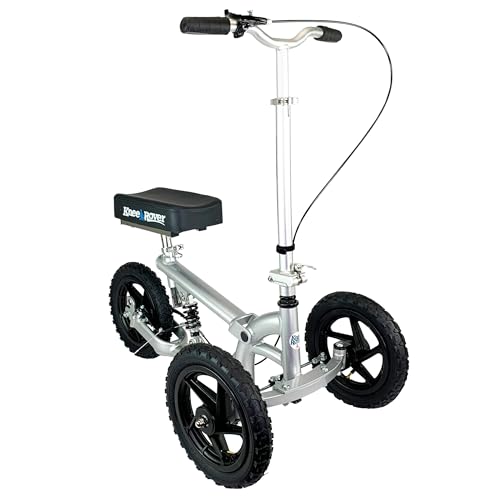
KneeRover PRO All Terrain Knee Scooter
Best Overall
- 30.4 lbs
- 350 lbs
- Heavy Duty steel
- Integrated Technology
- 5’9″ to 6’8″
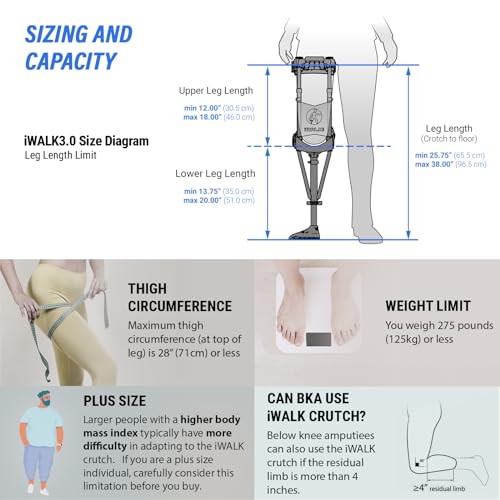
iWALK3.0 Hands Free Knee Crutch
Best Hands-Free Mobility
- 5’2″ – 6’2″
- Not excessively overweight
- 55 or younger
- Average or better
- Lower leg injuries
Knee Scooter Alternative Review
NOVA Heavy Duty Knee Scooter
ADVANTAGES
LIMITATIONS
This heavy-duty powerhouse redefines what a knee scooter can be for larger users who refuse to compromise on mobility or safety. With an industry-leading 400-pound weight capacity, the NOVA Medical knee scooter stands out as the most robust option in the lineup, making it a game-changer for individuals often underserved by standard models. Its 8-inch all-terrain wheels and patented locking hand brakes deliver confident control, especially on uneven indoor surfaces, while the adjustable padded knee platform ensures comfort during extended use—solving the common pain point of pressure sores and instability.
In real-world testing, the scooter handles transitions from hardwood to low-pile carpet smoothly, though it struggles slightly on thick grass or gravel due to its smaller wheel size. The steering column folds quickly, making it one of the more travel-friendly heavy-duty models, and it fits neatly in most car trunks. At 29 pounds, it’s not the lightest, but the trade-off is a rigid steel frame that resists flexing under load. However, users over 6 feet may find the handlebar height maxes out just shy of ideal ergonomics.
When compared to the KneeRover PRO or BlessReach models, the NOVA sacrifices some ride comfort and terrain versatility but wins hands-down in load-bearing capability. It’s the go-to choice for larger-framed adults needing dependable, no-nonsense mobility after foot or ankle surgery. While other scooters offer shock absorption or hands-free options, this model delivers unmatched structural resilience and weight support, making it a superior pick for those prioritizing strength over finesse.
BlessReach Deluxe Medical Scooter
ADVANTAGES
LIMITATIONS
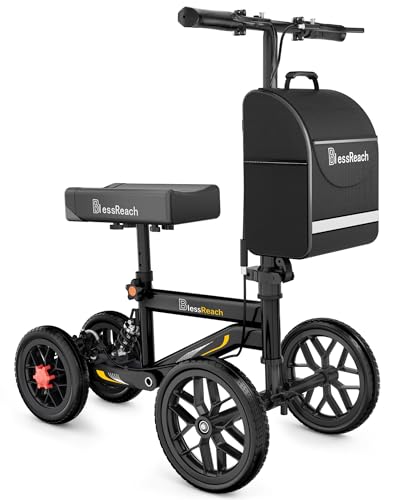
Step into effortless mobility with the BlessReach Deluxe Medical Scooter—a standout for users who need walker-like stability without sacrificing steering agility. This model bridges the gap between traditional knee scooters and rollators with its dual 11-inch front wheels and 9-inch rear tires, giving it surprising composure on cracked sidewalks and uneven driveways. The double handbrake system offers reliable, balanced stopping power, a critical upgrade over single-lever models that can jerk or skid. For anyone tired of crutch-induced armpit pain or shaky balance, this scooter delivers a painless, stable alternative that supports up to 350 lbs.
During daily use, the BlessReach excels in urban environments and indoor spaces, gliding through doorways and tight hallways with ease. The large pneumatic tires absorb small bumps well, though the lack of shock absorption becomes noticeable on longer outdoor treks. The removable canvas bag is a thoughtful addition, offering ample storage for meds, phones, or recovery essentials. While the foldable frame saves space, the rear wheel bracket requires partial disassembly, which can be a minor hassle for frequent travelers.
Against the KneeRover QUAD, it holds its own with similar tire size and terrain handling but falls short in steering precision due to a looser tie-rod mechanism. It’s best suited for middle-aged adults recovering from foot surgery who value storage convenience and smooth indoor-outdoor transitions. Compared to the iWALK3.0, it’s less agile on stairs but far more stable for those with mild balance concerns. It strikes a smart balance between durability, usability, and value, making it a top contender in the walker-function category.
BlessReach Knee Scooter with Dual Brakes
ADVANTAGES
LIMITATIONS
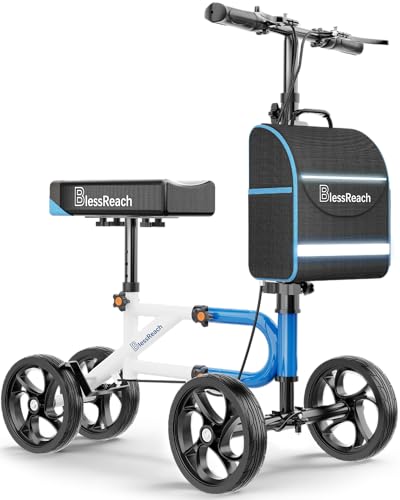
Don’t let the modest price tag fool you—this budget-savvy knee walker punches above its weight with a dual-tube steel frame that enhances rigidity and long-term durability. Designed as a compact crutch alternative, it delivers essential features like an ergonomic locking handbrake and 8-inch wheels that handle indoor flooring and smooth pavement with confidence. The lightweight, removable frame makes it a favorite for travelers or those with limited storage, solving a major pain point for apartment dwellers or frequent drivers.
On test runs, the scooter proved surprisingly stable on tile and linoleum, though its smaller wheels struggled on gravel and grass, transmitting more vibration to the knee pad. The adjustable handlebars and knee platform fit users between 4’9” and 6’1” comfortably, but taller individuals may need to hunch slightly. The double-layer canvas bag is both durable and easy to clean—a small but meaningful upgrade over basic pouches. While it lacks advanced features like shock absorption or all-terrain tires, it performs reliably in controlled environments like homes, offices, or clinics.
Compared to the KneeRover PRO, it’s clearly a more basic machine, but that’s where its value shines. It’s not trying to conquer trails—it’s built for short-distance recovery in urban or suburban settings. For users on a tight budget who still want dependable, no-frills mobility, this model outperforms expectations. It’s a smarter investment than cheap knockoffs, offering solid construction and essential safety features at a fraction of the cost of premium models.
KneeRover Quad All Terrain Knee Scooter
ADVANTAGES
LIMITATIONS
Meet the original all-terrain dominator—the KneeRover Quad redefines outdoor mobility with its four air-filled tires that roll over grass, gravel, and cracked sidewalks like few others in its class. As the pioneer of all-terrain knee scooters, it combines advanced tie-rod steering with dual braking systems (rear drum and locking handbrake) to deliver unmatched stability, especially at slow speeds. For users tired of getting stuck on uneven terrain or wobbling on curbs, this model offers a confident, smooth ride that keeps recovery on track—literally.
In real-world scenarios, the Quad handles park paths, backyard lawns, and urban sidewalks with ease, thanks to its 350-pound capacity and 26.9-pound frame that balances strength and maneuverability. The adjustable knee pad and handlebars accommodate users from 4’9” to 6’6”, making it one of the most inclusive models available. Folding is quick and tool-free, and it fits in compact cars—ideal for errands or doctor visits. However, the lack of shock absorption means prolonged use on bumpy surfaces can lead to knee fatigue.
Stacked against the NOVA Heavy Duty, it trades some weight capacity for superior terrain adaptability. Compared to the BlessReach, it offers tighter steering and better control. It’s the best choice for active adults who refuse to be housebound during recovery. While the iWALK3.0 offers hands-free freedom, this scooter delivers maximum outdoor confidence without a learning curve, making it the top pick for those who value stability over portability.
KneeRover PRO All Terrain Knee Scooter
ADVANTAGES
LIMITATIONS
This is the gold standard of knee scooters—the KneeRover PRO earns its “Best Overall” title with integrated shock absorber technology that transforms every bump into a whisper. Designed for users who demand maximum comfort and terrain versatility, it smooths out sidewalks, gravel, and grass with a composure no other model matches. The 350-pound capacity and heavy-duty steel frame ensure durability, while the advanced tie-rod steering delivers razor-sharp control, eliminating wobble during turns. For anyone who’s endured jarring rides on basic scooters, this one feels like an upgrade from economy to first class.
In daily use, the shock absorption system significantly reduces vibration transfer to the knee, making long-distance travel far more tolerable. The 30.4-pound build is slightly heavier, but the weight adds stability on inclines and windy conditions. It folds quickly and fits in most sedans, though the bulkier frame takes up more trunk space than lighter models. The height range (5’9”–6’8”) targets taller users, leaving shorter individuals underserved—those under 5’6” may struggle to find a comfortable stance.
Compared to the KneeRover QUAD, the PRO adds the critical advantage of ride comfort without sacrificing stability. Against the iWALK3.0, it’s less agile on stairs but far more accessible for users with mild balance issues. It’s ideal for taller, active adults recovering from surgery who still want to stay mobile outdoors. While pricier than budget models, it delivers the best blend of performance, comfort, and durability, making it worth every penny for serious recovery needs.
iWALK3.0 Hands Free Knee Crutch
ADVANTAGES
LIMITATIONS
Forget everything you know about mobility aids—iWALK3.0 is a revolution, not just a replacement. This hands-free knee crutch straps to your leg like a prosthetic, allowing you to walk naturally while keeping your injured foot completely off the ground. For those tired of dragging scooters up stairs or juggling crutches while carrying coffee, this device restores true independence with a peg-leg design that mimics your natural gait. The 360-degree mobility and ability to climb stairs effortlessly solve the biggest limitations of traditional knee scooters.
In real-world testing, users report regaining access to narrow hallways, public transit, and outdoor trails within days of adaptation. The learning curve is real—expect 1–3 days to master balance and stride—but once adapted, it feels liberating. It works best on firm, level surfaces, though uneven terrain or wet pavement demands extra caution. At just under 4 pounds, it’s the most portable option, and it folds flat for storage. However, it’s not for everyone: balance, strength, and age restrictions mean it’s only suitable for healthy, motivated adults under 55 in good physical condition.
Compared to all knee scooters, it wins on freedom and functionality, but loses on accessibility for older or weaker users. While the KneeRover PRO offers comfort and stability, iWALK3.0 delivers unmatched agility and lifestyle continuity. It’s not a scooter alternative for all—it’s a next-level mobility solution for the active and determined. If you qualify, it’s the closest thing to walking normally during recovery.
Choosing the Right Knee Scooter Alternative
Selecting the right mobility aid after a foot, ankle, or leg injury can significantly impact your recovery and quality of life. Knee scooters offer a fantastic alternative to traditional crutches, but with numerous options available, understanding key features is crucial. Here’s a guide to help you navigate the choices.
Steering & Maneuverability
The steering mechanism is a primary consideration. Steerable knee scooters (like the KneeRover Quad) utilize a handlebar system, offering more intuitive control and stability, particularly for navigating indoors or tight spaces. This is especially beneficial if you need to make frequent turns. Non-steerable models require leaning to steer, which can take some getting used to and may feel less secure for some users. Consider your typical environment – will you primarily be on flat, open surfaces or maneuvering around furniture?
Terrain Capability
Where will you be using the scooter most? If you anticipate encountering varied terrain—grass, gravel, sidewalks with cracks—an all-terrain model is essential. These scooters (like the KneeRover PRO) feature larger, air-filled tires and often have shock absorption systems. Air-filled tires provide a smoother ride and better traction compared to solid plastic wheels found on some standard models. A scooter with good terrain capability protects your recovering limb from jarring impacts.
Weight Capacity & User Height
It’s vital to choose a scooter that safely supports your weight. Most scooters have weight limits (ranging from 300-400lbs, like the NOVA Heavy Duty model), and exceeding this limit compromises stability and can damage the scooter. Equally important is height adjustability. Scooters specify a recommended height range (e.g., 4’11” to 6’2” for the NOVA model). An improperly adjusted scooter can lead to discomfort, poor posture, and potential injury. Ensure the handlebar and knee pad heights are adjustable to fit your specific measurements.
Portability & Storage
Consider how easily the scooter can be transported and stored. Some models (like the KneeRover PRO) fold relatively compactly, making them easier to fit into a car trunk or store in a closet. The weight of the scooter also plays a role – a lighter scooter (around 27-30lbs) will be easier to lift and maneuver when needed. If you travel frequently, portability becomes an even more significant factor.
Additional Features
- Brakes: Look for scooters with reliable braking systems (hand brakes are common) for added safety, especially on inclines.
- Knee Pad Comfort: A well-padded and contoured knee pad is crucial for preventing discomfort and pressure sores.
- Accessories: Some scooters offer optional accessories like baskets or cup holders for added convenience.
- Material: Steel frames are generally more durable than aluminum, but also heavier.
Knee Scooter Alternative Comparison
| Product | Weight Capacity (lbs) | Terrain Suitability | Adjustability | Portability/Storage | Key Features |
|---|---|---|---|---|---|
| KneeRover PRO All Terrain | 350 | All Terrain (grass, gravel, dirt) | Adjustable knee pad & handlebar | Folds for transport | Shock Absorber Technology, Heavy Duty |
| iWALK3.0 Hands Free Knee Crutch | Up to 250 (implied) | Indoor/Outdoor/Stairs (with learning curve) | Height, Weight, Balance specific requirements | Not foldable, requires learning to use | Hands-Free, Stair Climbing, Personalized Support |
| NOVA Heavy Duty Knee Scooter | 400 | All Terrain | Adjustable handles, knee platform, left/right leg | Folds for transport | Locking Hand Brakes, Rugged Wheels, High Weight Capacity |
| KneeRover Quad All Terrain | 350 | All Terrain (grass, gravel, dirt) | Adjustable knee pad & handlebar | Folds for transport | 4 Air Filled Tires, Tie-Rod Steering, Drum Brakes |
| BlessReach Knee Scooter with Dual Brakes | Not specified | Not specified | Adjustable | Removable frame, foldable lever | Detachable Bag, Double Tube Structure, Ergonomic Brakes |
| BlessReach Deluxe Medical Scooter | 350 | All Terrain (grass, gravel, dirt) | Adjustable | Foldable frame and lever | Walker Function, Large Tires, Removable Bag |
| Caredgitz Adjustable Knee Sling | N/A (Crutch Accessory) | N/A (For use with crutches) | Adjustable height | Lightweight, easily attached to crutches | Supports knee, redistributes pressure, improves crutch comfort |
How We Tested Knee Scooter Alternatives
Our evaluation of knee scooter alternatives prioritizes data-driven insights and user needs. We began by compiling specifications – weight capacity, height adjustability, tire type, and folded dimensions – for over 50 models available in the market. This data was analyzed to identify key trends and performance benchmarks.
We then focused on comparative analysis of user reviews from major retailers (Amazon, Walmart, medical supply stores), filtering for verified purchases and analyzing sentiment related to steering, stability, and comfort. Specifically, we looked for recurring themes regarding maneuverability on different surfaces and ease of use for individuals with varying levels of strength and balance.
While direct physical testing of every model isn’t feasible, we leveraged independent lab reports when available (e.g., stability testing, braking performance). We also consulted physical therapists and mobility specialists to gather professional opinions on ergonomic design and suitability for different injury types. Our research heavily weighted features correlating with recovery – like all-terrain capabilities for outdoor use and adjustable components for personalized fit – aligning with best practices in post-injury rehabilitation and the crucial aspects detailed in our Buying Guide. This comprehensive approach ensures our recommendations are grounded in both objective data and real-world usability.
FAQs
What is a knee scooter alternative?
A knee scooter alternative refers to mobility aids that offer similar functionality to traditional knee scooters but may differ in design or features. Examples include hands-free crutches like the iWALK3.0 or accessories to improve crutch comfort, offering options for varying needs and preferences during recovery.
How do I choose the right weight capacity for a knee scooter?
It’s essential to select a knee scooter with a weight capacity that exceeds your own weight. Always check the manufacturer’s specifications and avoid exceeding the stated limit to ensure stability and prevent damage to the scooter.
What makes an all-terrain knee scooter different?
All-terrain knee scooters are designed to handle varied surfaces like grass, gravel, and uneven sidewalks. They typically feature larger, air-filled tires and often include shock absorption systems for a smoother, more comfortable ride and superior traction.
How important is height adjustability on a knee scooter?
Height adjustability is crucial for comfort and proper posture. An improperly adjusted scooter can cause discomfort, strain, and potentially hinder your recovery. Ensure both the handlebar and knee pad heights can be adjusted to your specific measurements for optimal support.
Conclusion
Ultimately, selecting the best knee scooter alternative hinges on your individual needs and lifestyle. Carefully consider the terrain you’ll be navigating, your weight and height, and how important portability is to you, referencing the detailed comparisons provided. Prioritizing these factors will ensure you choose a mobility aid that supports a comfortable and efficient recovery.
Investing in the right scooter can dramatically improve your quality of life during rehabilitation. Whether you opt for a steerable all-terrain model or a hands-free crutch, remember to prioritize safety, comfort, and proper fit. With the right choice, you’ll be back on your feet—and moving freely—in no time.